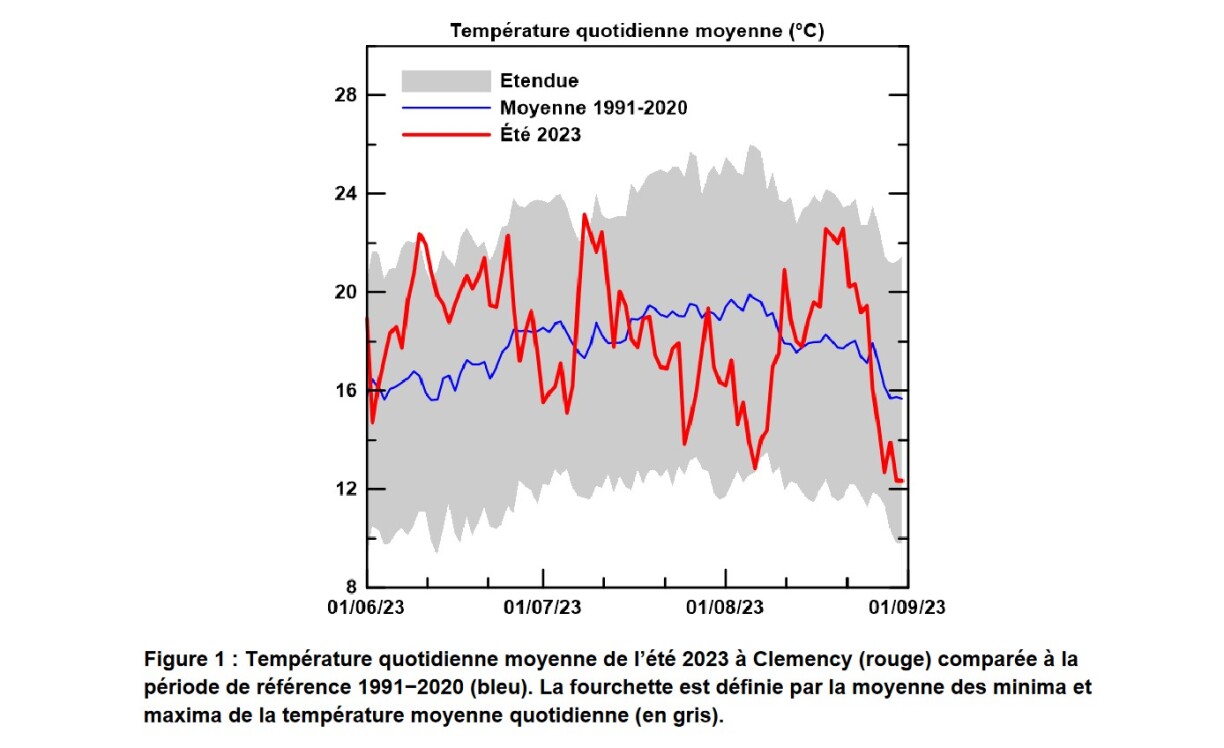
This summer has been characterised by extreme fluctuations in temperature and precipitation, particularly between the first and second halves of the season. The initial weeks witnessed a significant drought in June, followed by a pronounced surge in rainfall from mid-July onwards.
Regarding temperature, the season registered above-average warmth, with temperatures in Luxembourg City peaking up to +1.4°C higher than the norm. Precipitation patterns varied across regions, with Remich (east) experiencing a rainfall deficit while Asselborn (north), Luxembourg City (central), and Clemency (south-west) reported an excess of rainfall.
June stood out as the 6th warmest June since meteorological records commenced in 1838, with temperature anomalies ranging from +2.6°C to +3.6°C. However, precipitation levels across the country were notably deficient, ranging from -55.4 mm to -40.3 mm.
July was marked by slightly cooler temperatures, with averages falling up to -0.7°C below normal, except for Luxembourg City, where temperatures exceeded the norm by +0.5°C. Rainfall gradually intensified throughout the month, ranging from 71.7 mm to 108.2 mm.
August began with relatively cool and rainy conditions throughout Luxembourg. From mid-August onwards, temperatures rose, only to fall again. The month, on the whole, registered colder temperatures than usual, with anomalies of up to -0.7°C, except for Luxembourg City, which deviated from the pattern. Rainfall, conversely, exceeded the norm across the Grand Duchy, with a surplus of up to +54.7 mm.
The data has been collected from a network of 39 automatic weather stations distributed across all regions of Luxembourg. The values from four representative stations - Asselborn (north), Clemency (south-west), Remich (east), and Luxembourg City (central) - were compared against the average values for the reference period from 1991 to 2020.
All the data recorded by the 39 ASTA weather stations and the weather bulletin are available at www.agrimeteo.lu (website in German).