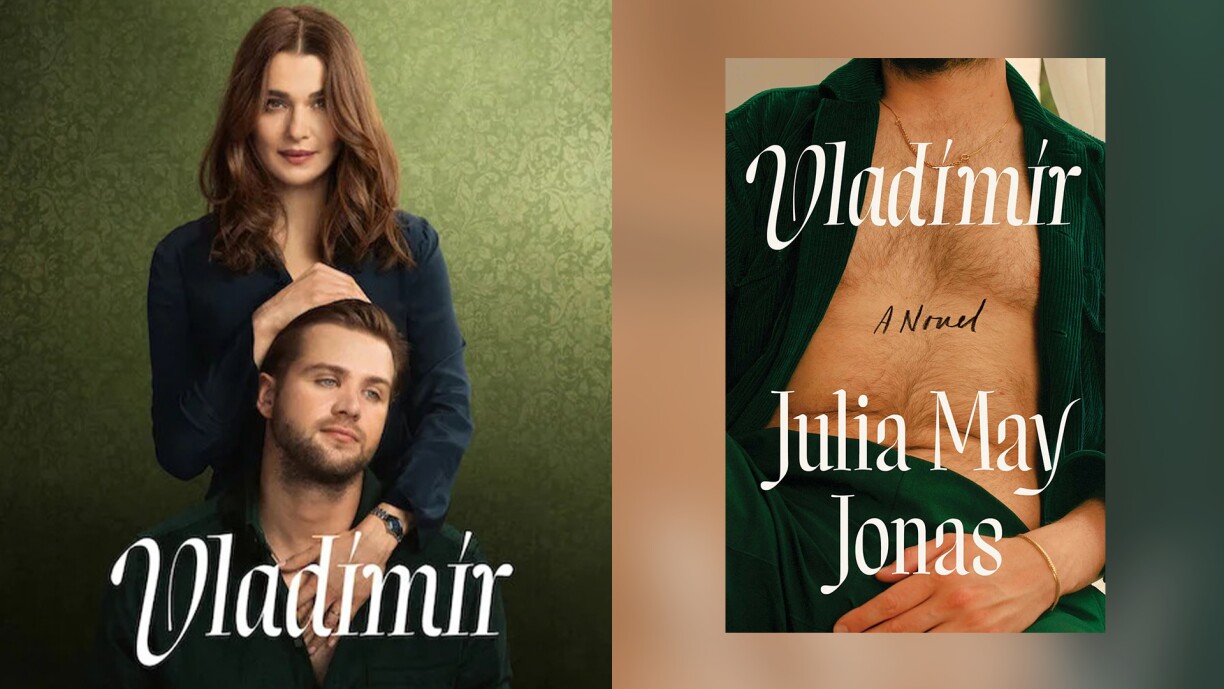
It remains a never-ending discussion whether books or films do it better, and while everyone should ultimately choose what suits them, it is a debate that continues to spark conversation, from Harry Potter to The Lord of the Rings and countless other stories brought from page to screen.
Not everyone has the time to read, and series and films are often the more accessible option, but when Netflix released a new adaptation this March, it set up the perfect newsroom experiment when we realised that one of us was watching the series, while another turned to the book first, drawn in by the trailer – with the book reviewed by Alannah Meyrath and the series by Ina Molakava.
The aim is not to decide which version is better, but to offer two spoiler-free perspectives and make it easier for you to choose for yourself whether to read or watch Vladimir – because in the end, it should be about fun.
Before we dive into the reviews, here’s the premise: Vladimir, written by Julia May Jones, follows a literature professor, whose carefully constructed life begins to unravel when a charismatic new colleague enters the picture, blurring the lines between admiration, obsession, and control.
I love literary fiction, especially when it leans into what you might call 'weird girl fiction', where the protagonist sits slightly outside of what is considered normal. Here, we follow a 58-year-old unnamed narrator who is deeply unreliable as she navigates her husband's sex scandal, the arrival of a much younger, attractive colleague, and her strained relationship with her daughter.
The novel is highly internal. We spend most of the time inside her head as she explains, digresses, and reflects, often in small asides and parentheses that tie everything back to her current situation. Through this, we slowly piece together her marriage, her role as a mother, and ultimately her growing obsession with Vladimir.
This is not the first book I read about female obsession, but it feels different. Rather than focusing purely on desire, it takes a more philosophical approach. Written by a literature professor, it explores motherhood, sexuality, generational shifts, and changing social norms, offering far more than just the story of an older woman fixating on a younger man.
At times, I was taken aback by the narrator's thoughts. Some of her points feel sharp and valid, others make her difficult to like. Her unreliability becomes clear early on: while students describe her as "hot", she repeatedly fixates on her own ageing body, emphasising sagging skin and perceived decline. That tension between how she is seen and how she sees herself runs throughout the book.
In many ways, the novel feels like an exploration of shared womanhood, celebrating femininity while also acknowledging its vulnerabilities and contradictions, long after what is typically labelled as 'girlhood'. Her obsession drives her into increasingly strange situations, all of which she carefully rationalises, often in a way that is quietly funny.
This is not a romance, and it is not quite a comedy either. It is a slower but never dull exploration of what it means to exist as a woman in a society that suggests she is past her prime, and her attempt to push against that idea, even if she cannot fully escape it. As the story progresses, the obsession edges into the absurd, leaving you wondering how it can possibly resolve.
I am not entirely convinced by the ending, which felt a little too easy. If you have watched the series, though, one thing is clear: the book takes a different route.
The series is a rather fellow adaptation of the book, even though there are many differences worth noticing.
As mentioned, the book focuses on the internal world, thoughts, and imaginations of the unnamed narrator, which is something that is often hard to depict in film. This series therefore adapts a 'fourth wall', which is a technique that I do not typically see in modern cinematography, serving as a tool to externalise the narrator's obsessive thought patterns.
The protagonist looks directly into the camera and the framing tightens into intimate close-ups, which creates a confessional tone and feels as if the audience is being pulled into her private mental space.
At the same time, these moments destabilise the narrative, which reminds us that what we are seeing is subjective and possibly performative, making it seem like a staged monologue, which mirrors her own profession as an English literature professor.
The series is a lot more sensual and sexual than the book. As a lot of her internal thoughts are obsessive, the shots often give way to her erotic fantasies, which is closely followed by classical, almost divine chorus. Scenes grounded in reality tend to employ more neutral palettes and restrained compositions, while her fantasies are saturated with warm, golden hues that verge on the excessive.
The camera frequently adopts her gaze: slow tracking shots across his body, fragmented close-ups, and prolonged visual fixation all mirror her obsessive attention. This appears ironic and almost kitsch, as if Vladimir is a god-like figure.
The screen adaptation is also amazing in blurring the lines between the real and the imaginative, which closely reflects the novel's ambitions. The audience often has to weigh whether some scenes are a product of the woman's imagination or are a true representation of what is happening.
This is an unreliable narrative at its core and almost feels like a staged play at times. The literary allusions are omnipresent throughout the series, which also acts as an ironic element in portraying a woman's impossible romanticising of ordinary events.
In general, the series doesn't take itself seriously: it is a desperate, ironic, and almost satirical representation of an older female sexual desire to assert her presence in a world that doesn't seem to notice her.
Whether you choose to read or watch Vladimir, you are in for some laughs, a few exasperated sighs, and perhaps even a lingering sense of discomfort as you're drawn into the narrator's obsessive and unreliable world.





