Despite its name, the Jardin du Luxembourg has no connection to the Grand Duchy, and even the Parisian nickname ‘Le Luco’ is not, as is often assumed, a simple contraction of ‘Luxembourg’. Instead, the term derives from Lucotitius, the name of an ancient Gallo-Roman district of Lutetia located to the east of the garden, on the slopes of what is now the Montagne Sainte-Geneviève, once known as Mont Lucotitius.

The name of the Jardin du Luxembourg and its palace traces back to the estate’s first owner, François, Duke of Piney-Luxembourg, who in 1570 purchased a townhouse with an eight-hectare park on Rue de Vaugirard, later known as the ‘Petit Luxembourg’.
Despite the title, the family’s link to Luxembourg was only indirect, descending from cadet branches of the House of Luxembourg rather than holding any connection to the Grand Duchy itself. In 1612, Marie de Medici, then regent of France, acquired the property, expanding it by a further 16 hectares and commissioning the construction of the present palace, which would give the gardens their enduring name.
The palace remained a residence for members of the royal family, first housing Gaston d’Orléans from 1642, followed by his widow and daughters, the Duchess of Montpensier and the Duchess of Guise, who donated it to Louis XIV in 1694.
In 1715, it passed to the regent Philippe d’Orléans, who in turn left it to his daughters, the Duchess of Berry and Louise Élisabeth d’Orléans, former Queen of Spain. Louis XVI later granted the palace to his brother, the Count of Provence, before the French Revolution forced him into exile.

During the French Revolution, the palace was used as a prison before being assigned in 1795 to the French Directory, the governing body of the republic, and then, by the end of 1799, to the Conservative Senate.
Following the fall of the Second Empire, it briefly housed the Prefecture of the Seine before becoming the seat of the Senate under the Third Republic. In 1940, it was requisitioned by German forces to accommodate the Luftwaffe’s general staff, before returning once more as the seat of the Senate under the Fifth Republic. Today, the palace and its gardens cover around 23 hectares.
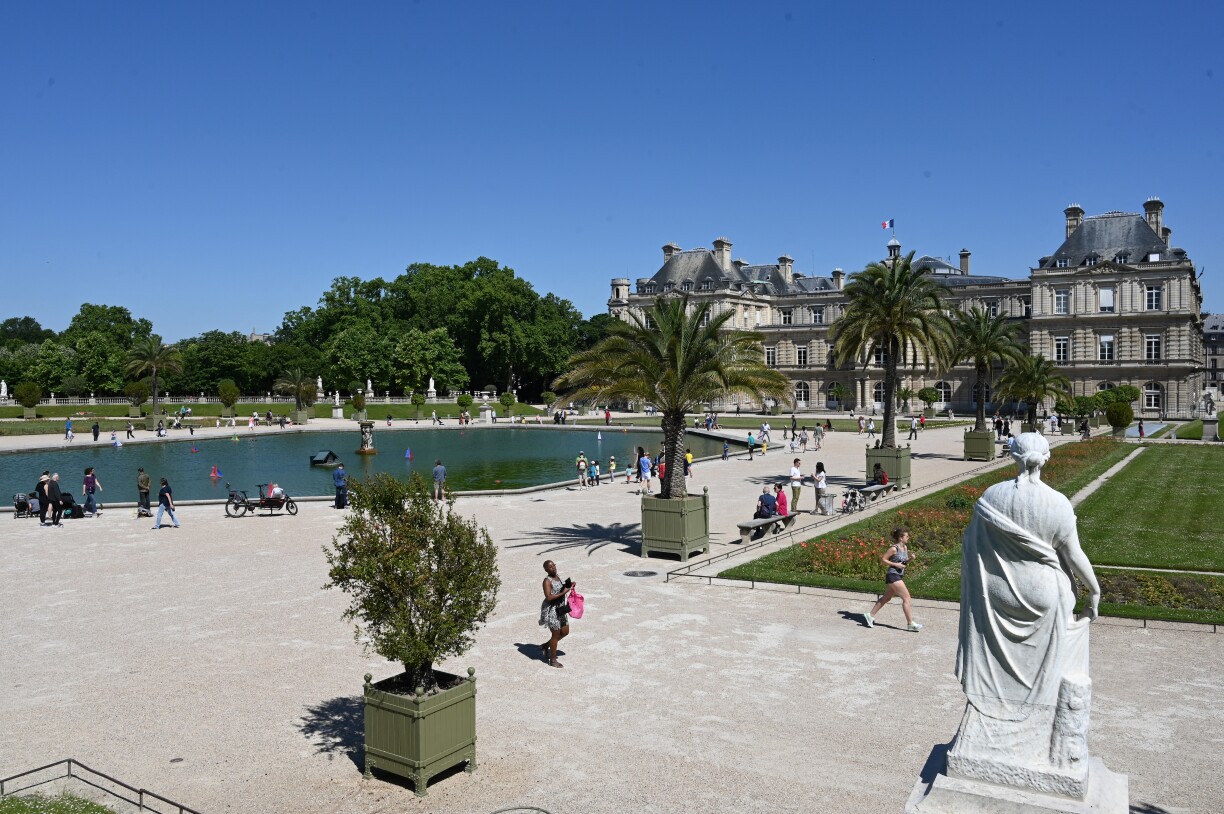
The grounds feature formal French and English-style gardens, planted with 3,000 trees of various species, 5,000 m² of flower beds, an orchard preserving more than 500 ancient varieties of pear and apple trees, and an exceptional orchid collection.
Online, the Jardin du Luxembourg was voted the most beautiful garden in Europe in 2022, and the third most beautiful in the world.
According to a ranking by the English-language website HouseFresh, based on tourist reviews on TripAdvisor, Gardens by the Bay in Singapore takes first place, followed by the Majorelle Garden in Marrakech. The Jardin du Luxembourg ranks third worldwide and attracted more than six million visitors in 2022.
While the palace and its gardens have evolved considerably over the centuries, the name Palais et Jardin du Luxembourg has remained unchanged.





