With the collapse came hopes for rapid democratisation and economic balance between East and West – which to this day remains unachieved.
An openly anti-liberal Prime Minister in Hungary, a third of Poland declared LGBT-free zone after a war on gay rights – here’s how Central Eastern European countries are witnessing a democratic backsliding.
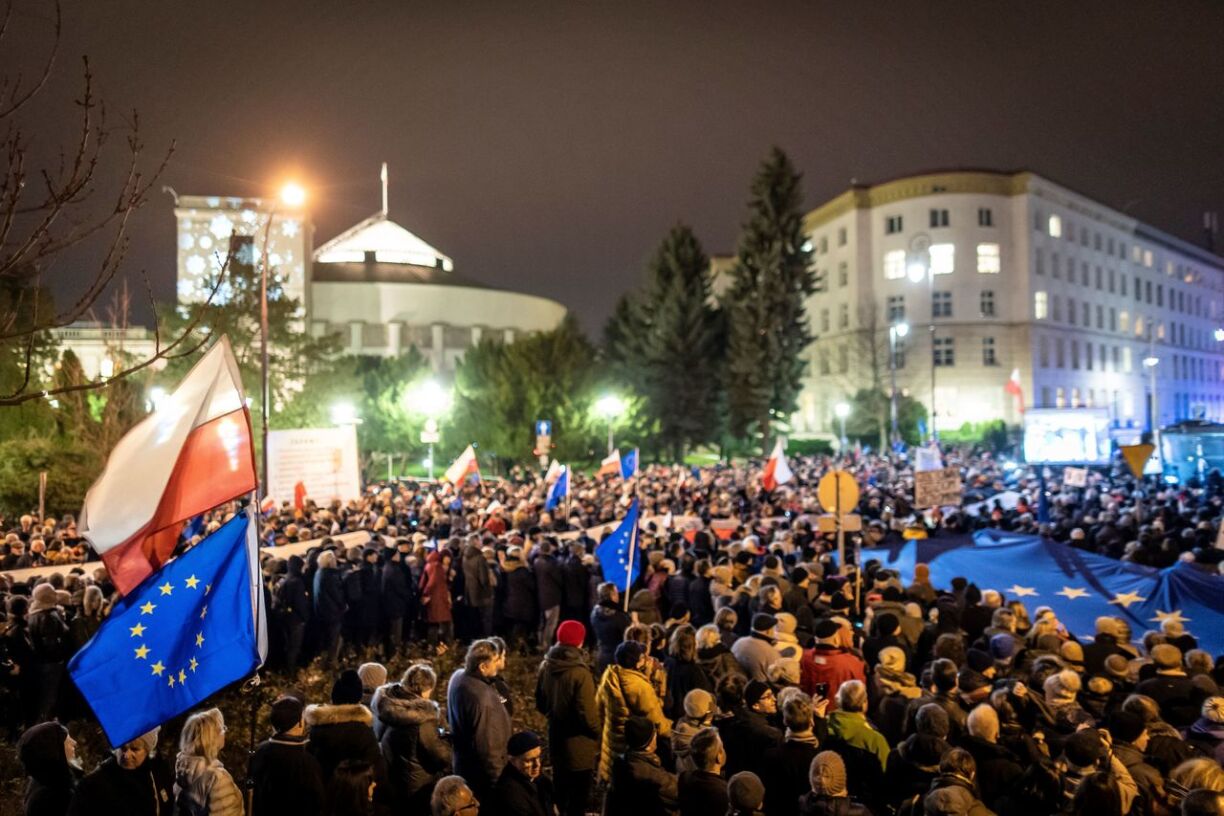
Poland has been struggling with LGBT rights in recent months - partly due to the affiliation with its reactionary Catholic Church – as declarations on anti-LGBTQ+ ideology are rapidly being established throughout south-eastern regions. A strong advocate of this development is Kaczynski’s Law and Justice (PiS) party, which since 2015 has been the largest party in the Polish parliament with 44% of the popular vote. But LGBTQ+ rights are not the only humanitarian issues Poland is facing. PiS has been accused on several occasions for infringing the principles of democracy and advocating right-wing populism for good reason.
Not only has the party taken control of the Polish judiciary sector, but it has also severely undermined opposition through propaganda campaigns on the state-controlled media. Telewizj a Polska (TVP) is the perfect reflection of the party’s lenience to right-wing extremism. While TVP is not the sole broadcaster in Poland, many estimate that rural voters get their news from TVP only, making it an essential political mouthpiece.
With a constant emphasis on the laws that are being passed in favour of social programmes and a majorly conservative body of employees, it comes to no surprise that the broadcaster has been accused of undermining press freedom by journalists from The Economist and the New York Times.
In no way does Poland come close to neighbouring Hungary, where PM Viktor Orbán removed independent media outlets and shows nearly total control over the media.
The populist leader has been passing many constitutional changes, from imposing restrictions over the opposition, the media and academia, to redrawing the electoral system. His stance as a strong spokesman and ‘protector’ of the Hungarian people has been fairly successful in moving towards what could be termed a ‘soft autocracy’ – and his intimidation tactics only contribute to this.
To put things into perspective: Hungary scored a 70% performance on civil and political liberties in the Freedom House Survey of 2019 (compared to the Benelux countries’ average of 97.6%), deteriorating from a good score to that of a ‘partially free’ status, and ultimately ranking worst of the 27 EU member states. To add more to this, the Pew Research Centre deduced that increasingly more CEE citizens worry about their political systems and the inequality they bring about, especially as a result of the economic corruption that is hindering development for ordinary people.
Despite his openly corrupt actions (i.e. Hungarian elites benefitting enormously off the EU subsidies), no scholarly consensus has been established on Hungary’s situation as the previously established causes for democratic defects do not correspond to the ‘de-democratisation’ result witnessed there.
This does not suggest the need to declare an overall emergency in Europe, as his single-party model is most unlikely to spread to the West. However, his influence is felt across the Eastern neighbours as he gains in popular support by ‘protecting the Hungarian people’ and promoting a new sort of ‘ethnic nationalism’ in the age of mass migration from the African continent – something which must be watched carefully by the EU.
This trend cannot be applied to Central Eastern Europe as a whole, as countries such as Slovakia are looking on the up (its corrupt left-wing party SMER only scored 8% of the vote) and pro-EU values and satisfaction are increasing in numbers. Many would argue that the political movements that we are witnessing are part of the larger wave of populism observed at the moment, but it is clear to conclude that Central Eastern Europe is struggling to uphold its post-Cold War democratisation goals and resembling its 20th-century predecessors more and more.
-----
Maura Lehmann is a student and former RTL Today intern who now regularly contributes as a freelancer.





