This is an opinion article. The views expressed belong to the author.
In a recent interview between newspaper Tagblatt and Luxembourg City Alderman Patrick Goldschmidt, the latter states that many of the roads in Luxembourg City have been reduced to single-lane roads in an ongoing road diet. This is a commendable first step and is part of a well-documented phenomenon known as 'traffic evaporation'.
When road capacity for single occupancy vehicles is cut, traffic does not simply relocate, a real share of it disappears. A landmark UK study spanning over 60 case studies found average traffic reductions of 20–25% following similar capacity cuts.
When space is limited and transportation demands are high, we must move from single occupancy vehicles to higher throughput options.
I would like to explore how residents and commuters move through our historic city centre, a space the alderman refers to as a "main thoroughfare".
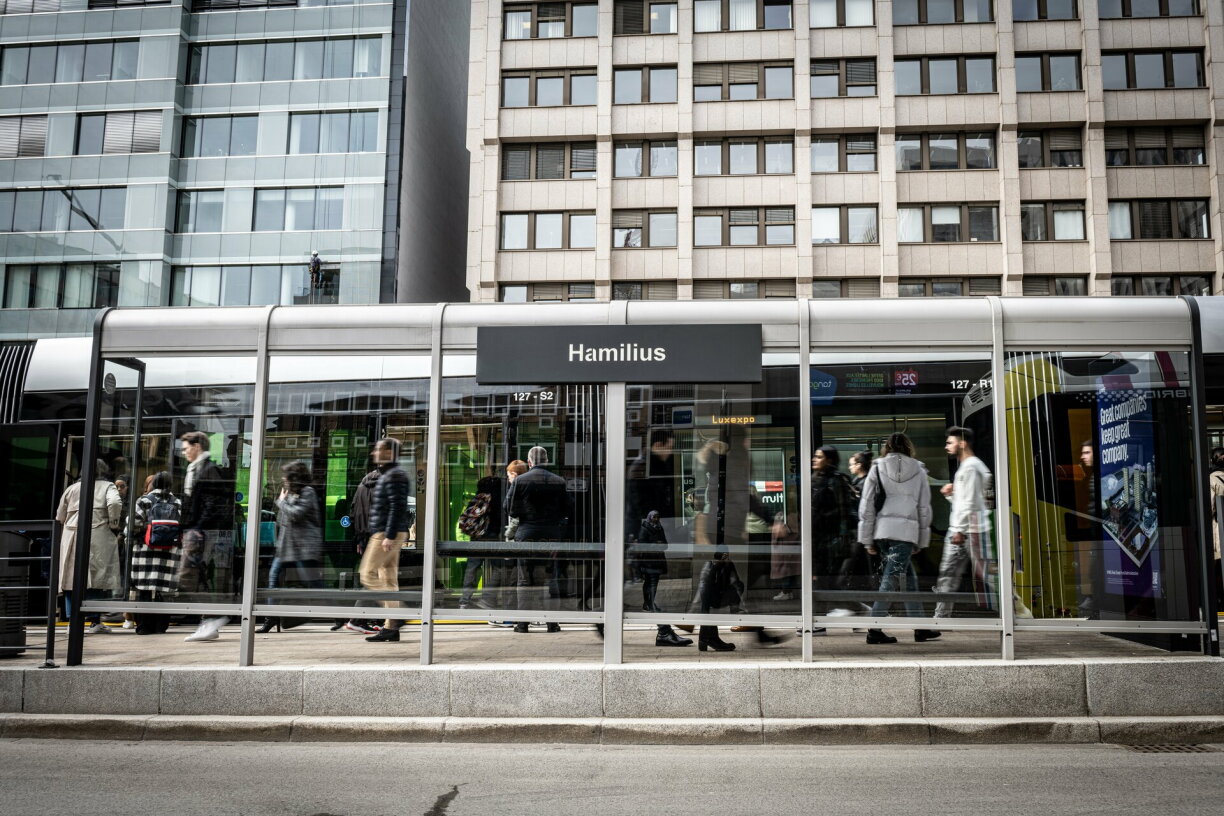
Hamilius is a perfect example of the densification of our transportation. The clustering of bus and trams stops in the heart of the city creates a transportation hub that serves tens of thousands of people every day.
Let's look at the cross-sectional area of Hamilius; or the distance between one side of Boulevard Royal to the other.
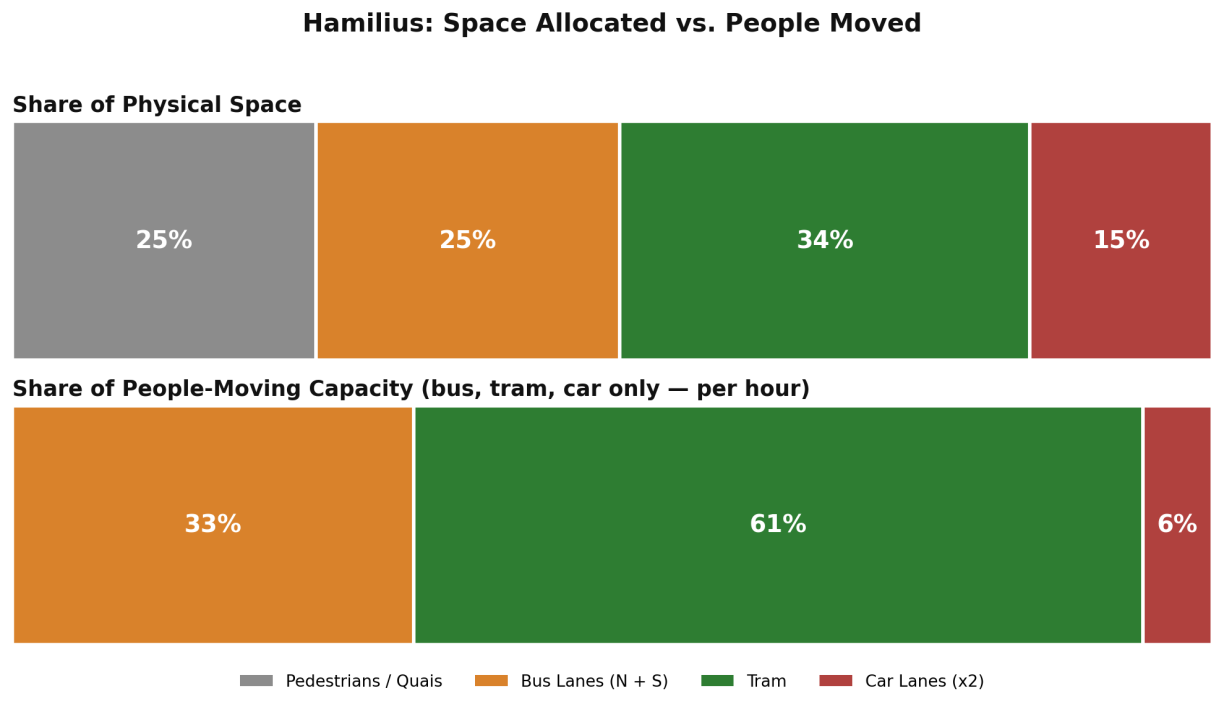
The total distance across the transportation hub is around 40 meters. 10 meters are dedicated to the sidewalks and quais for pedestrians and bus users. 10 meters are dedicated to the north and south bus lines. 13.5 meters are dedicated to the tram stop and bidirectional tram lines.
Finally, 6 meters are dedicated to two lanes of traffic.
At first glance, it appears that the two lanes of traffic have very little footprint in the total area of the transportation hub. However, the arithmetic changes when we add transportation capacity.
After accounting for transportation capacity per meter of cross section, the 6 meters that represents car traffic is one-fifth of the cross section and provides less than 10% of the throughput. Vehicle lanes simply cannot compete with the 20,000 people per hour on the tram or the 11,000 people served by the 60 buses per hour.
Removing one lane of car traffic (under 5% of the hub's total throughput) would give city planners a plethora of options for better utilizing the space in one of our busiest transportation hubs. During the summer a row of large trees would provide passive cooling for commuters and much needed greenery year-round.
Increasing the footprint of the bus lanes and increasing the number of buses above the current designed capacity can further increase the efficiency of our existing critical thoroughfare.
Let's now examine Rte de Longwy and the bus routes that run along it. Rte de Longwy supports inner-city and inter-city commuters with roughly 12 busses per hour. During morning traffic, it is around 1,200 people per hour – or 1000 cars.
Without those busses, the additional bumper-to-bumper queue would be 7 kilometers long every hour!
Rte de Longwy is slated for a much-needed bicycle/soft mobility corridor upgrade that will massively increase the aggregate capacity of the road. I would propose that the city supercharges that route by adding a morning/evening camera-enforced modal filter at the termination of the cycling infrastructure at Av du Dix September.
Bus commuters today are guaranteed delays from the endless traffic queues at this intersection and onward into the city. While, admittedly, a modal filter would push some traffic onto Avenue Guillaume, it would link commuter buses to the dedicated bus infrastructure of Avenue Monterey and (farther on) Hamilius.
This would also facilitate the connection of the brand-new hardened bike lanes to our beautiful Municipal Parc and the heart of the city.
Free public transportation is a key part of Luxembourg's social fabric, and it deserves to be excellent. Currently, however, we are paying for these services to be stuck in traffic.
Every hour that a bus driver spends in traffic costs all of us money, while actively reducing the quality and throughput of our transportation services.
While the proposals I have laid out here may be considered 'radical', they are very far from unprecedented. There are countless examples of cities who have successfully tackled traffic through road diets and innovative road infrastructure.
One that stands out with relevance in context of modal filters is the city of Ghent. In April 2017, the city of Ghent introduced and implemented a 'radical' idea of sectioning the city centre into six regions. Access between the regions was greatly reduced with modal filters, redirecting traffic out and around the city while allowing handicap, emergency services, buses, and soft mobility users direct access.
The results were independently verified by Transport & Mobility Leuven, the research institute Ghent commissioned to assess the plan. The result was a large reduction in car use and an increase in cycling, public transportation and walking; in short, more transportation users began utilizing the high-capacity modes of transportation.
Ghent will no doubt reap the well-documented rewards of such a system: cleaner air, increased profits for small businesses, and better overall transportation experience.
Reduction of lanes was the first step. Now, we must go further.





