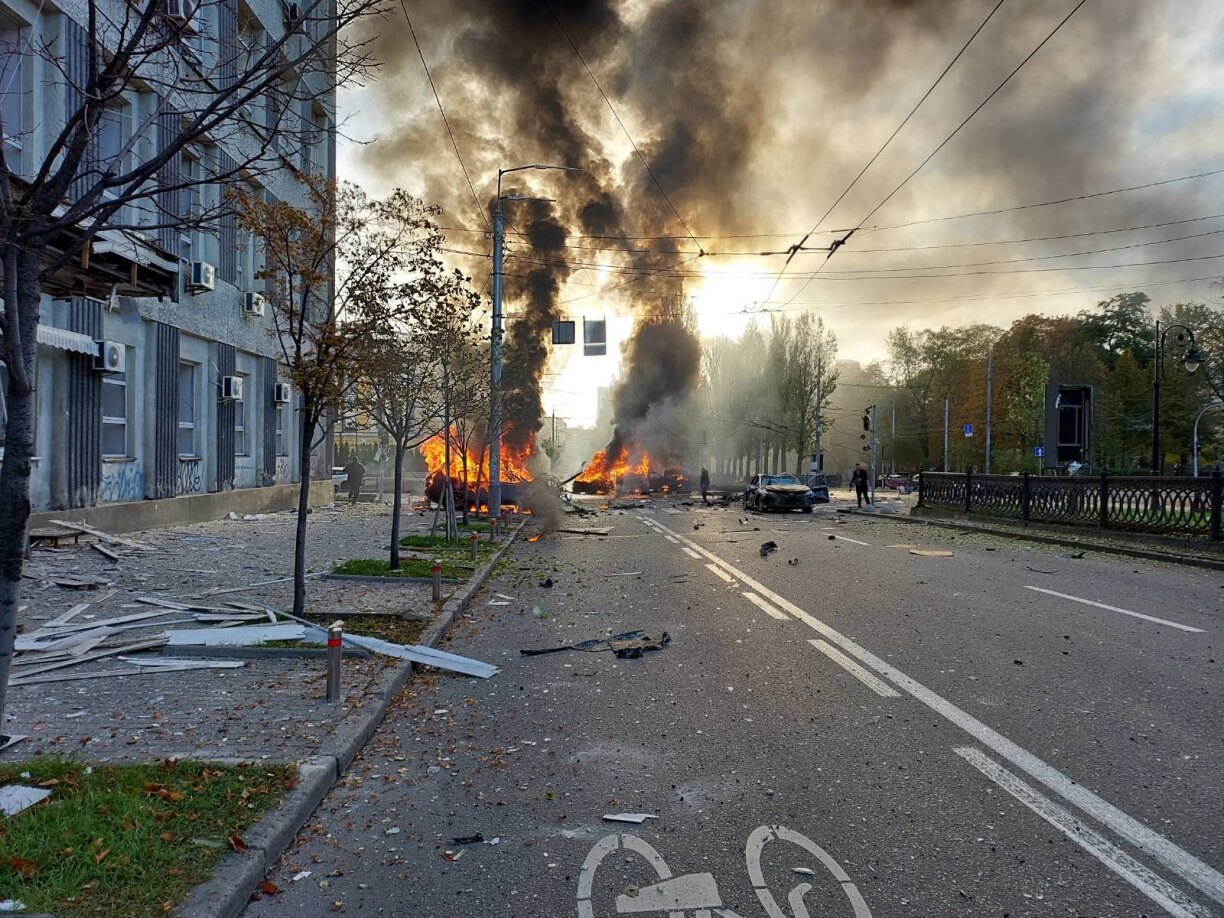
The biggest wave of strikes across Ukraine in months killed at least 11 and wounded more than 80 in retaliation for an explosion this weekend that damaged a key bridge linking Russia to the Moscow-annexed Crimean peninsula.
"Let there be no doubt," Putin said in televised comments addressed to his security council, "if attempts at terrorist attacks continue, the response from Russia will be severe."
Kyiv said Russian forces had fired more than 80 missiles on cities across the country and that Russia had also used Iranian drones launched from neighbouring Belarus, spurring panic and damaging energy facilities throughout Ukraine.
Putin's predecessor Dmitry Medvedev warned that the strikes were only "the first episode" of a response to explosion on the Kerch bridge.
"The first episode has been played. There will be others," Medvedev, now deputy head of the Security Council, said on social media, adding that the future goal should be "the complete dismantling of Ukraine's political regime".
Mass retaliatory Russian strikes across Ukraine on Monday killed at least 10 people and hurt dozens more, according to the national police service.
"As of now, 10 people have died and about 60 have been injured across the country as a result of missile strikes by the Russian Federation on the territory of Ukraine," the national police service said in a statement on Facebook, adding that work was underway to collect evidence of "Russian atrocities".
The explosions hit Kyiv around 8:15 am local time, and an AFP journalist in the city saw numerous ambulances appearing to head towards the scene of the blasts. Kyiv police say at least five people have been killed, with a dozen injured.
One AFP journalist in the city said one of the projectiles landed near a children's playground, and that smoke was rising from a large crater at the impact site.
"Several explosions in the Shevchenkivskyi district -- in the centre of the capital," Kyiv mayor Vitali Klitschko said on social media.
Videos posted on social media showed black smoke rising above several areas in the city. Russia's last strike on Kyiv took place on June 26.
The presenter of the BBC morning programme, broadcasting from the capital, was interrupted when the strikes took place.
More cities were under attack: "Ukraine is under missile attack. There is information about strikes in many cities of our country," Kyrylo Tymoshenko, deputy head of the president's office, said on social media, calling on the population to "stay in shelters".
Matthew Luxmoore, reported for the Wall Street Journal, captured the impact site in Shevchenko Park, usually "packed with people and street musicians."
Oliver Carroll, working for the Economist, shared this dashcam clip of the moment a missile hits:
Ukraine's western region of Lviv was hit Monday morning by bombardments that targeted critical infrastructure, including energy facilities, the region's governor said.
"Strikes on energy infrastructure facilities in the Lviv region have been recorded," the governor, Maxim Kozytski, said in a statement on Telegram, calling on residents to stay indoors.
The explosions came a day after Moscow blamed Ukraine for the explosion on a bridge linking Crimea to Russia, leaving three people dead.
"The authors, perpetrators and sponsors are the Ukrainian secret services," Russian President Vladimir Putin said of Saturday's Crimea bridge bombing, which he described as a "terrorist act".
Putin was speaking during a meeting with the head of the investigation committee he has set up to look into the bombing, Russian news agencies reported.
The Russian leader is gearing up for a meeting with his Security Council later Monday, the Kremlin told local news agencies.
"Tomorrow the president has a planned meeting with the permanent members of the Security Council," Kremlin spokesman Dmitry Peskov said.
The blast that hit the bridge sparked celebrations from Ukrainians and others on social media.
But Ukrainian President Volodymyr Zelensky, in his nightly address on Saturday, did not directly mention the incident, and officials in Kyiv have made no direct claim of responsibility.
On Saturday, Russia said some road and rail traffic had resumed over the strategic link, a symbol of the Kremlin's 2014 annexation of Crimea.
The 19-kilometre bridge is a vital supply link between Russia and the annexed Crimean peninsula.
Some military analysts argue that the blast could have a major impact if Moscow sees the need to shift already hard-pressed troops to Crimea from other regions -- or if it prompts a rush by residents to leave.
Mick Ryan, a retired Australian senior officer now with the Center for Strategic and International Studies in Washington, said that even if Kyiv was not behind the blast, it constituted "a massive influence operation win for Ukraine.
"It is a demonstration to Russians, and the rest of the world, that Russia's military cannot protect any of the provinces it recently annexed," he said on Twitter.
Zelensky meanwhile denounced a Russian missile strike on Sunday that killed at least 13 people, one of them a child, in Zaporizhzhia -- the latest deadly bombardment of the southern Ukrainian city.
The attack also wounded 89 people, including 11 children, according to a statement from the president's office.
Zelensky described the "merciless strikes on peaceful people" and residential buildings as "absolute evil" perpetrated by "savages and terrorists".
Regional official Oleksandr Starukh posted pictures of heavily damaged apartment blocks on Telegram and said a rescue operation had been launched to find victims under the rubble.
Russian officials meanwhile denounced on Sunday what they said was a surge in Ukrainian fire into its territory that had hit homes, administrative buildings and a monastery.
Russia's FBS, which is responsible for border security, said on Sunday: "Since the start of October, the number of attacks from Ukrainian armed formations on Russia's border territory has considerably increased."
More than a hundred artillery attacks, concentrated on the western border regions of Belgorod, Bryansk and Kursk, had hit housing and administrative buildings, said the statement.
The attacks had killed one person and wounded five others.
The Moscow stock exchange plunged nearly 12 percent in the first minutes of trading on Monday following.
The benchmark ruble-denominated MOEX index dropped 11.9 percent to 1,780.39 points at 0703 GMT, briefly falling below the 1,800 mark for the first time since Moscow sent troops to Ukraine on February 24.
International community responds to Ukraine attacks on Monday





