Astronomy involves distances so enormous that our minds can hardly understand them. Take the Sun, for instance: the closest star to our planet lies at a distance of about 150 million kilometres (93 million miles). That is the equivalent of lining up almost 12,000 Earths side by side!
And that is still practically next door.
Outside our Solar System, the distances get so large that kilometres become impractical, so we usually switch to light-years instead. One light-year is the distance light travels in one year: about 9.46 trillion kilometres.
The nearest star beyond the Sun, Proxima Centauri, is about 4.24 light-years away. Sirius, the brightest star in our night sky, is roughly twice as distant, at 8.6 light-years. Many of the other stars we can see with the naked eye are hundreds, sometimes thousands, of light-years away.
But this brings us to the real question: how do we know?
We obviously can't travel these distances, and no measuring tape would be long enough anyway. Instead, astronomers use a simple geometrical trick called parallax, and its basic principle is surprisingly easy to demonstrate.
A simple way to see the effect is to hold a finger in front of the face and look at it first with one eye, then with the other. The finger appears to shift slightly against the background, even though it has not actually moved. The closer the finger is, the larger this apparent shift becomes; as it moves farther away, the shift becomes smaller.
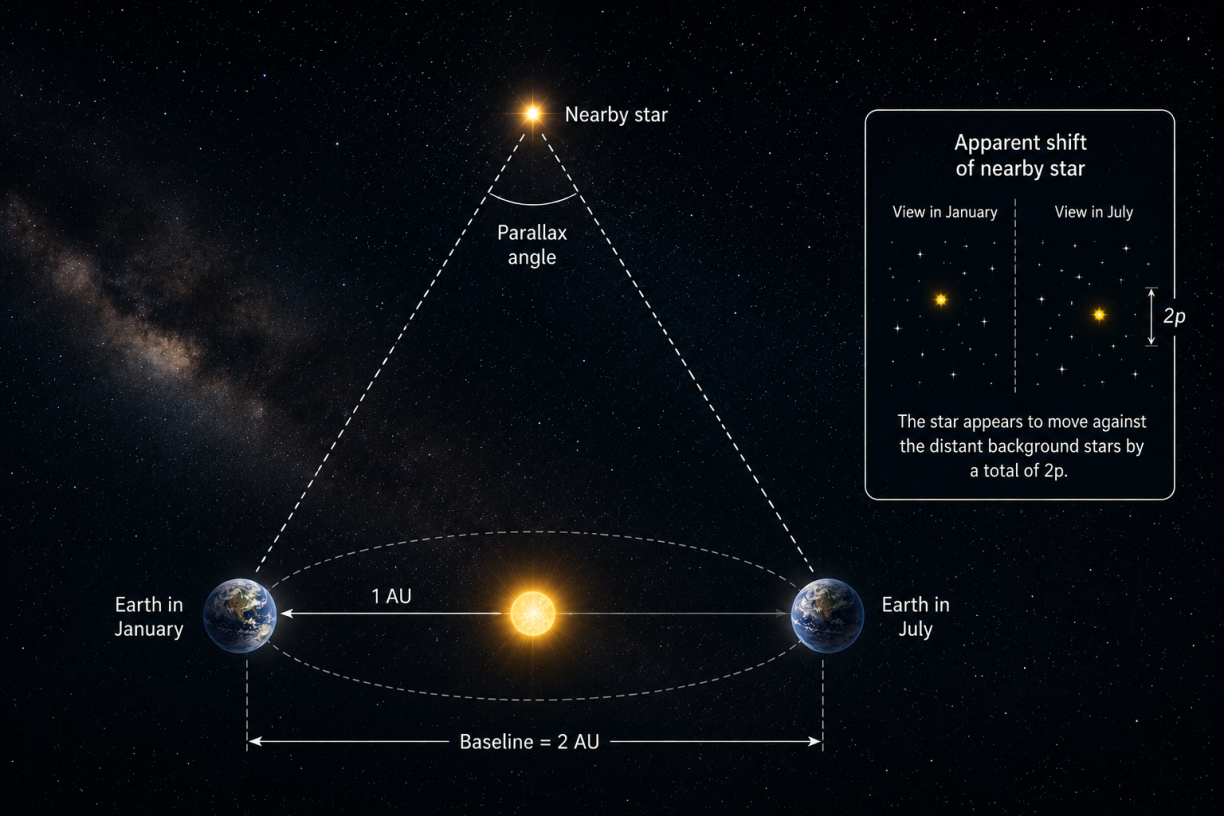
Astronomers do essentially the same thing with stars, only instead of using two eyes a few centimetres apart, they use the Earth at two different points in its orbit around the Sun.
They observe a nearby star, wait about six months, then observe it again. By then, the Earth is on the opposite side of its orbit, giving astronomers two viewpoints separated by roughly 300 million kilometres.
Compared with the more distant stars behind it, the nearby star seems to move slightly. By measuring this tiny shift and knowing the size of Earth's orbit, astronomers can calculate how far away the star is.
At astronomical distances, however, this apparent movement is incredibly small. Even the nearest stars have parallax angles of less than one arcsecond, which is just 1/3,600 of a degree.
The smaller the shift, the farther away the star is. Astronomers use this relationship to calculate distance, and it is also where the unit parsec comes from.
A star with a parallax of one arcsecond is one parsec away, or about 3.26 light-years. A smaller parallax means a greater distance; a larger one means the star is closer.
The idea itself is not new. Astronomers had understood the principle of parallax for centuries, but the movement of the stars was simply too small for early telescopes to measure accurately.
That changed in 1838, when German astronomer Friedrich Bessel measured the parallax of 61 Cygni, a nearby star system. His result placed it at roughly ten light-years from Earth, remarkably close to the modern value of about 11.4 light-years.
It was a major moment in astronomy: For the first time, the distance to another star had been measured directly.
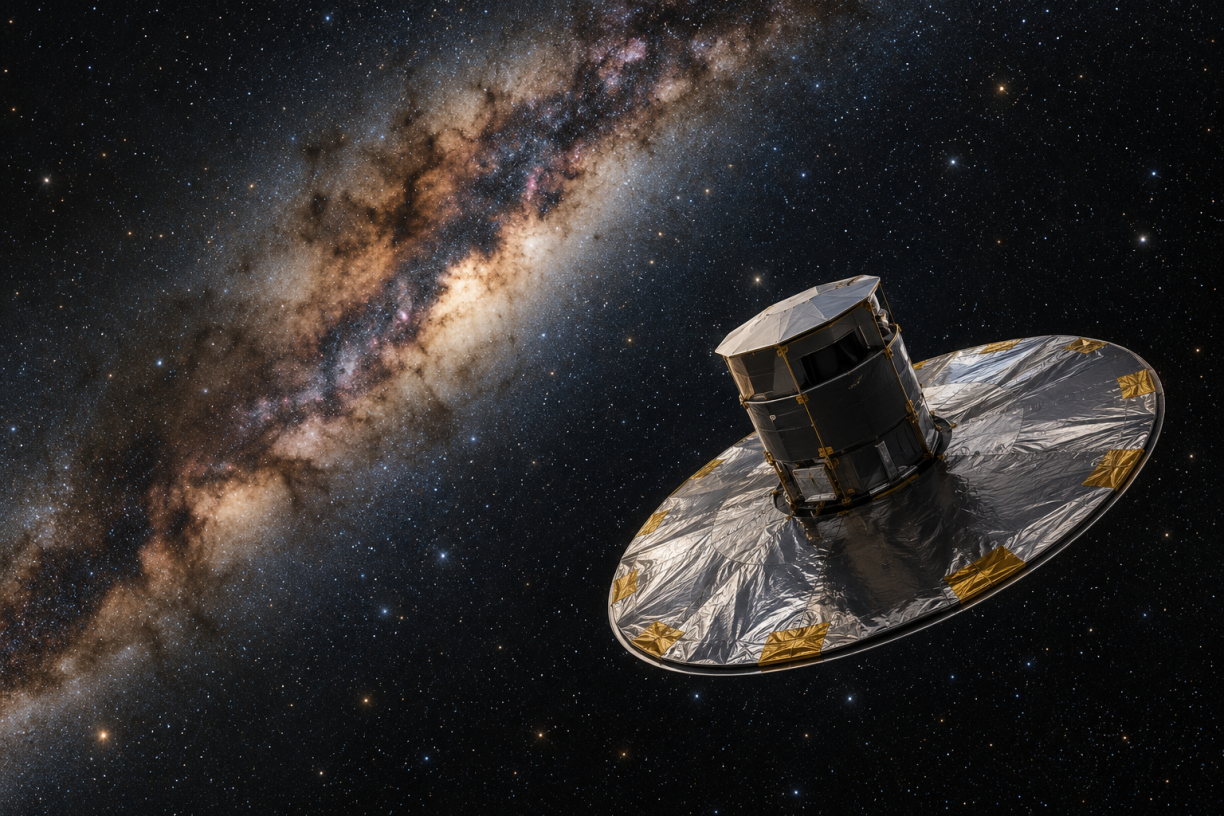
Today, the same basic method is used on an entirely different scale. ESA’s Gaia space observatory spent more than 10 years repeatedly measuring the positions of stars as it travelled around the Sun.
By the end of its observations in January 2025, Gaia had collected more than three trillion observations of around two billion stars and other objects.
But parallax has its limits. The farther away a star is, the smaller its apparent shift becomes.
Eventually, the movement is so tiny that even the most precise instruments can no longer measure it reliably. What happens then?
When parallax no longer works, astronomers have to rely on other clues. Brightness is one of them, but it can be misleading: a faint star may be very far away, or it may simply produce less light.
By studying a star's colour and spectrum, astronomers can estimate how bright it really is and compare that with how bright it appears from Earth to work out its distance.
Some stars are especially useful for this. Cepheid variables, for example, regularly brighten and fade, and the length of this cycle is linked to their true brightness, making them valuable distance markers.
Together, these methods form what astronomers call the cosmic distance ladder, in which one reliable method helps calibrate the next, allowing distances to be measured farther and farther into space. So, when we read that a star is hundreds or thousands of light-years away, that figure comes from a combination of geometry, light, and careful observation.
The distances may be difficult to imagine, but the ideas used to measure them often begin with something surprisingly simple.
A few useful terms: