Did you know that Tali will represent Luxembourg at the next Table Tennis World Cup? Or that Georges Christen is the only person to have counted to infinity, three times already? Brilliant, right?
Obviously, these statements are fake news, and that is exactly what this episode is about.
Misinformation is harmful. It can, for instance, influence political elections, make sick people seek dubious treatments, or contribute to dividing society.
Studies show that misinformation spreads more quickly online than true information because it is often shocking or emotional, causing people to be more inclined to share it.
But automated social bots, in other words machines, also help to spread misinformation. According to a study, during the period when Donald Trump sought to withdraw from the Paris Agreement, around a quarter of all climate change-related tweets were generated by bots rather than humans.
For this episode of Ziel mir keng!, we have looked into the best ways to debunk misinformation. In order to do this, we mainly based our research on a publication where an interdisciplinary research group gathered the findings of several scientific studies on misinformation and fake news: the Debunking Handbook.
In this episode, we will specifically address:
Let's start by defining fake news. The Debunking Handbook differentiates between 'misinformation', 'disinformation', and 'fake news'.
Let's now take a look at why we are all prone to being fooled by misinformation.
This is mostly due to the following effects:
It is important to realise that we are all susceptible to these effects. Being aware of them, questioning yourself and being critical are the first steps towards not falling for misinformation.
Studies show that there are benefits to warning people that they may be misinformed, either through specific alerts, or in general by strengthening their media literacy, for instance by raising awareness of the argumentation patterns of fake news or encouraging people to:
Studies indicate that all of these measures lead to people being less prone to sharing misinformation. And if no one shares misinformation, it cannot cause much damage.
For a while, researchers highlighted a problem in this context: the so-called 'boomerang effect'.
If you want to debunk misinformation, you have to say that it is wrong, and thus repeat it.
By doing so, you are giving it exposure. And as we have just seen, people tend to believe things they have heard several times before. This means that the more you talk about misinformation, the more likely people are to believe it is correct.
But there is also good news: new studies show that the positive effect of debunking is stronger than the negative impact of the boomerang effect. If you go about it the right way, you can indeed help to expose misinformation and contain its spread.
But you should always question whether misinformation is even worth debunking. If it is largely unknown, why give it the extra exposure?
But there is also not so good news. For instance, even if it has been debunked, misinformation can still have a long-term influence on people's behaviour.
The Debunking Handbook gives an example. Misinformation circulates that a customer suffered from food poisoning in a certain restaurant. Even if this ends up being debunked, there is a chance that people may still avoid this restaurant in the future.
Another interesting example: in polarised societies such as the US, people don't care when they learn that the politician they support lied. They continue to support them regardless. In less polarised societies, debunking politicians' lies does have an impact.
Let's look at the best possible way to debunk misinformation where this is necessary.
Consider the following fake news:
The fourth season of Take Off, scheduled for next year, was cancelled.
To debunk this correctly, it is important to start with the correct information, ideally by phrasing it in a snappy way: A new season of Take Off – Science Challenge Show will be broadcast next year!
Then we need to say that misinformation is circulating about the show and that it is untrue.
There are false claims that the fourth season has been cancelled.
While we are repeating the misinformation, at the same time, we are saying that it is false.
Then we show with arguments why one piece of information is false and the other is true.
The actors involved have all officially confirmed that the fourth season will be broadcast and registration will open soon.
This point is very important: the argument needs to be convincing and correct. After all, this is not about a difference in opinion, but about facts.
And at the end we repeat the correct statement once more:
It's official: the fourth season of Take Off will drop in January 2027!
As you can see, it requires a certain amount of effort to debunk misinformation. Another problem is that misinformation often has a head start. While misinformation is often based on snappy and simplistic black-and-white thinking, debunking is often more nuanced and takes longer. Nevertheless, it is still worth doing!
Misinformation, disinformation, and fake news damage our democracies and our societies.
To stop people from sharing misinformation, it helps to post warnings, preventively boost their media literacy, and encourage a more critical evaluation of sources.
But once misinformation is circulating widely, it helps to debunk it, and we need to do it effectively.
So this was not fake news, but rather the latest science on the topic. And don't forget to stay critical!
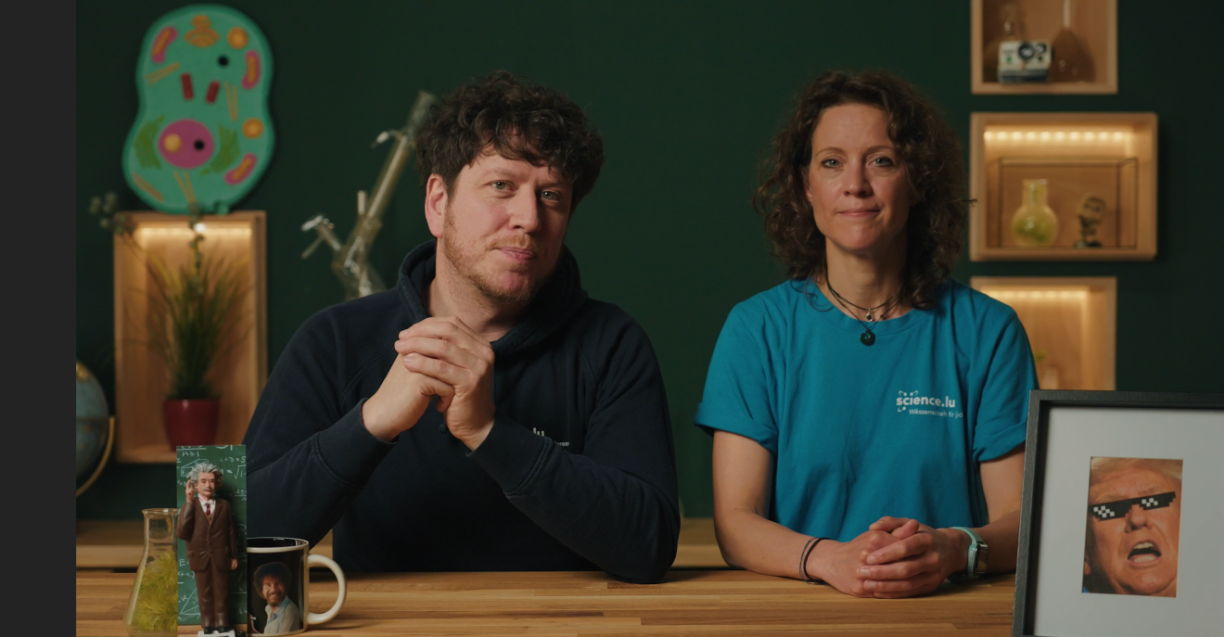
Ziel mir keng! is broadcast on Sunday evenings after the programme Wëssensmagazin Pisa on RTL Tëlee and is a collaboration between RTL and the Luxembourg National Research Fund. You can also watch the episodes on RTL Play.
Author: Jean-Paul Bertemes (FNR)
Editing: Michèle Weber (FNR)
Presentation: Jean-Paul Bertemes and Michèle Weber
Video: SKIN
Translation: Nadia Taouil (www.t9n.lu)





