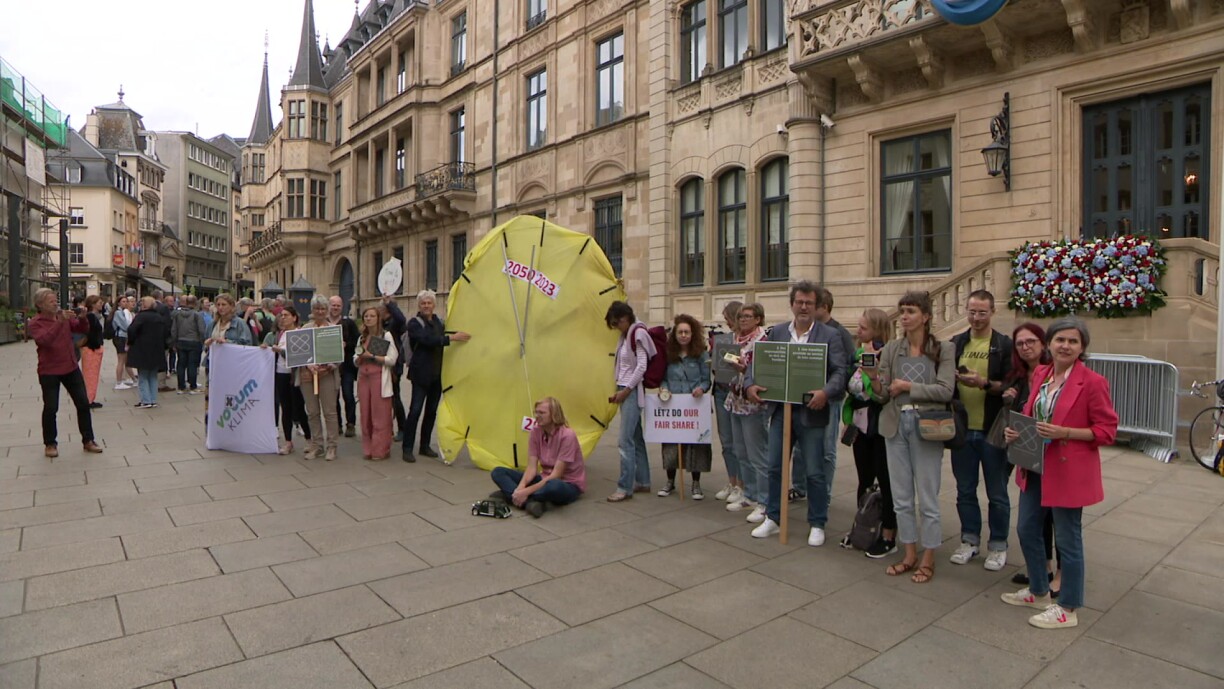
To its regret, Votum Klima said the urgency of climate change was not sufficiently emphasised in the election manifestos.
Earlier in the year, the collective had formulated 18 demands and addressed these to the parties. Most of these were consequently found in the election programmes, Votum Klima's Magalie Paulus told RTL. The key points consisted of an ambitious and fair transition for the country, responsibilities beyond Luxembourg's borders, and a social transition to benefit everyone. The collective then analysed the party programmes to see how far the points had been fulfilled.
Although the majority of topics were addressed by the parties, Votum Klima said they had noted a lack of ambition and detail in the manifestos. "It seems as though everything that happens outside of Luxembourg does not take place," said Cedric Reichel, referring to Luxembourg's responsibility for its financial sector and supply chains, which mostly went unmentioned.
The Greens, the Left and the LSAP scored highly according to the Votum Klima analysis, with more than half of the collective's demands appearing in the manifestos.
The DP, Volt, Pirates and KPL all scored between 26% and 50%, while the CSV, Fokus and the ADR followed.
Liberté and the Conservatives scored lowest.
Reichel said he noticed that quantity did not always represent quality when analysing the manifestos. Some programmes presented good points, but suffered from a lack of prioritisation and vision. Others were bland and lacked detail. Paulus noted that many of the manifestos appeared reluctant to upset voters by questioning their way of life.
It is important to emphasise that the analysis is just that, and not an election recommendation, Reichel said. The project is designed to offer voters an overview of climate change and biodiversity proposals, as well as serving as a reminder to political parties that they should consider certain topics. "There are parties that have rediscovered climate protection for the election campaign," commented Reichel, while other parties have been dealing with the subject for years.
Video report in Luxembourgish:





