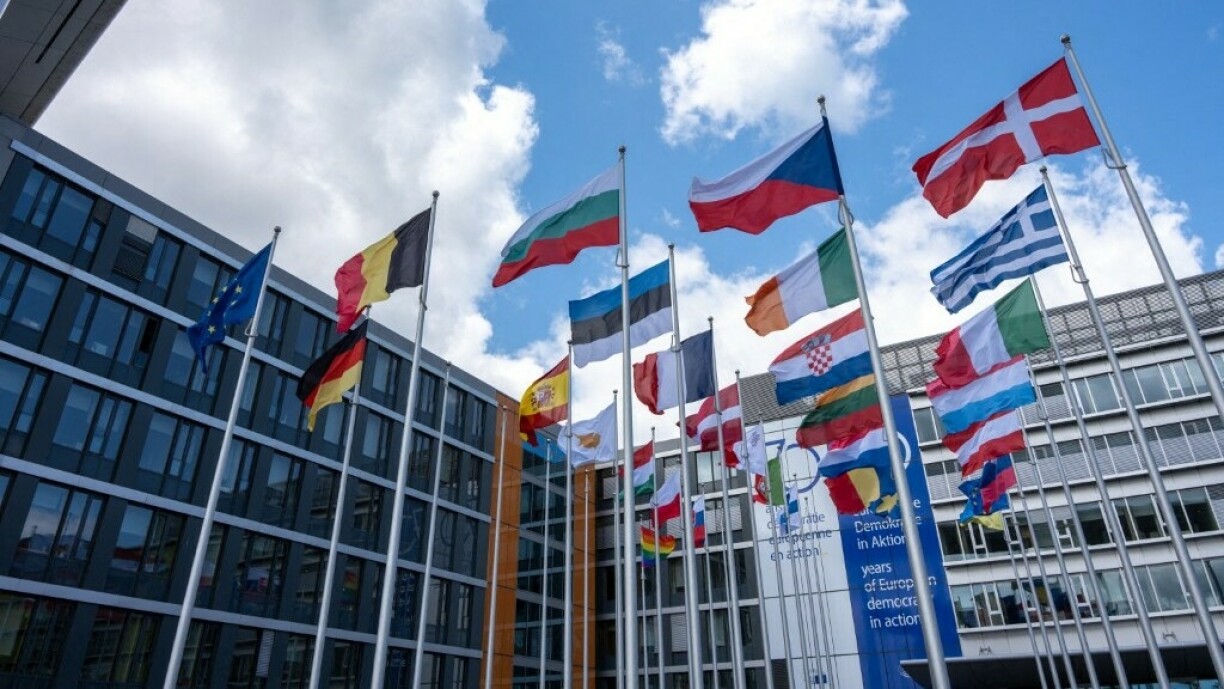
Recent geopolitical developments, notably the war in Ukraine, have elevated the issue of security within the EU to a prominent position in the political discourse. Citizens are increasingly concerned about the EU's ability to safeguard their security in an ever-changing global landscape.
Ahead of Sunday's election, our colleagues at RTL.lu took a closer look at the foreign policies of parties in the race for office.
A majority of Luxembourg's political parties firmly advocate for a robust European Union.
The Luxembourg Socialist Workers' Party (LSAP), for instance, emphasises the importance of an international economy, a strong domestic market, membership in the Schengen Area, and a common currency as essential for a small country like the Grand Duchy.
The Green Party (déi gréng) aligns closely with this stance, especially in their commitment to addressing challenges related to climate change and environment protection.
The same is true for the Democratic Party (DP) and the Christian Social People's Party (CSV). The latter also pleads for a "better" Europe founded on domestic solidarity and foreign unity.
The Pirate Party, in addition to advocating for deeper European integration, proposes measures such as establishing a shared stockpile of medicines and medical equipment among member countries.
The Left (déi Lénk) supports improved integration within the EU, focusing on issues like social justice and the preservation of fundamental rights.
In contrast, the Luxembourg Communist Party (KPL) asserts that the EU primarily represents the interests of banks and corporations rather than its citizens. They do not regard the EU as a body dedicated to peace.
Liberty supports the free movement of people, capital, and goods within the Union. However, they caution against a "centralised European government" due to concerns about excessive interference in national legislation.
The Alternative Democratic Reform Party (ADR) shares a similar position, advocating for European unity while opposing European federalism.
Fokus believes that the EU already possesses sufficient competences that should be optimally leveraged.
On the other end of the spectrum, The Conservatives (déi Konservativ) prioritise Luxembourg's sovereignty and independence over deeper European integration. Nevertheless, they emphasise the importance of fostering dialogue and cooperation among nations.
LSAP party officials stress the importance of maintaining alignment with the United States while upholding European values. They consider autonomy a key principle but view Washington as a crucial ally.
Advocating for enhanced European autonomy, particularly in foreign policy and security matters, the Green Party aims to consolidate the European Union's voice on the global stage, positioning it as a serious international actor.
The DP echoes the call for increased European autonomy, emphasising that the conflict in Ukraine underscores the EU's independence from the United States in foreign policy matters.
The Left also supports greater European autonomy from the United States in foreign policy decisions.
While underscoring the need for EU unity, the CSV advocates moving away from unanimous decision-making in foreign policies. They value the alliance with the United States, which they do not see as a geopolitical rival, even as they seek to promote autonomy and sovereignty.
The pan-European party Volt places particular importance on EU autonomy and calls for coordinated foreign policies among member states.
The ADR asserts that the interests of EU nations must be vigorously identified and defended.
The KPL questions the strive for more EU autonomy given that they think the Union is aligning with the US anyway.
Advocating for greater autonomy of EU nations in foreign policy, Liberty champions the Swiss model of neutrality.
The Conservatives propose a broader separation from US leadership, advocating for Europe to chart its own course in foreign affairs.
While recognising the significance of the US as a partner sharing common values, Fokus supports a European sovereign position in the world. This, they contend, can only be achieved by optimising the competences of the EU.
The LSAP leans towards maintaining distinct armies of member states that collaborate closely. They stress the vital role of NATO in this cooperative framework.
The ADR echoes the preference for distinct national armies and calls for improved coordination among them. They express reservations about the proposed Belgian-Luxembourg battalion.
Advocating for enhanced European cooperation, including in security and defence, the Greens champions the idea of EU task forces to bolster the Union's ability to act autonomously from the United States.
While open to the concept of a European army, the DP highlights the importance of continued collaboration among individual country armies.
The Left supports a "collective European security initiative," but stresses that such an initiative should be purely defensive in nature.
The CSV calls for deeper collaboration among European armies, ultimately leading to the creation of a European army. They assert that a more robust "hard power" approach is essential in an increasingly perilous global landscape.
The Pirate Party endorses the idea of an EU army and advocates increased cooperation across all defence domains, except for nuclear weapons. They suggest that an EU army should be funded from a shared pool.
Both Liberty and the KPL firmly oppose the notion of a European army.
The Conservatives also firmly reject the idea of an EU army, prioritising the strengthening of Luxembourg's armed forces.
Volt supports the establishment of a European army and a cohesive European defence policy, aimed at enabling coordinated responses among EU member states in times of crisis.
Fokus, too, advocates for the creation of a European army. In the interim, they stress the importance of solidarity within the Union in defence matters.
(The following countries currently have EU candidate status: Albania, Bosnia-Herzegovina, Moldova, Montenegro, North Macedonia, Serbia, Turkey, and Ukraine).
The LSAP, like virtually all other parties in Luxembourg, asserts that countries aspiring to join the EU must meet the Copenhagen criteria, which include benchmarks such as institutional stability and a functioning market economy.
The DP supports a gradual accession process, particularly in the case of Ukraine.
The Green Party underscores the symbolic significance of candidate status for Ukraine.
Volt views the matter as contingent on adherence to established criteria, rather than individual preferences.
The Pirate Party is prepared to endorse candidacy for all listed countries that meet the prescribed criteria. However, they express scepticism about Turkey's near-term prospects for compliance.
The CSV and the ADR question Turkey's candidacy due to doubts regarding its eligibility. The ADR is open to exploring economic integration possibilities with Ukraine while monitoring its evolving status.
Fokus advocates for a more expansive approach to EU enlargement, particularly in the Western Balkans, viewing it as a potential contributor to regional stability. They also believe in providing Turkey with a path toward accession.
The KPL takes a firm stance against any form of EU enlargement.
Liberty expresses strong scepticism toward enlargement initiatives.
The Conservatives oppose any enlargement, particularly to the east, with a specific rejection of Turkey's candidacy.





