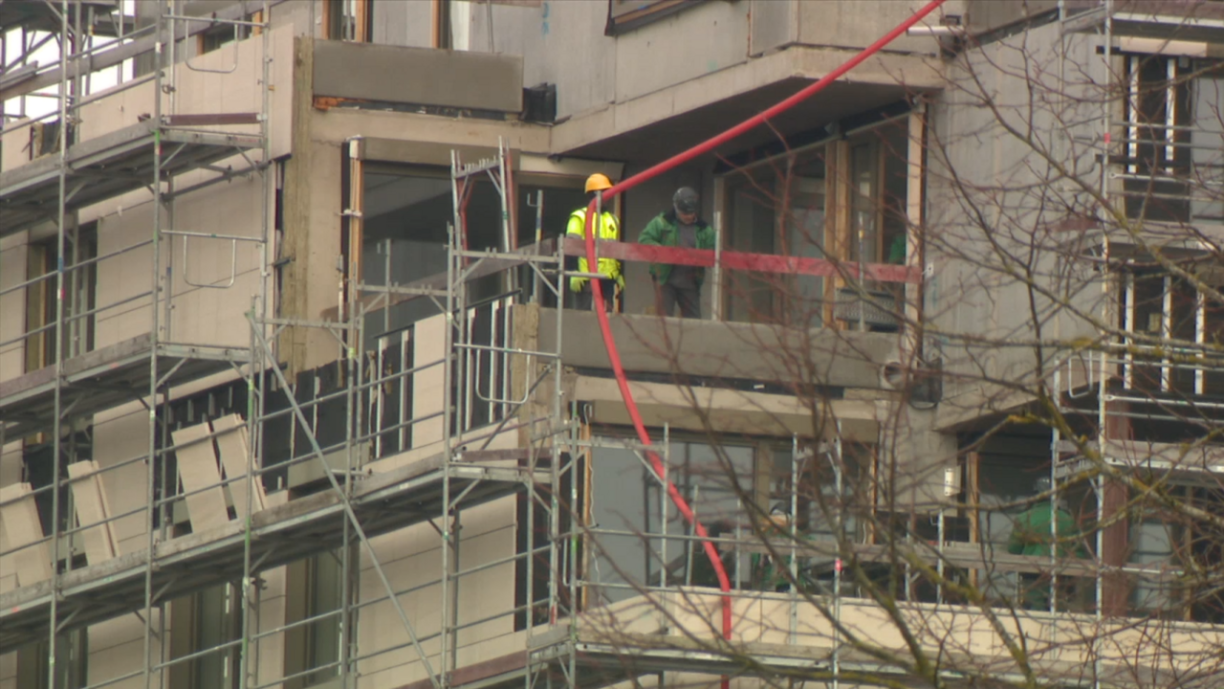
Recently, our colleagues at RTL.lu published a report on a housing project in Oberkorn, in which a number of the homeowners accused the property developer Capelli of not advancing the project enough. In a written response, the property developer then spoke of internal problems and promised improvement.
The report then prompted numerous other readers, who had similar experiences with the same construction company elsewhere in the country, to come forward. Often the same question came up: why does no one intervene?
First and foremost, the question that arises is: what exactly is a property developer? Jean-Paul Scheuren, President of the Luxembourgish Real Estate Association (CIGDL), describes the profession as follows:
"A building developer is someone who adds value to a piece of land by assessing its construction potential and then building on it. The developer also assembles a team of architects and engineers as well as selects craftsmen. The property developer is the client's representative until construction works are done, ultimately accompanying the client from start to finish."
There are currently around 1,000 real estate developers in Luxembourg. However, Jean-Paul Scheuren estimates that only 200 or 300 of these are professionals, because not every property developer is equally qualified. In recent years, Luxembourg has been a profitable country for foreign developers, too. This naturally raises the question of what the requirements are to be allowed to 'develop' in Luxembourg.
"Of course you can study real estate development, but it is not a prerequisite. Technically, the only thing you need to do to do get a permit as a developer, is to complete a 3-month course at the Chamber of Commerce and then prove you're insured. Technically, that's all it takes, but of course construction development is a profession where you need a lot of finances. That's where the banks' criteria come into play."
Since land in Luxembourg is not exactly affordable, one usually needs a bank loan to purchase. In an economic environment with ever climbing building costs and interest rates, banks examine closely to whom they grant a credit.
However, property developers are not subject to government scrutiny. When Jean-Paul Scheuren is asked whether developers should be subjected to auditing, he protests.
"An audit is, after all, a private company. I think the biggest financial crises we've had so far have usually been with companies that are on the stock market, and they have all been audited. I don't know if this will do much in our sector."
For more financial security and thus more trust, Jean-Paul Scheuren is in favour of an evaluation of bank guarantees instead. "You naturally ask yourself how you can improve the situation for the customer. After all, the bank guarantee only covers the construction, not the land."
Introducing a ten-year insurance, i.e. guaranteeing a certain quality of the material used, is another trope, he believes.
A real estate developer is interested in doing serious work anyway, for there is always personal cash involved. That is why a good relationship of trust between clients and developers is extremely important. This can only be achieved through transparent and open communication. From the very beginning, one should make sure that the client does not have false hopes with regard to the duration and price of the project.
However, if there are disagreements with the developer, customers can submit their complaints online to the CIGDL mediation commission. The goal is always to reach an agreement. After all, court cases can drag on for over ten years.
When asked about the future of developers in Luxembourg, Jean-Paul Scheren is afraid its number will decrease. And that at the expense of the Luxembourgish middle class.





