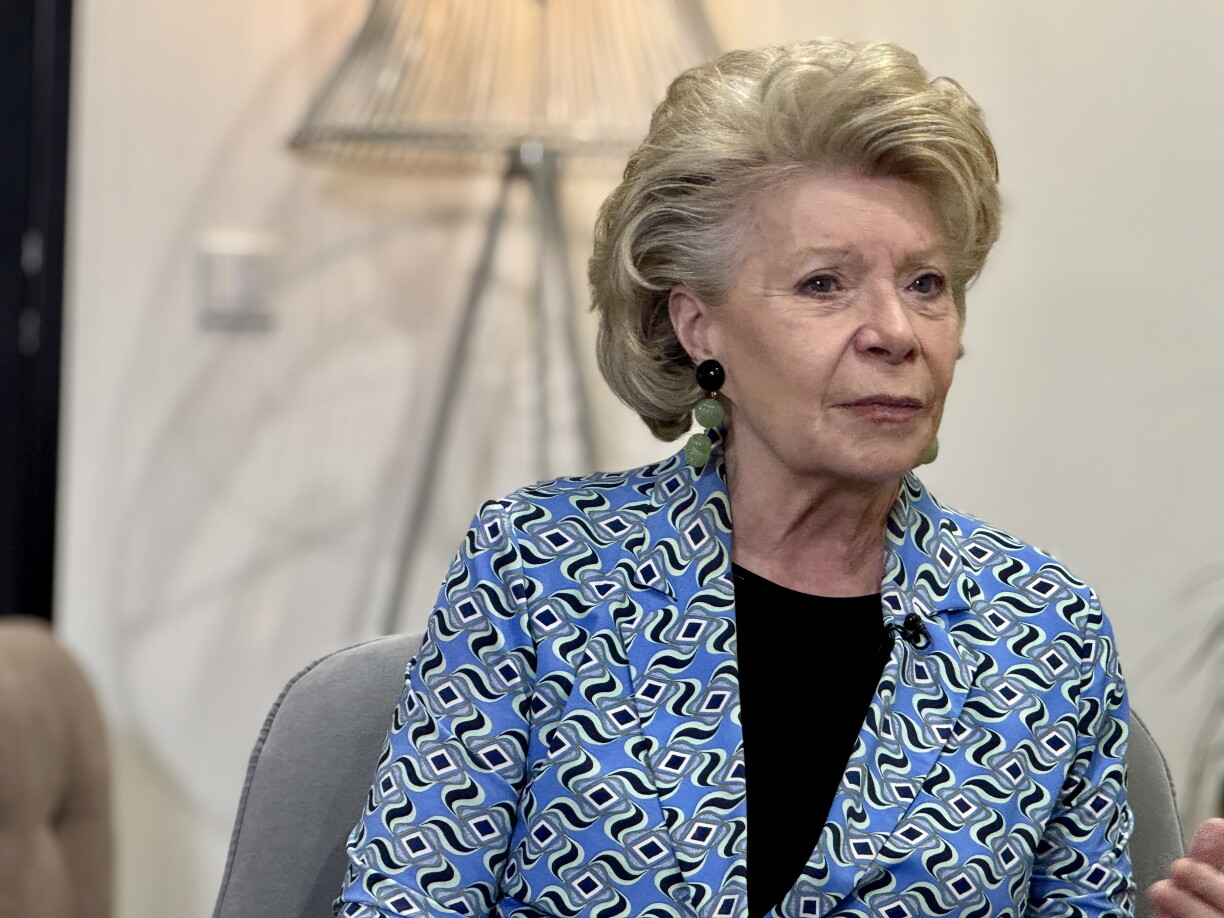
For many people in Luxembourg, former politician Viviane Reding of the Christian Social People's Party (CSV) is still closely associated with one achievement in particular: ending roaming charges in Europe. But Reding herself points out that her political career went far beyond that.
Members of the EU institutions who nominated her for the European Merit award clearly agree. The former politician is due to receive the distinction in Strasbourg on Tuesday morning.
Viviane Reding entered politics in the 1970s, at a time when, as she puts it, she believed she had to completely change the world. By chance, MP Jean Wolter was her neighbour in Esch-sur-Alzette. He told former PM Pierre Werner about the young woman's ambitions, and that is how she entered politics.
During her early years in the Chamber of Deputies, Luxembourg was facing the steel crisis. Reding describes these as her formative years, during which she learned how politics worked and how elections were won.
She was also able to observe Werner at close quarters as he managed the steel crisis and helped push through the euro. Her 15 years in the European Parliament then taught her how institutions function.
After the Schengen Agreement came into force in 1995, borders were open and people could travel, study, and work across them. But Reding, then an EU Commissioner, was troubled by the fact that communication remained limited by high roaming charges.
There was also a Luxembourgish interest involved, she admits, given that Luxembourg is a country where borders are always close by.
The battle took years, she recalls, as ministers feared losing tax revenue and telecommunications companies warned they could go bankrupt. Nevertheless, in June 2017, extra roaming charges were abolished across the EU.
Reding's faith in the European Union remains strong, even today. However, she believes the problem is that Europe cannot compete with dictatorships, pointing to China as a dictatorship and describing the US as heading in that direction.
Europe, she explains, is a system made up of national democracies that have handed over part of their powers so that the EU can function. This worked as long as Europe's partners were also democracies. With other partners, she argues, Europe must rethink its approach and become tougher.
EU cohesion is often called into question, but Reding says this has always been the case whenever unanimity was required. Still, she believes the current way of working can no longer continue. Long discussions need to be reduced, and decisions must be taken faster and more decisively, she says.
Reding, now 75, says the EU cannot afford to stand still. She is working to help small technology companies grow into European champions.
In the field of quantum computing, she says she has already helped make this happen with one company, noting that Europe now has a firm that sold more computers last year than US technology giant IBM.
Europe, she argues, failed to do what was needed to compete with the US and China in the technology sector. If Europe does not move quickly, it will not only fall behind but become dependent, according to Reding.
And, as she puts it, anyone dependent on technology is no longer free. For that reason, she believes Europe needs far more private investment and a different way of financing companies.





