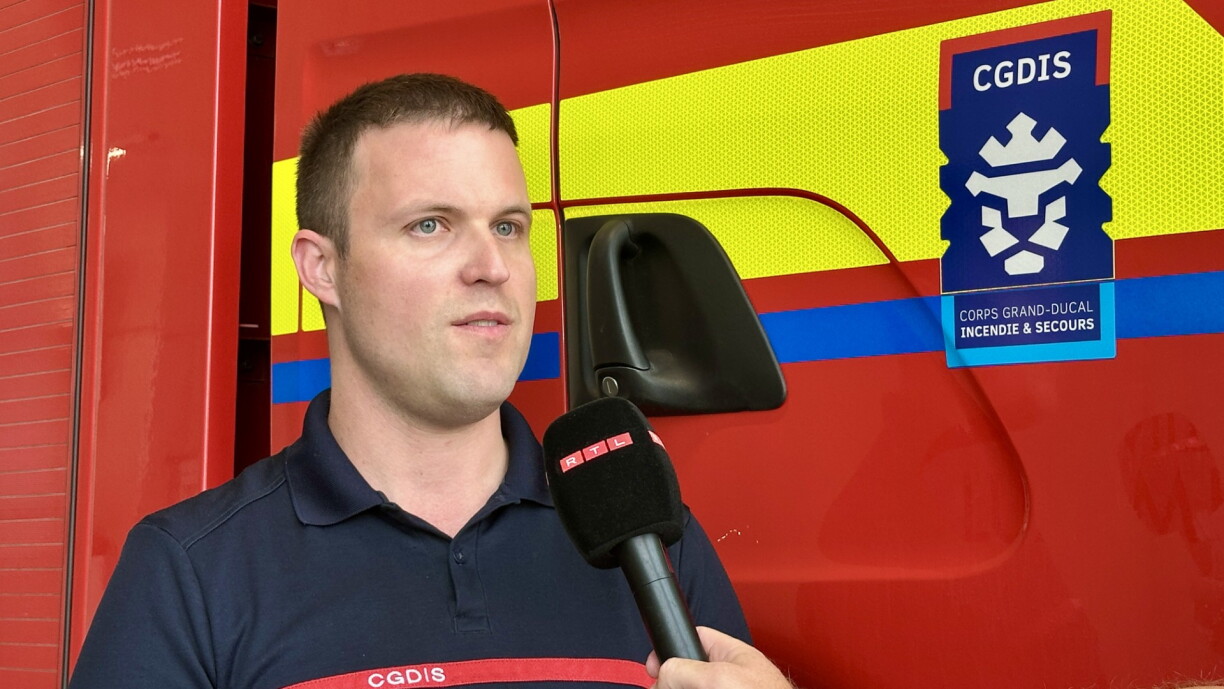
Firefighters were called out to seven separate vegetation fires on Sunday. "We're seeing that when it's warmer and drier outside, and there's been little rain, the risk of forest fires here in Luxembourg goes up," said Colonel Steve Meyer of the CGDIS.
Last week, firefighters had to respond to 15 such fires. "That was similar to the week of 22 June, when we had the heatwave around National Day. The week before that, we were looking at a maximum of around five call-outs. Because of the drought and high temperatures, the vegetation fire risk is extremely high."
The goal is always to prevent the fire from spreading further and larger. "In a second phase, the focus shifts to containing the fire. After that, the mop-up work on site is very labour-intensive, in order to fully extinguish the fire and make sure it's secured, so that it can't flare up again," Meyer explained.
In Luxembourg, the fires are mostly vegetation fires. Firefighters use so-called fire beaters to try to smother these blazes, particularly in locations where it's harder to access water.
To avoid vegetation fires, a few basic rules should be followed.
Anyone who spots a fire should first bring themselves to safety. They should then call 112 and give the operator a precise description of what they've seen and their exact location. When emergency responders arrive on site, people should make themselves visible and clearly show firefighters exactly where the fire is burning.
The CGDIS currently expects further vegetation fires to occur. As recently as Monday afternoon, a fire broke out in the Hoscheidt-Dick forest. Another fire broke out near the Rond-point Schinker, which required a large number of emergency responders on site. "We monitor this using various indices, which we analyse partly with Meteolux, but also via the European Forest Fire Monitoring system."
The risk of forest fires is expected to remain relatively high until at least the end of the week, Meyer confirmed to RTL.
When asked by RTL about vegetation fires, the nature and forestry agency (Administration de la nature et des forêts) responded with the following statement:
"When it comes to forest management, this naturally means that, over the coming decades, the administration will need to assess how, for example, forest stands can be adapted so that they become more resilient, always taking local biodiversity into account. Factors such as climate change, but also the risk of forest fires, play an important role here."





