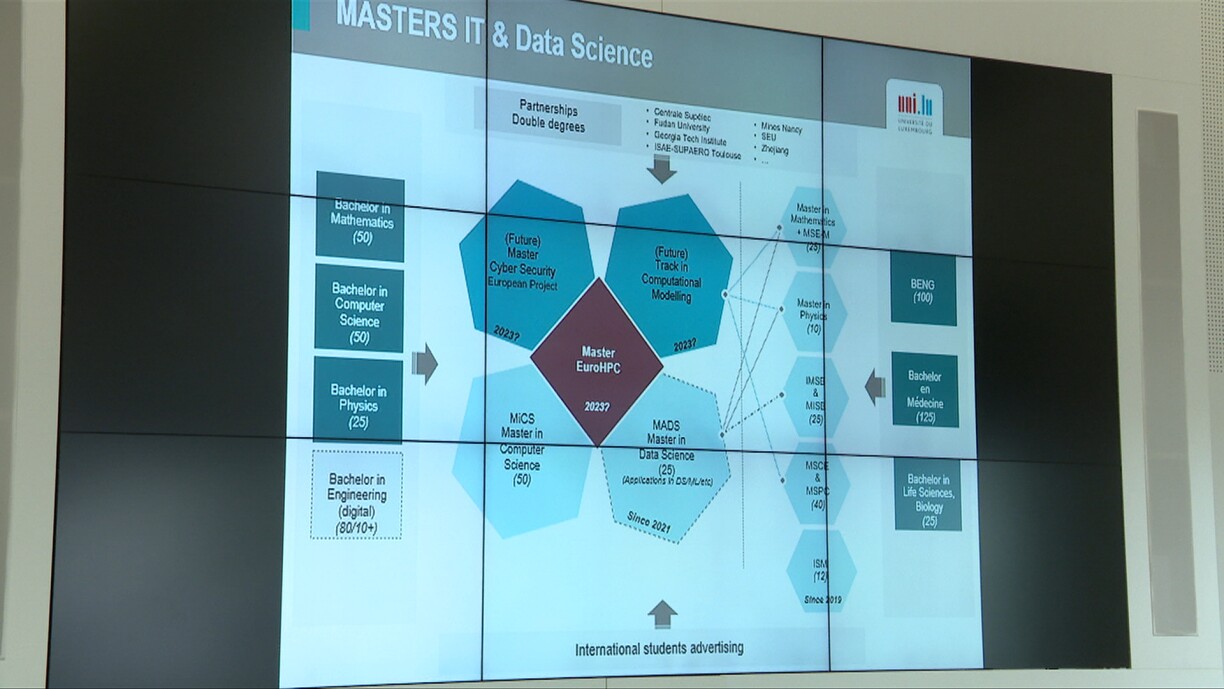
The new programme is made possible thanks to a joint convention with the Ministry of the Economy. The Ministry will contribute to the course by financing its three first years with €1.8 million.
As of 2023, students will thus be able to learn more about a variety of topics, including supercomputers, analysis of large data sets, and artificial intelligence. Minister for Higher Education and Research Claude Meisch commented: "The main goal is to have people graduate with the necessary competences to start working in both small and large businesses. Potential can be found anywhere, after all."
Minister of the Economy Franz Fayot also praised the advantages of the programme and its focus on key technologies: "This can help fight climate change, which we rather have to call a climate crisis today, or advance energy efficiency and personalised medicine."
People with a Bachelor degree in computer science or mathematics can apply for the master programme, explained Pascal Bouvry, who is in charge of managing applications: "We will launch a Europe-wide call for applications, after which a committee will decide on a first round of candidates. ... 50 students will be allowed in the first year, followed by 100 in the second one."
Since a number of European partners also contributed to the programme, the European Commission helps finance it with €7 million.





