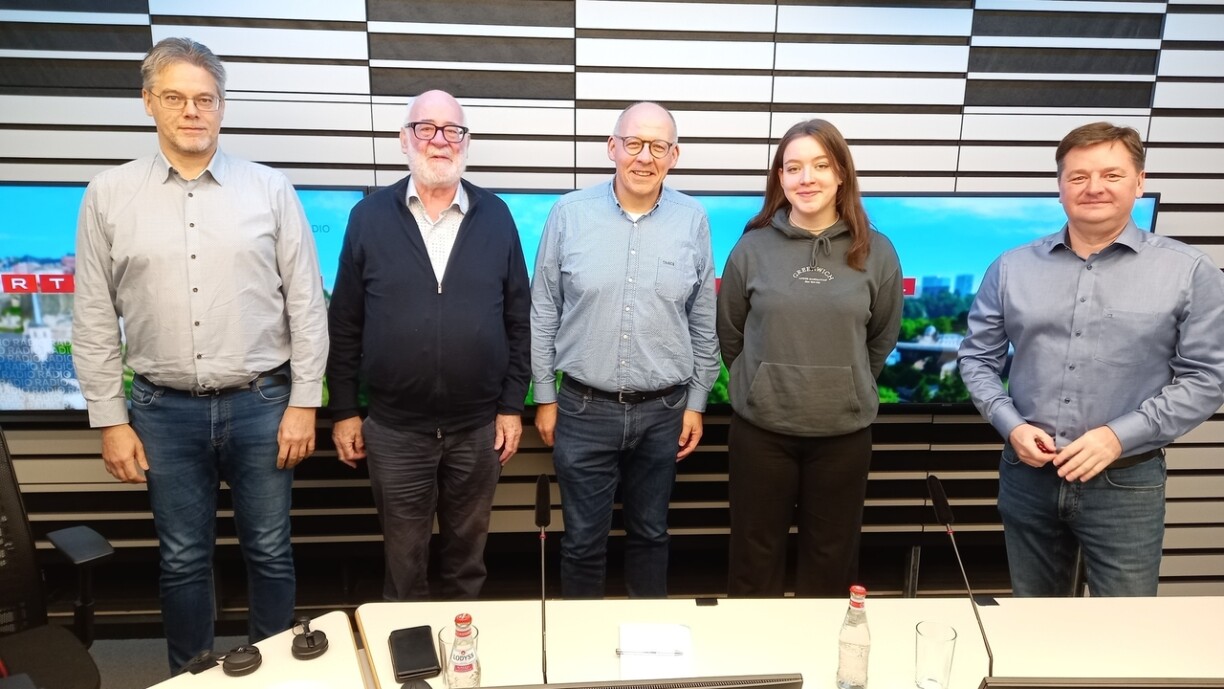
The panel included Frank Schroeder, Director of the Resistance and Human Rights Museum in Esch-sur-Alzette, Guy Dockendorf, Vice-President of the Committee for the Remembrance of the Second World War, Marc Schoentgen, President of the Auschwitz Committee, and Emma Garson, a final-year student at Lycée Ermesinde in Mersch.
Garson's decision to actively contribute to Second World War memory work followed her visit to the Auschwitz concentration and extermination camp. She expressed how personal visits and conversations with contemporary witnesses have a profound impact, motivating her to provide the same opportunity for other young people.
Schoentgen commended the initiative coming directly from the youth, emphasising its positive influence on the reception of remembrance culture among younger generations. Recognising the diminishing number of contemporary witnesses, he stressed the importance of continuing such projects.
Dockendorf acknowledged the commitment of many students to upholding the culture of remembrance. The Vice-President of the Committee for the Remembrance of the Second World War highlighted an ambitious educational programme in Cinqfontaines, where Jews were interned during the Nazi dictatorship, stressing the dual purpose of remembrance and education.
Director Frank Schroeder of the Resistance and Human Rights Museum underscored the need to expand programmes to attract younger audiences. He highlighted the importance of showcasing the multifaceted nature of war and introduced the "50 Faces" project, a collaborative effort with various institutions aimed at depicting the diverse experiences during the Second World War in Luxembourg. Schroeder noted that not everyone in Luxembourg was a victim; some collaborated, and it is crucial to present this complexity.
An intriguing question arose during the roundtable discussion — had the issue of collaboration in Luxembourg been deliberately obscured over time? Dockendorf responded, reflecting on his own experiences across distinct eras. According to him, it was only after the 1960s that the topic of collaboration was forgotten.
Schoentgen noted that with each passing generation, a certain distance naturally evolves. Memories are often transmitted through relatives in deeply personal ways. Schroeder emphasised the pivotal role of research in shedding light on these aspects: "There are a few examples, but they haven't really been worked processed." Schroeder underscored the necessity of research, suggesting that young historians approaching the past with a fresh perspective is crucial, offering a less emotionally charged lens.
Dockendorf concurred, acknowledging the importance of collaboration in these endeavours. However, he cautioned against relying solely on statistics, asserting that they fall short in capturing the complexity of the past. From his standpoint as a representative of the resistance, Dockendorf stressed the importance of preserving the human aspect of historical narratives. Schroeder reinforced this point, specifying that the "50 Faces" exhibition, beyond highlighting different wartime roles, will prominently feature contemporary witnesses.
In today's context, cultivating young ambassadors who have engaged with contemporary witnesses and can share not only knowledge but also emotional experiences is deemed increasingly crucial. Emma Garson highlighted the significance of such roles among the younger generation, emphasising that passing on personal experiences need not be a burden. For Garson, it is also about conveying symbolic acts, like laying flowers, which can hold profound meaning when informed by a deep understanding of the historical context.
80 years after the Second World War, Schoentgen underscored the enduring importance of remembrance work. However, he advocated for a more frequent linkage to the present day, aiming to connect the people residing in the country with Luxembourg's history. Schoentgen pointed out that the Grand Duchy is home to individuals with diverse histories, emphasising the need to broaden the narrative to include those whose families did not experience Luxembourg in the 1940s.
And there are plenty of connections to make. For instance, older Portuguese citizens who lived through a dictatorship in Portugal or refugee children with their unique experiences could enrich the cultural remembrance landscape. Dockendorf concluded by acknowledging that there is still work to be done in this regard.





