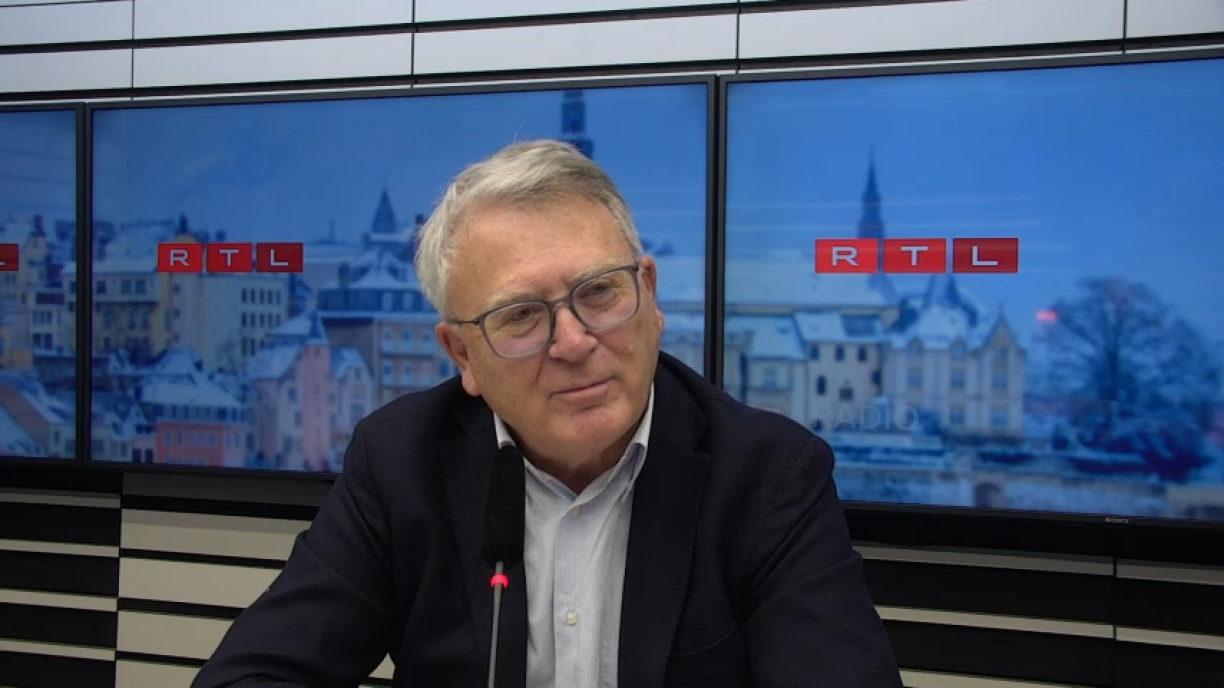
When introduced as a former minister, ex-EU commissioner, and past lead candidate for the European Socialists, Schmit was asked directly whether he intended to become the next lead candidate for the Luxembourg Socialist Workers' Party (LSAP). He replied that such speculation was not something he wished to comment on.
Asked whether he still advises LSAP MPs or participates in internal discussions, Schmit said clearly that he does not, adding that the party's parliamentary group is perfectly capable of doing its work without him.
Asked about an article in the Lëtzebuerger Land claiming that PM Luc Frieden had blocked his potential nomination for a senior OECD post, Schmit declined to elaborate, saying he knew exactly what had happened and had read Frieden's vague response. Schmit repeated that he had nothing further to add and that the issue was not important to him.
Turning to European politics, the conversation highlighted Schmit’s role as co-founder of the Strasbourg Declaration and the Europe Power Initiative. At the end of November, around one hundred figures from politics, business, and civil society signed a declaration calling for Europe to reposition itself. Schmit explained that the project emerged some time ago, even before Donald Trump's first election, and partly in response to Russia's aggression against Ukraine.
He said that long before these recent shocks, many had already questioned whether Europe could continue operating as it had in the past. The world, he said, had changed significantly, and the turning point arrived with Moscow's attack on Ukraine, followed by the political shift triggered by Trump's return to the White House.
The initiative, he explained, was launched by the French think tank Europa Nova and brings together leading figures such as Margrethe Vestager, Paolo Gentiloni, and Sylvie Goulard, reflecting cooperation across liberals, social democrats, and the European People's Party (EPP). They all share the view that Europe must rethink its foundations, according to Schmit. He argued that without such a rethink, Europe risks losing its relevance in the world that is now emerging.
He added that events in recent days in the United States only reinforced this sense of urgency. The American administration had just outlined a strategy describing how it now sees the world, and Europe's place in it. Schmit echoed comments by foreign-policy specialist Norbert Röttgen of the Christian Democratic Union (CDU) of Germany, saying this marked a historic rupture. He argued that the United States could no longer be considered Europe's natural ally.
Schmit stressed that the shift was not only geopolitical but also ideological, with serious implications for the future of democracy. Asked how Europe should respond, he said the EU needs a much clearer strategic direction. The EU performs well on the single market and trade, but lacks a coherent vision of the role it wants to play globally, he said.
He emphasised Europe's technological lag behind the US, noting that entire sectors are dominated by tech giants such as Google, Apple, Facebook, and Amazon, companies that increasingly act with political ambition. He criticised Elon Musk directly, pointing to recent statements where Musk suggested dismantling the European Union. Schmit argued that such rhetoric reflects the worldview promoted under Trump: a superpower that wants to reorganise the world on its own terms, whether in trade, technology, or rule-setting, leaving Europe dangerously exposed.
He argued that Europe must invest far more, work towards real security and technological autonomy, and stop demonstrating weakness, as he believes it did during a recent meeting between Ursula von der Leyen and Trump at his Scottish golf course. According to Schmit, Europe presented itself as a subordinate rather than as an equal partner.
For Schmit, any strategic reorientation must include the public. He said that European prosperity, democratic rights, and the future of younger generations can only be protected through a strong European Union. The alternative, retreating into national self-interest, would be catastrophic for Luxembourg, as small states would lose their influence and protection in such a system.
Schmit insisted that Luxembourg citizens must understand this, and that political leaders across all 27 EU member states need to make the case more clearly. He added that nationalist and far-right movements are openly supported by the Trump administration, pointing to the party Alternative for Germany (AfD), whose representatives are reportedly welcomed in Washington more warmly than mainstream European politicians.
He warned that extremist movements exist in Luxembourg as well, noting that MP Fernand Kartheiser of the Alternative Democratic Reform Party (ADR) had been invited to Sochi and celebrated by Russian hosts. Schmit said such individuals betray Europe in favour of other powers and that this must be strongly resisted.





