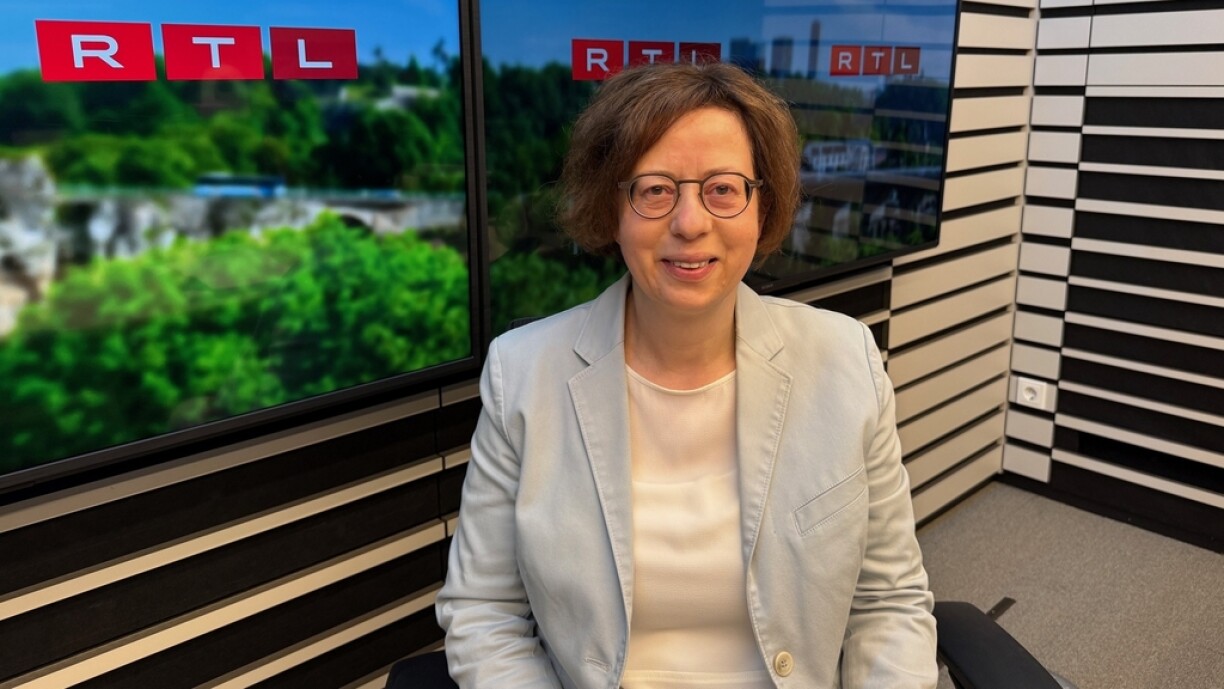
On Thursday morning, Doctor Danielle Schronen, observer at the National Observatory for Children, Youth and School Quality, answered some of RTL Lëtzebuerg's questions surrounding the development of the national childcare system.
Twenty years ago, the first childcare centres opened their doors in Luxembourg, offering around 5,000 spots at the time. Today, Schronen explains, numbers have risen to more than 71,000 spots. "Naturally", she says, "this brings with it a number of challenges".
Because general access to childcare centres is one of the criteria of the European Quality Framework, Schronen states that Luxembourg is demonstrably doing well on that front, as well as regarding governing, financing and the curriculum implemented in the centres. This was made possible through Childcare Service Vouchers (CSA), which by now make up 820 million euros of the national budget.
However, one of the challenges Dr Schronen addresses is the statistical evaluation of the information surrounding the different childcare centres. Although some data is already being transmitted through the CSAs, for some proper processing is still an issue.
Dr Schronen also names the interpersonal factor of the child–educator relation as complicated for different reasons. While one difficulty arises from the children's multicultural and, especially, their multilingual background, another one is the differing professional backgrounds of the educators and their pedagogical traditions.
A solution currently applied in childcare centres is to adapt how to apply the principles of non-school education within each centre according to the centre-specific conditions and nations represented. New staff are planned to systematically undergo what Schronen referrs to as "onboarding".
That is, a kind of training that should combine the educators' theoretical know-how with the case-specific conditions of their workplace. Dr Schronen makes clear that one priority, aside from professional schooling, is the educators' in-house-training and team-coaching.
A structural issue that is in the process of being addressed is the competition between state-regulated institutions and the predominant private sector of non-school education.
Due to differing remuneration systems as well as working conditions, private, social, and state structures find themselves working against each other. Ensuing staff turnovers are especially hard on the children who, as a consequence, often lose their attachment figure.
As a solution, Dr Schronen explains, the coalition accord now proposes that personnel from childcare centres might now also be integrated to the cycle 1 in schools. Because childcare centres are scheduled so as to complement school hours, this step might help regulate the educators' working hours by filling inconvenient empty periods.





