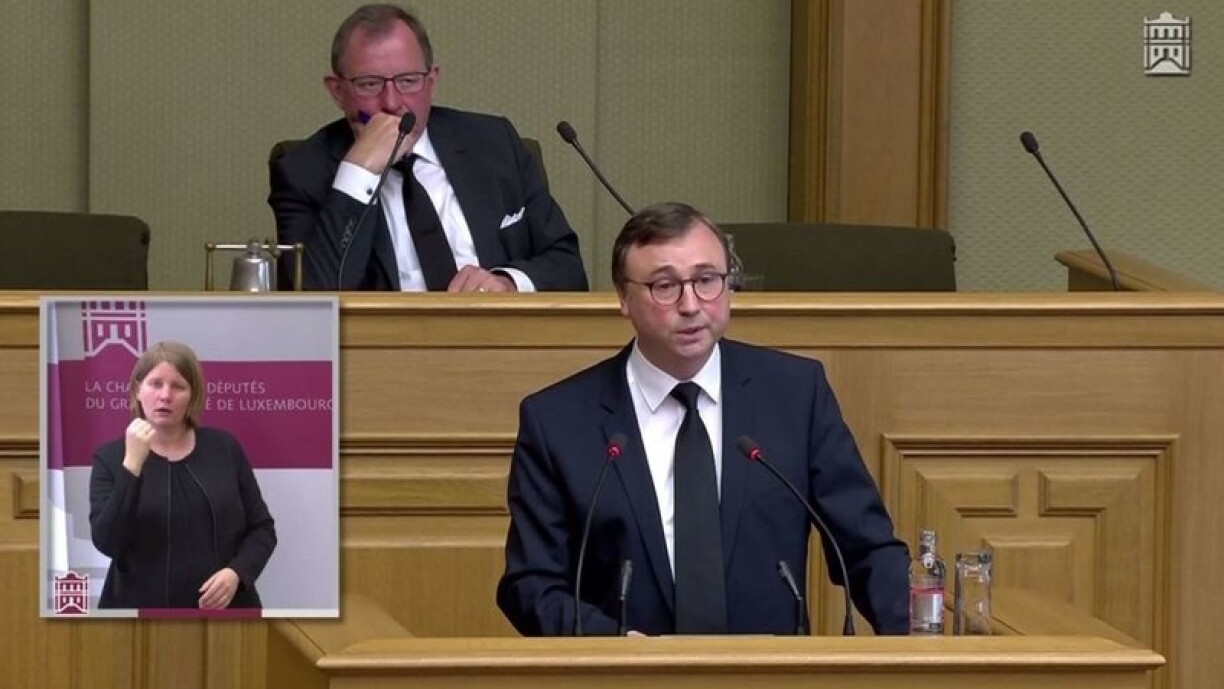
Democratic Party MP Bauler presented the first budget of the legislative period on Wednesday, highlighting the key goals: namely, increasing the attractiveness of Luxembourg's economy, introducing and promoting digitalisation in all areas, workings towards a stronger societal cohesion, and focusing on sustainability.
Bauler stated that the fiscal measure increasing the minimum wage by €100 net and the 2017 fiscal reform would both increase the purchasing power of individuals with smaller incomes. On the whole, these measures would promote social cohesion in society.
As one of the key points in the government programme, he added that an increased focus on sustainability would be reflected in the budget. He explained that the government is taking the Paris agreement climate commitments seriously and is consequently investing in both climate and nature protection.
In specific statistics, 20% of the budget's investments will go towards climate and nature protection projects, corresponding to €455 million alone this year. The amount will continue to rise over the next few years to reach more than €2.3 billion in climate and environment investments over the legislative period.
As an aside, the government also continues to invest in the country's mobility networks, such as the extension of the rail network, of train stations, and the tram network. Bauler confirmed that the Ministry of Mobility's budget will rise to a record €2 billion in investments.
The main purpose of the increased drive in digitalisation is to improve the well-being of the Grand Duchy's citizens. The areas that the government will target are varied, ranging from facilitating administrative tasks to improving mobility and providing more security online. Other measures include appropriate training and new methods to be used in the health sector.
Bauler provided a number of recommendations, notably a personnel increase in financial authorities, a simplification of tax explanations, and the reality of digital tax returns. Bauler also called for an improvement of political measures initiated by previous governments, mainly by critically examining policies years later in order to make amendments or reform these policies if required.
He also spoke of increasing the parliamentary control over large infrastructure projects with high costs around the €10 million mark. In this sense, MPs could verify that the state is sufficiently subsidising construction projects.
His recommendations also related to the area of digitalisation, as he suggested setting up a high committee of digital transformation. Another point recommended by Bauler was to make services more efficient and appealing to citizens and businesses, mainly through a faster data sharing process between administrations.
As the first speaker of the opposition, the CSV's Martine Hansen had a number of questions concerning the budget. She had many reservations concerning the budget, namely a lack of initiative in improving the well-being of residents. Consequently, Hansen concluded that the CSV could not pass the budget.
Hansen also reiterated the issue of the optimistic predictions making up the budget's basis. Whilst she did not want to paint the future as completely bleak, she refuted the idea of looking ahead with rose-tinted glasses.
Previous budgets may have worked out somehow, she wondered whether the government was acting wisely in continuing this process of basing its financial calculations on luck.
Hansen also criticised that the government did not release any statistics pertaining to the first three months of the year, claiming that the lack of security concerning expenses and profits reflected the chaotic coalition agreement.
Before Hansen unleashed her criticism, Minister of Finance Pierre Gramegna highlighted the key points of the budget, justifying that 50% of expenses belonging to the social area as belonging to the budget's goal of social cohesion and justice.
Gramegna also referred to specific proposals made by the Chamber of Commerce and discussed fiscal measures relating to climate change.





