The EU's Biodiversity Strategy for 2030 sets the goal of protecting at least 30% of land and sea areas. Luxembourg is already close to reaching this target, with around 29% of its territory under some form of nature protection.
However, setting ambitious environmental standards often sparks criticism, as they are perceived to hinder demographic and economic growth. The debate often frames environmental protection and the economy as being in opposition. In this context, the key concept is compensation.
If you have been driving around the country lately, you will have noticed that despite the ongoing housing crisis, construction projects are widespread. With construction inevitably comes the destruction of natural areas. To ensure that this loss is not permanent, Luxembourg has put in place nature restoration and compensation schemes.
Michaela Plein, who heads the compensation department at the Nature and Forest Agency, explains: "When assessing development or construction projects, the first step is to determine whether any protected areas or species are affected. An impact assessment is then carried out to identify critical points. We also evaluate what type of nature existed before the project and compare it with what would remain once construction is complete. These values are translated into so-called eco-points. Any loss must then be compensated."


The land is divided into five zones and the nature has to be compensated in the same zone in which it is being destroyed. At present, the south of the country is the only region where compensation measures are struggling to keep pace, as the state is not acquiring the necessary land quickly enough. A great example of how compensation works can be seen in the north, at the Përmesknupp. Here, a wetland forest was gradually restored. Instead of a monoculture, a diverse but careful variety of trees were planted, and ponds were also created. Michèle Federspiel, a forester in the Wiltz district, highlights how this benefits biodiversity.
"Now there are many nooks and crannies for diverse animals to find refuge, from dragonflies to larger species such as birds. And more flora too! As soon as more light hits the forest floor, more flowering plants appear, and there is far greater diversity of tree species compared with a spruce monoculture. Anyone who has walked through a dense spruce forest knows how limiting that can be if no restoration work has been done."
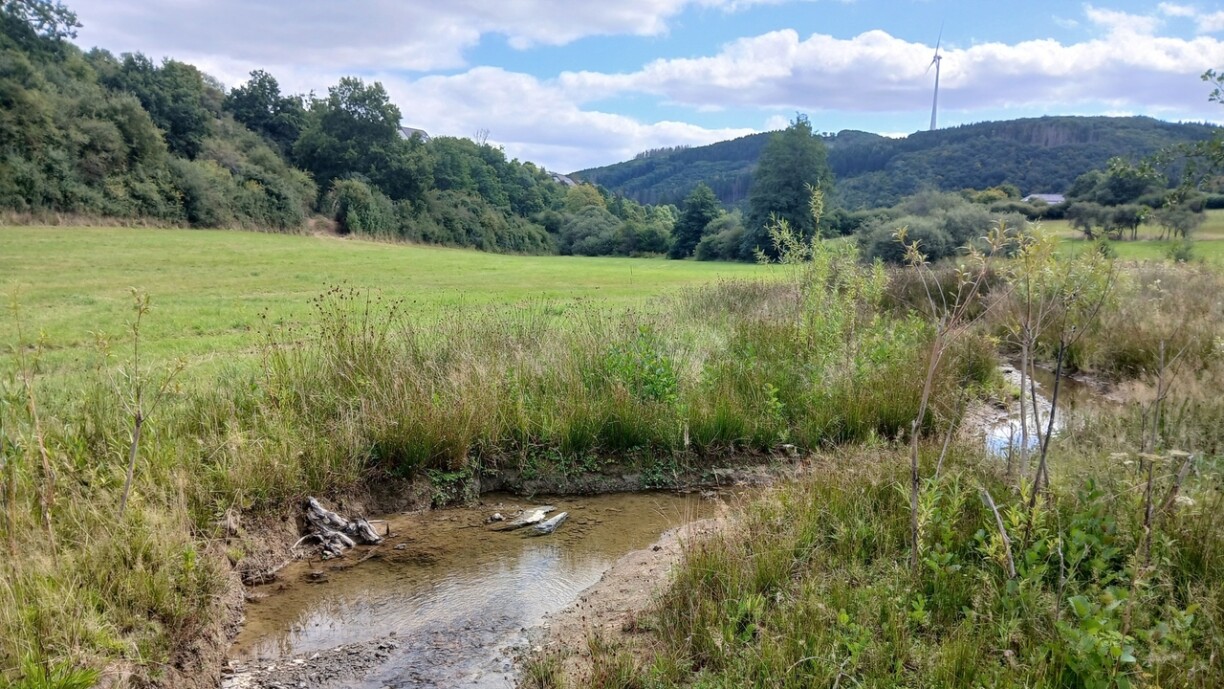
On the nearly 50-hectare site, two streams have also been renaturalised over a combined length of almost one kilometre, at a cost of between €100,000 and €150,000.


A few kilometres to the south east, right next to Heiderscheid, visitors can find the Hetschendeltchen. In 1988, the foundation "Hëllef fir d'Natur" ("Helping Nature"), bought two hectares of fallow land as the owners were unable to work the land and make economic use out of it. How does restoration on such a site work? Geographer Claude Schiltz, who works at the foundation, explains:
“The land is then cleared of undergrowth, a new fence is installed, and some areas are even improved. Here, we planted fruit trees in 1988 and established a hedge. In other places, we also carry out seed transfers. If typical species are no longer present, that becomes an essential step. Once these measures are in place, it is much easier to find people who want to use the land for agricultural purposes.”
Meanwhile, the foundation manages 17 hectares of forests and meadows in the Hetschendeltchen area around the Wooschenterbach, and Highland cattle help maintain the landscape. As traditions are important in Heiderscheid, there are plans to potentially revive flax cultivation, which is part of UNESCO’s intangible cultural heritage.





