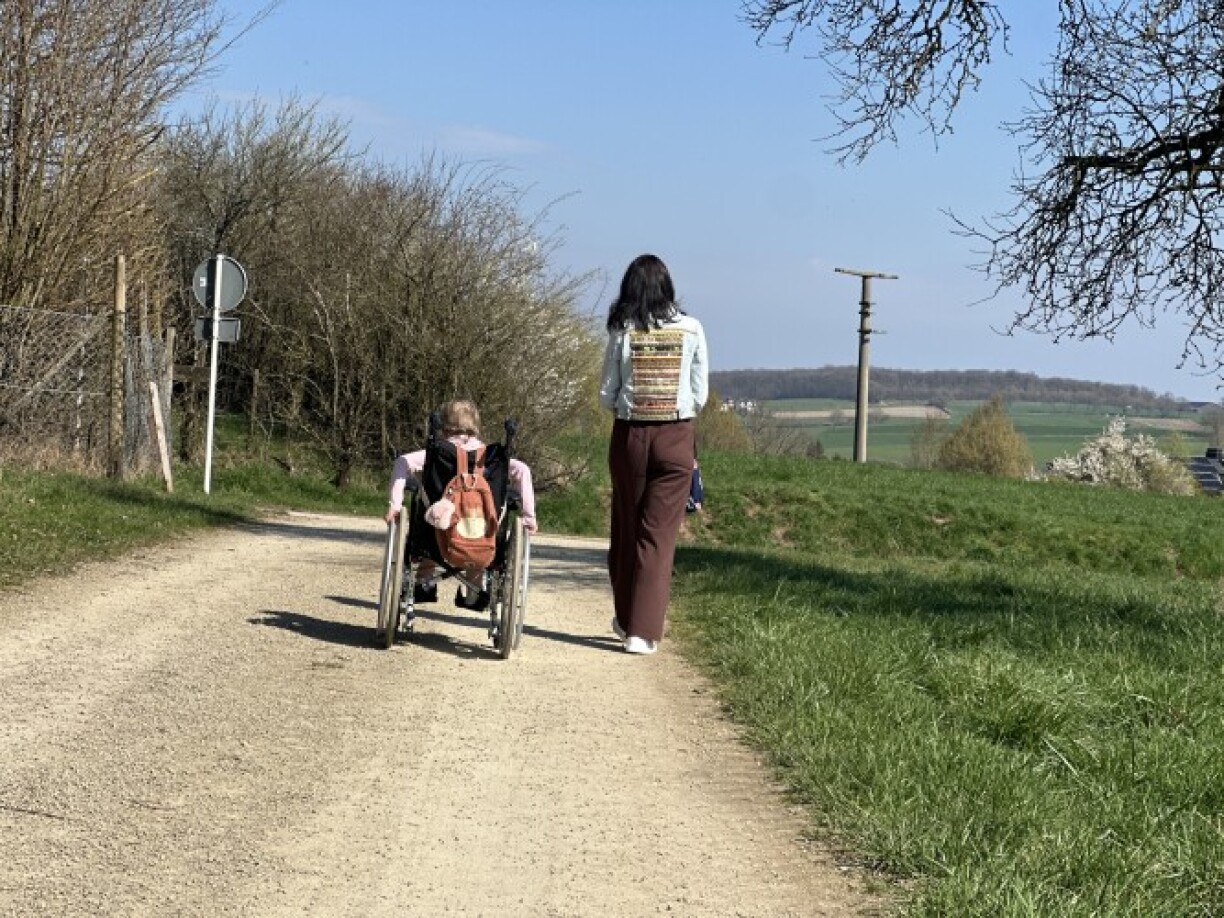
For eight-year-old Yana, there is no cure – only the possibility of stabilisation. This situation presents her mother, Carol, with significant challenges.
Doctors have told Carol that they cannot cure her daughter, only attempt to stabilise her condition. The tumours in Yana's head cannot be surgically removed.
In October 2024, Yana received the diagnosis: three tumours in her head, one of them the size of an orange. The tumours developed as a result of a genetic disorder – neurofibromatosis type 1 – which was diagnosed in the girl at the same time.
Hospital appointments and visits to a rehabilitation centre have since become part of Yana's daily routine. She is currently undergoing her third round of chemotherapy. So far, no positive development has been observed. The tumours have not shrunk.
Despite her severe illness, Yana's joy for life remains infectious. The little girl can often be heard laughing. According to her mother, this is no coincidence: "I have learnt to make ourselves a priority. We enjoy every moment together. It is the little things that have an immense impact on Yana's psychology."


Carol, 35, is a single mother and lives under constant pressure that something might happen to her daughter. She is currently unable to work.
Yana requires round-the-clock care. "I cannot leave her alone, with family or friends. The responsibility is simply too great. Yana has motor issues, is unsteady on her feet, and could choke and suffocate at any moment. At least once a week, I have to perform first aid on her," Carol said.


For couples caring for a sick child, both partners are entitled to up to 52 weeks of "leave for family reasons" each, to be taken separately. Together, parents can thus care for their child for 104 weeks – a total of two years. In a single-parent household such as Carol's, however, only the aforementioned 52 weeks are provided.
"I have sole parental authority over Yana. There is no second parent to look after her. As a single parent, I am therefore only entitled to a total of 52 weeks, even if my child's therapy lasts longer. I don't think that is fair on my child. Yana is losing out because of this. And it makes our lives much more complicated," Carol said.
In her view, the issue needs to be taken seriously at a political level and the law amended.
At present, there is no indication that Yana's situation will improve drastically. The chemotherapy she is receiving is merely stabilising her condition. The tumours remain inoperable, and her genetic disease – which can cause new tumours to form at any time – is incurable.
More information on the conditions of "leave for family reasons" can be found on guichet.lu.





