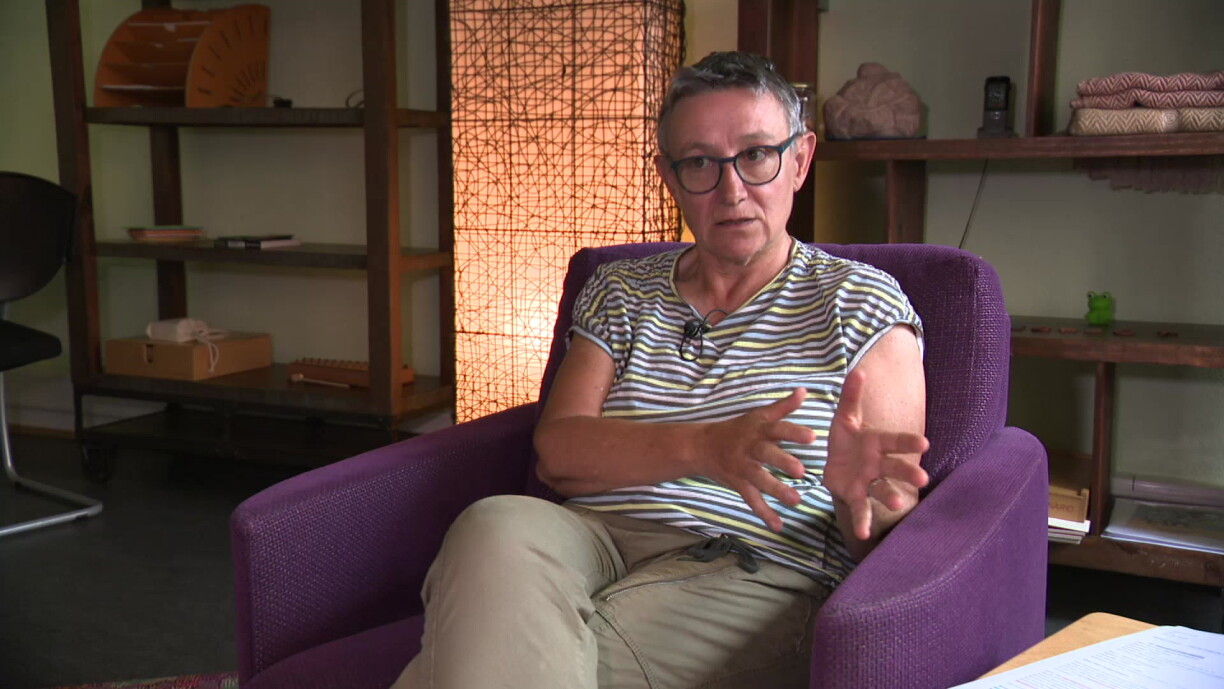
Europe is facing a wave of radicalisation, as German-Israeli psychologist Ahmad Mansour, active in prevention work in Germany, recently outlined in conversation with RTL. Karin Weyer, who runs the Respect.lu radicalisation prevention centre as a psychologist and psychotherapist, concurs: "What is being observed is a broader societal climate in which more extremist proposals and more hatred are surfacing online, all of which is a concern."
Weyer points out that there is also a risk in Luxembourg that attacks could be carried out by radicalised individuals. There is no guarantee, she said, that nothing will happen.
The number of people with whom Respect.lu has worked in recent years has grown since the centre was set up, and the number is currently relatively stable. Weyer points out, however, that the figures come with a certain lag, since it usually takes two to three years for the justice system to refer people who have become radicalised on to the centre.
The breeding ground for radicalisation is typically a crisis. Young people in particular are open to radical ideologies because they are searching for identity and belonging, for meaning and structure, the director of Respect.lu explained. Supposed answers to those questions can then pave the way to radicalisation.
Young people can come across radical proposals or ideas on any number of forums, gaming platforms, or apps. In Luxembourg, contacts tend to come from groups based abroad, like IS or far-right networks.
Some young people, Weyer noted, currently lack a positive circle of friends and have not been able to build one – part of the lingering fallout of the Covid pandemic. They lived through a period in which older generations had already built up their friendships and were more dependent than ever on finding peers online.
That often went well, but on occasion young people ended up connecting with the wrong people, the psychotherapist emphasised.
Weyer does not see the risk that poor integration of migrants could lead to radicalisation, as the German expert Ahmad Mansour argued, as being as pronounced in Luxembourg. In her view, there are fewer parallel societies here than in Germany.
There is much more togetherness in the country, she said, and more mixing between people, which broadens the range of identities on offer.
The danger, she argued, lies rather in young people searching for identity or orientation online, where they can stumble across content that is deeply problematic. That risk cuts across whether the person has a migrant background or not.
Prevention against radicalisation, in Weyer's view, cannot begin early enough. Alternatives have to be offered, whether around stability, group membership, or club life.
If something in another person's behaviour causes concern, she said, people should reach out to Respect.lu.
How easy or difficult deradicalisation proves depends on where the person finds themselves in the process. The attempt, she explained, is to work out what kind of need a radical ideology fills for the individual.
Often, it comes down to the feeling of not finding one's place in society.
"Finding one's place is not straightforward", Weyer said. "The anxiety that comes with that is understandable. The conclusion that others are to blame, whether foreigners, Muslims, or migrants, is not, however, the right one."
The task is then to work with the person to see how that need can be met without turning against another group or resorting to violence. Where an identity has already been built around a particular ideology, therapy takes longer.
The first task for politicians, which the board of Respect.lu highlights, is the regulation of the internet. The police, the judiciary, and civil society also have their part to play.
The psychologist does not, however, believe that harsher sentences for people who have become radicalised are the right path. She has yet to find any study, she said, that shows tougher penalties actually deliver results.
"Without a doubt, there is no question that police prosecutions must go ahead", Weyer clarified. However, anyone prepared to risk their own life for an ideology is unlikely to be deterred by the prospect of a harsher sentence.
Radicalisation has many facets. Respect.lu was set up in 2017 in the wake of the Islamist attacks in Paris and Brussels. At that time, the focus was more on right-wing extremist themes.
During and after Covid, attention shifted to conspiracy theories, Weyer explained.
In more recent times, people have increasingly been drawn into hybrid ideologies. A newer development is nihilistic extremist violence, driven by violence for its own sake, with ideology fading into the background.





