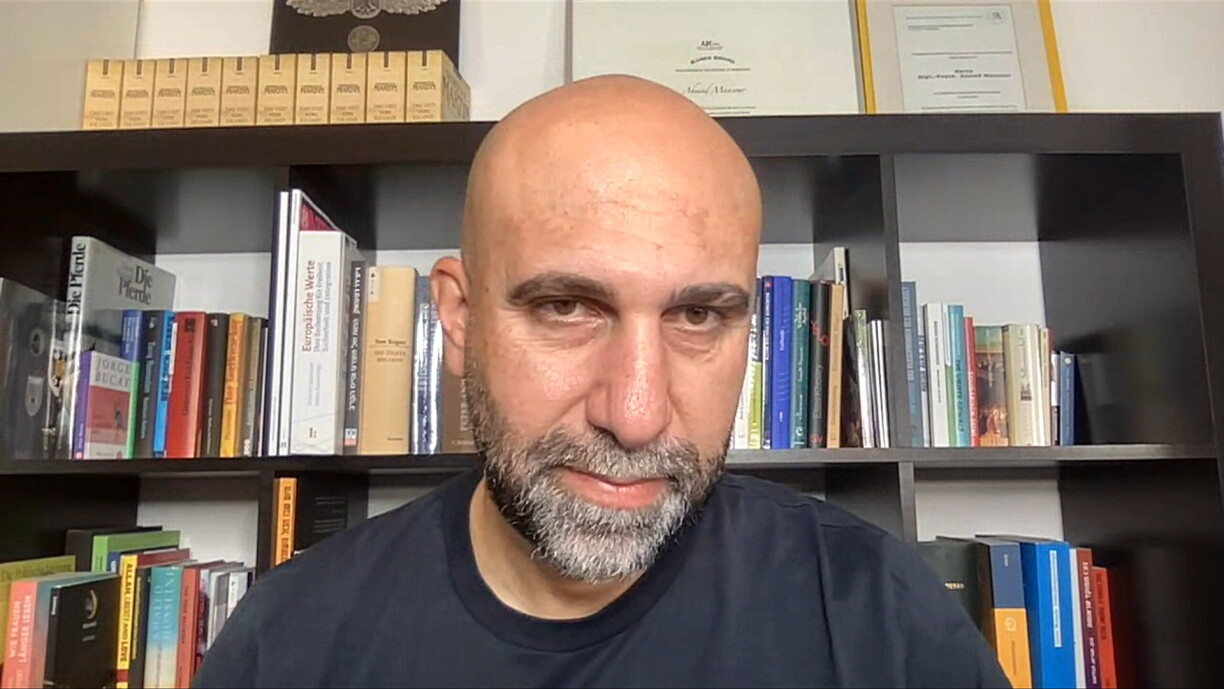
The recent Islamist attack at Berlin's Christopher Street Day parade came as no surprise to psychologist and extremism expert Ahmad Mansour, who says Europe has been facing a growing wave of radicalisation since Hamas's 7 October 2023 attack on Israel.
Psychologist, author and extremism expert Ahmad Mansour is of Arab-Palestinian origin. Israeli-German, he has lived in Germany since 2004, where he advises public authorities and political institutions. His outspoken views on migration have earned him both widespread support and sharp criticism.
"What surprises me is that people are surprised," he told RTL in a video interview.
He points to a wave of radicalisation across Europe since Hamas's attack on Israel on 7 October 2023 and the subsequent war in the Middle East, saying attacks now occur almost weekly.
In his view, this should prompt societies to confront the persistent threat of extremism rather than reverting to business as usual after each incident.
According to Mansour, various actors pose security threats across Europe. The so-called Islamic State (IS) seeks to orchestrate attacks, while repressive regimes such as Iran's mullah government actively recruit young people.
Networks such as Hezbollah and Hamas also remain operational, but he notes that in recent years, individual attackers radicalised online without links to any formal organisation have become increasingly common.
These are often young people searching for identity, stability and orientation in a world marked by multiple overlapping crises.
Mansour argues that this environment leaves many feeling overwhelmed and desperate for clarity, making them vulnerable to Islamist propaganda, which offers a sense of belonging and identity rather than overt radicalisation.
He believes policymakers could do much more to counter these developments.
Mansour argues that limiting migration could significantly reduce the number of people who may pose a security risk, adding that "we were naïve to think it would always work out to welcome people with completely different socialisation and value systems".
He emphasises that while not all migrants become radicalised, many live in parallel societies and resist integration. He warns that when fundamental social values are rejected, the risk of radicalisation increases significantly.
Mansour also criticises what he sees as the state's insufficiently robust response. He insists on the need for deterrent sentences, pointing to the United Kingdom and France as stronger examples than Germany.
In the field of prevention, his area of expertise, Mansour calls for a proactive approach, "fighting for every soul" and urging society to be faster and more present than Islamists, especially online.
He laments that too much ground has been ceded to extremists on the internet, despite the appeal of freedom, which, he argues, should be far more attractive than what he describes as the exhausting ideology of Islamism.
For the past decade, Germany has debated whether to introduce an upper limit on migration. Mansour insists that a country's resources are finite if integration is to extend beyond language skills, employment and crime rates.
He argues that genuine integration requires migrants to internalise core societal values, an arduous and time-consuming process, especially for those raised in very different cultures. In his view, Germany can successfully integrate around 100,000 people per year, but not 1.1 million.
Moreover, he contends that experiences in France and the UK have already demonstrated what happens when parallel societies emerge: successful integration fails when newcomers remain disconnected from the majority society. Addressing this challenge, he says, is essential.
According to Mansour, even discussing the need to transmit values to newcomers is often branded as racist by some political groups.
He argues that as soon as someone says society needs to convey its values, the left-wing party Die Linke accuses them of racism, claiming it assumes newcomers hold different values, something Mansour says is unquestionably true.
In the aftermath of the recent Berlin attack, he specifically criticised Die Linke for its response, noting that the party issued a lengthy statement without once mentioning Islamism.
He sees this reluctance to openly address the issue as part of the problem, arguing that anyone who tries to speak about it is quickly labelled a racist. He says that even he, as a Muslim, has been accused of Islamophobia by Die Linke.
For this reason, Mansour argues, Die Linke is not a partner in the fight against Islamism or in defending democracy, adding that the party's radical identity politics fosters antisemitism and Islamism instead of combating them.
He concludes that defending democracy is paramount, warning that there are forces on the right, the left and among Islamists that seek to undermine or abolish democratic values.
While considerable efforts are made to counter right-wing extremism, he believes society is not equally vigilant against Islamist threats.
Asked what advice he would give Luxembourg on migration policy, Mansour says the country should avoid repeating what he considers the mistakes made by Germany and France and instead identify structures that are incompatible with core societal values.
He stresses that integration should be understood as incorporating newcomers into a shared set of values, with these fundamentals taught from day one.
Those who refuse to accept them, he argues, should face consequences, as they have no future in a democratic country if they remain unwilling to change.
When asked how much migration Europe can absorb, Mansour says the answer depends on the origins of newcomers, arguing that greater cultural differences can make integration more difficult.
For example, he believes someone arriving from Ukraine would integrate more easily than someone from Syria or Afghanistan.
He advocates a differentiated approach, arguing that opportunities should go to those who associate Europe with freedom and individualism, and that integration should focus on individuals rather than communities.





