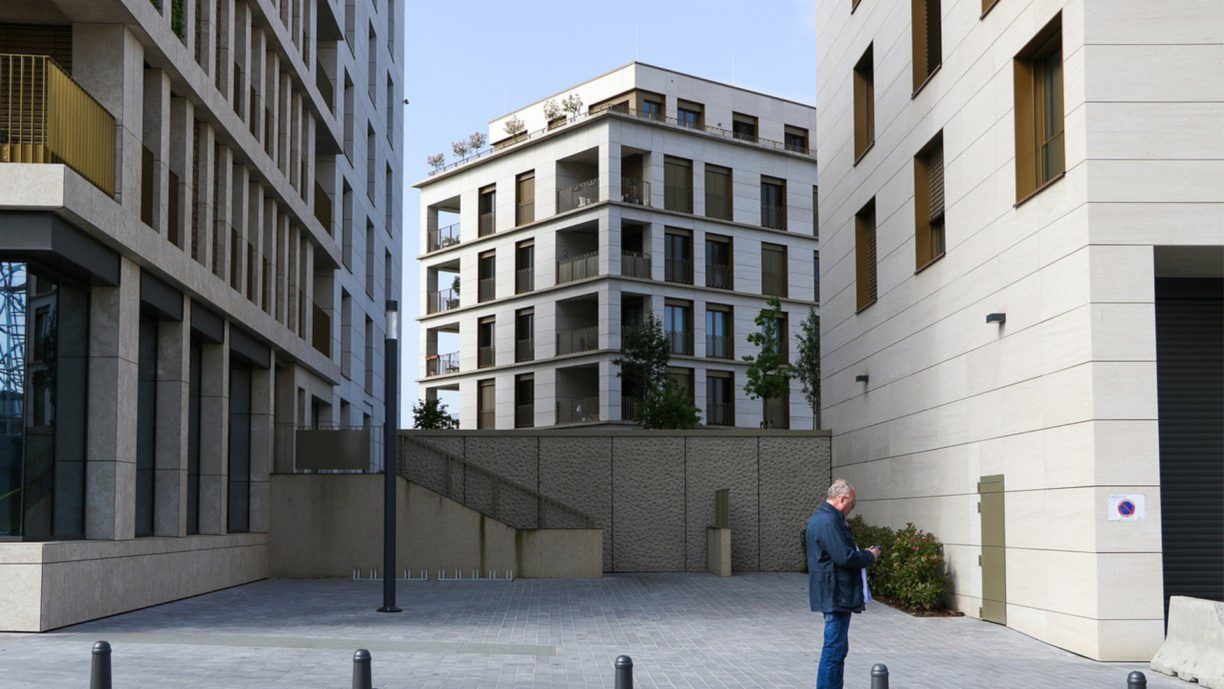
Luxembourg is building virtually no new homes, with a major fall in activity having been observed in the new housing market since at least the start of 2022. One of the main reasons for this slump, according to the National Institute of Statistics and Economic Studies (STATEC), has been the increase in key ECB interest rates.
This is a major problem for a country like Luxembourg, which welcomes more than 10,000 new residents every year. When construction was in full swing, the country already struggled to produce more than 4,000 new homes a year. And, as reported earlier his year, the situation worsened considerably in 2023.
Luxembourg has not finished suffering the consequences of this drop in productivity. The rental market, already under pressure before the rampant inflation rise, is now "clogged", according to Gilles Hempel, Director of the 'Agence Immobilière Sociale' ('Social Real-Estate Agency').
Things are not expected to get any easier, says Georges Krieger, President of the 'Union des Propriétaires' (Union of Homeowners'): "We're going to suffer the consequences of the fall in housing construction in 2024 and 2025."
"There will be a delayed effect on construction", agrees Jean-Michel Campanella, chairman of the 'Mieterschutz' ('Protection of Tenants').


The rental market might experience an unprecedented level of tension due to the lack of housing and the transfer of demand from the buy-to-let market. And tensions inevitably mean higher rents. The key to the problem therefore also lies in building for the rental market.
Against this backdrop, Krieger believes that "all means are good for boosting construction". In his view, there should be no hesitation to give preference to investors for a few months if this helps to get kickstart housing development.
However, the director of the Social Real-Estate Agency suggests a completely different plan of action. In his view, vacant homes should be taxed. "It's an existing source of housing, there's no need to build it", he argues. The director further claims that this might put between 10,000 and 20,000 homes back on the market "overnight". "We've always relied on the carrot, now it's time to pull out the stick ... let's put in place taxes that really hurt landlords", says Hempel.
The President of the Homeowners Union does not share this view. Taking over the homes of people who are going into retirement homes is not a solution, in his estimation. Krieger also claims that a large portion of vacant homes are unoccupied because they do not meet the necessary criteria to be marketed, insisting that many flats in the Oesling resion are not let because of insufficient ceiling height. "There are very few people who don't let their property on the pretext that a tenant might break everything", he adds.
Faced with this situation, Luxembourg might soon have no other choice, says Campanella: "We have no solution ... rents are rising too fast. It's tragic to see residents leaving because all the doors are closed", he laments.
The country's attractiveness is now being called into question. Hence the response of the new government, which introduced a series of construction-boosting measures at the start of the year.
However, not everyone is in favour of these measures. "We need to do a lot more for investors", argues Krieger. To make progress, the President of the Homeowners Union believes that "we need to simplify procedures and reduce taxation of capital gains".
Read also – Housing Minister Claude Meisch: To ease housing crisis, landowners must 'do something with their plots'Hempel, for his part, welcomes the measures concerning the 'Gestion Locative Sociale' ('Social Rental Management'). Nevertheless, he contends that the "construction engine has to be kept running". A point on which everyone agrees, including Campanella.





