
In Luxembourg, it's not just salaries that spark envy – pensions do too. Our colleagues at RTL Infos have created an interactive tool allowing users to compare their pension with those across various public and private schemes. And, as usual, there’s one group of retirees hitting the jackpot.
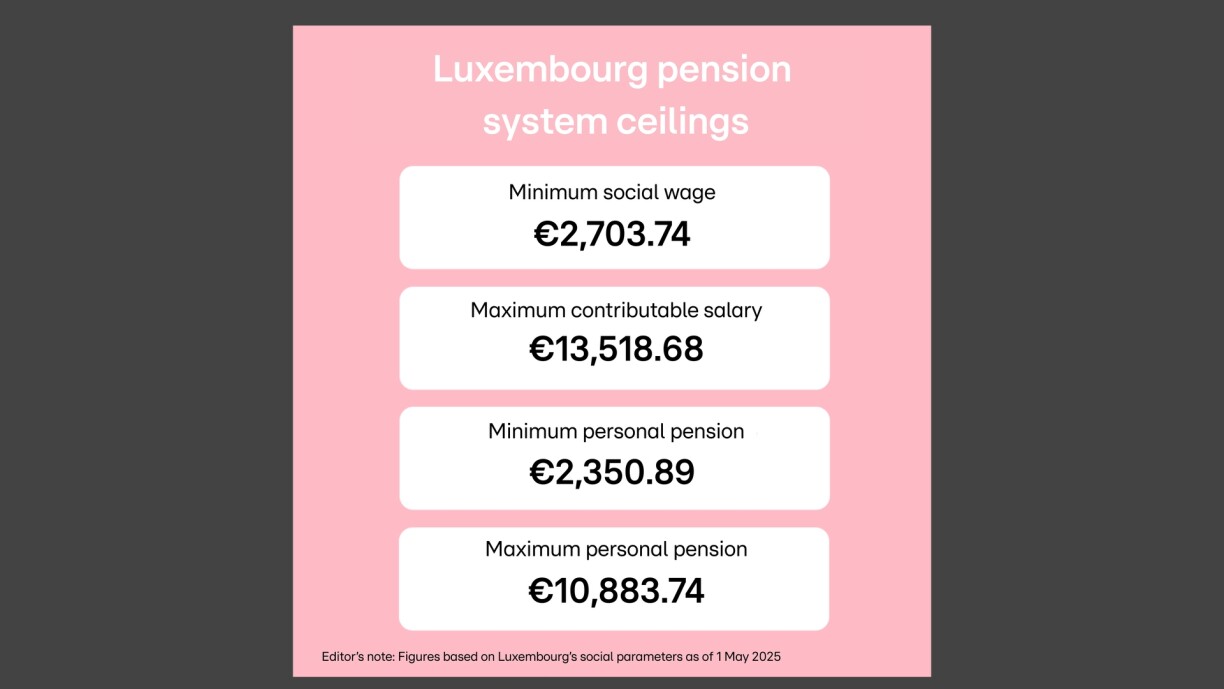
One thing is clear: with an average retirement age of 59.4 – the lowest in the EU – a minimum pension of €2,350.89, an average of €3,569.99, and retirees receiving more than 80% of their final salary, Luxembourg pensioners are among the most privileged in Europe.
https://today.rtl.lu/news/luxembourg/a/2314411.html
That said, even in the wealthy Grand Duchy, not all pensions are equal. No surprise there: as we recently showed with our 'salary scale' in Luxembourg, public and private sectors offer different earning prospects. Naturally, this carries over into retirement. To better understand this, we asked the IGSS (General Inspectorate of Social Security) to provide statistics so we could create a "pension scale".
Its functioning is simple: pensions are ranked by 10% brackets, from the lowest 10% to the highest. Below, you can test this pension scale by selecting the scheme that applies to you. As a reminder:
Private sector – general pension insurance scheme applies to private-sector employees and the self-employed (freelancers, company directors, etc.)
Public sector – special pension schemes applies to civil servants of the State and municipalities as well as CFL railway agents hired as of 1 January 1999 (more information here)
Please note that these pension scales were calculated based on gross pensions paid in December 2024, and are based on full careers without insurance periods in foreign pension schemes.*
Looking at the three pension scales, one scheme clearly stands out: that of pensioners who joined the civil service before 1999.
Let's take private-sector retirees and civil servants hired from 1999 onwards. Their pension scales are fairly similar:
Private-sector retirees: the lowest 10% earn up to €2,555 gross per month; the top 10% earn from €7,102 gross per month. The median income (dividing the population into two equal halves, with 50% earning less and 50% more) is around €4,318. 30% of private-sector pensioners earn more than €5,324.
In contrast, far ahead are beneficiaries of the transitional special scheme (hired before 1999):
In short, the gap with other public and private-sector pensioners is enormous – practically double.
The reason pensions are so high for civil servants hired before 1999 is because their pension is calculated based on their final salary. This is far more advantageous than in the private sector, where pensions are based on income earned throughout the entire career.
A figure published in a comprehensive study by the Forum journal illustrated this public/private gap: "In the general private-sector scheme, only 0.14% of all retirees in 2022 received a pension above €8,000, while among retired civil servants, 34% received pensions above that amount." This figure has since risen, as our pension scale shows.
A figure that stirs frustration: "Why should taxpayers fund the high pensions of state employees?" asked the president of the Luxembourg Employers' Association, for instance. That said, taxpayers should in theory be less burdened in the future, as the "transitional" pension schemes live up to their name: they will phase out after a generously extended transition period lasting until 2040. In short, the golden age is well behind us.
The issue of civil service pensions remains a politically sensitive one in Luxembourg. Nearly 40% of voters are public-sector employees. Targeting the privileges of the civil service is like walking through a political minefield.
Granted, no one has missed that a pension reform is under way, which will also affect the new generation of civil servants. As Luc Frieden announced, public-sector employees will indeed be subject to the same changes as the private sector (longer careers, etc.).
But those who joined the civil service before 1999 can rest easy: the Chamber of Deputies assures that the transitional scheme "is not affected by the ongoing discussions on the future of the pension system and its financing."
Clearly, civil servants hired after 1999 must be kicking themselves for not being born in the "good old days"!
*Method of calculating the pension scales: IGSS specifies that the figures correspond to all old-age pensions granted between 2020 and 2024 based on full careers. This includes all pensions granted before the age of 65 based on careers without insurance periods in foreign pension schemes (non-migratory careers).





