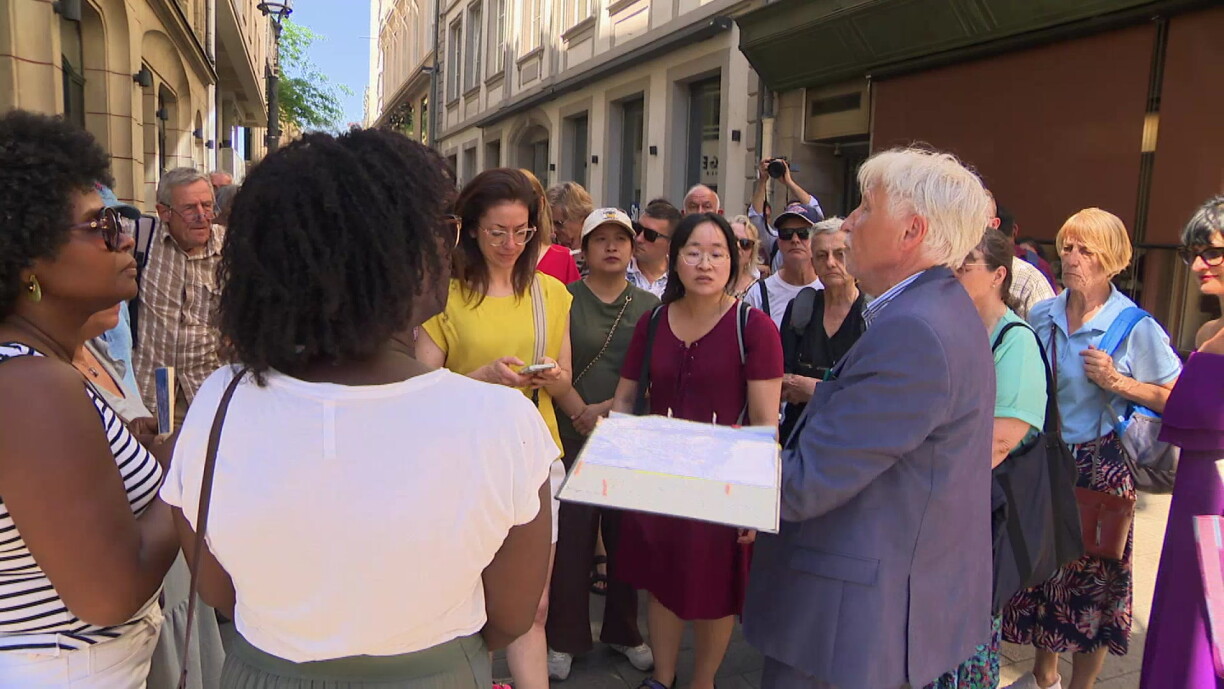
'Demystifying local politics' is a project run by the non-profit Politics For All in the European Union, under which around 50 people, most of them non-Luxembourgers, visited the Chamber of Deputies last weekend. The initiative's aim is to bring the country's national and local politics closer to citizens, for instance through direct, unfussy contact with politicians, who were also invited to the meeting.
Interest from elected officials was almost non-existent, aside from one MP, Marc Lies, who oversaw the Chamber visit, in addition to the sole municipal officer, Antonia Afonso Bagine, who made an appearance. A fact the president of the non-profit, Clara Moraru, regretted.
The tour through the city later proved all the more interesting, however, as concrete examples were used to illustrate the extent to which everyday life in Luxembourg has to adapt to international regulations. The walking tour was put together by historian and UNESCO specialist Robert Philippart, who tailored it to that theme.
Large parts of the city are protected under UNESCO, but the organisation and the convention Luxembourg has signed do not primarily safeguard all that is built. The protection extends to people, with inclusion as the keyword.
To take one example, where the streets of the old town used to be paved, a material would now be chosen that everyone could walk on without falling.
The lights lining the streets were also selected in line with UNESCO criteria, Philippart explained. A little further down the Fleesergaass, beneath the museum, where the Éimaischen used to take place, the aim was to conceal the old electrical boxes.
Many people, Philippart noted, would find them unsightly. Since UNESCO stipulates that intangible heritage, in this case the Éimaischen, should be woven into everyday life, the images from the past were an ideal way to hide the boxes.
The push is for inclusion on one hand, and freedom for all on the other.
Rather than letting poorly done graffiti accumulate, someone was commissioned to paint a piece on the Chemin de la Corniche, which gave the old façade a fresh look. UNESCO, the thinking goes, must take everyone into account, and that includes those who work in graffiti and need outlets for their expression.
The city's initiative has also paid off for the wider public. Since then, the façade on the Corniche has not attracted the attention of any untalented spray-can artist.





