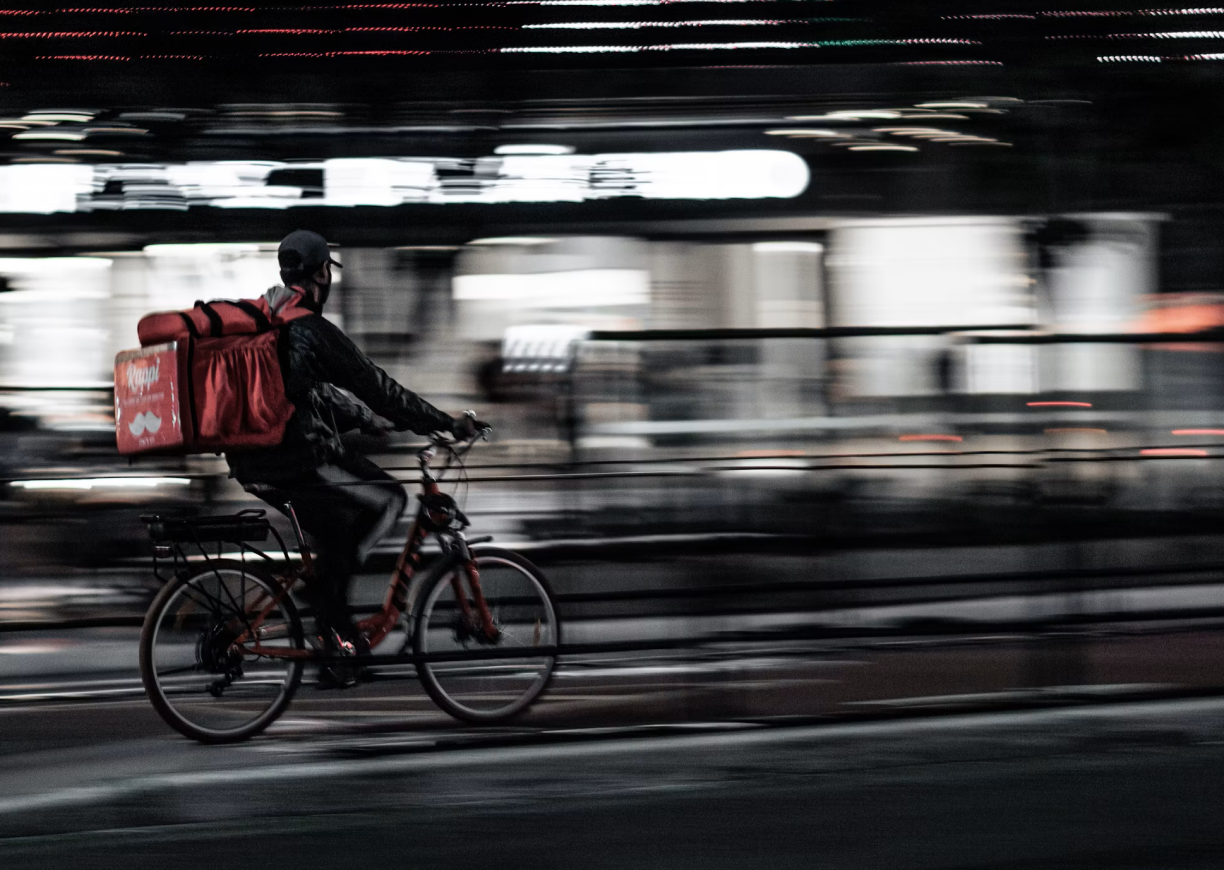
In a report spanning more than 30 pages, the Luxembourg Delivery Workers' Union (ULL) and researcher Salomé Lannier describe a sector that has become essential to daily life, yet one in which workers operate in a state of precariousness, with a lack of clear rights, economic pressure, and the risk of exploitation at every bend.
Their message is clear: the ongoing reform of platform work must at the very least take the reality on the ground into account. They regret not having been asked to join the ministerial discussions on the reform, even though it directly affects their day-to-day lives.
Delivery riders point out that the sector in Luxembourg differs considerably from the picture in neighbouring countries. Many are self-employed, while others work through fleet companies that manage several accounts at once.
Some operate through rented accounts, sometimes because they are unable to open one of their own. Others are asylum seekers who are authorised to work but are turned away by the platforms.
The result is a patchwork of often ambiguous employment statuses, providing fertile ground for abuse, a lack of social protection, and total dependence on platforms or intermediaries.
The report also describes the omnipresence of algorithmic management, with opaque order allocation, variable and undisclosed pricing, automated penalties, account closures without explanation, and pressure to remain logged in throughout the day.
Delivery riders explain that digital systems control their routes, their schedules, and their cancellations, and sometimes even verify their identities through biometric checks.
Many say they do not understand how decisions are reached or why their income drops even as their working hours climb.
Beyond the question of employment status, whether as employees or independent contractors, delivery riders point to a series of concrete issues: a lack of training, verbal or physical abuse from certain customers or restaurant owners, the inability to report incidents effectively, unpaid waiting times, and working days of more than 12 hours, seven days a week.
They also denounce the saturation of the market, with too many riders chasing too few orders, which drives earnings down and pushes some into accepting poorly paid or dangerous deliveries.
The ULL demands a reform that goes further than merely transposing the European directive. Delivery riders want full transparency around pricing, algorithms, order volume, and the number of active riders.
The ULL is pushing for appropriate institutional support, suitable sanctions, a right to disconnect, protection against retaliation, and the option to remain self-employed where that choice is genuinely voluntary.
The union is also calling for the creation of support and training structures, along with a review of how to regulate workers in precarious situations, so that the fight against abuse does not end up punishing the most vulnerable.
For delivery riders, the upcoming reform represents a decisive moment. They are calling on Luxembourg to acknowledge the reality of their work: a vital yet largely unregulated sector, in which worker dignity and safety must be made a priority.





