17 February once again marks an unwelcome milestone for Luxembourg: Overshoot Day. From this date onwards, the country has, at least in theory, used up all the natural resources available for the entire year.
Any resources consumed after 17 February are therefore considered to be used 'on credit' from nature. Luxembourg ranks among the countries with the highest per capita resource consumption worldwide, currently in second place behind Qatar.
There are several reasons why Luxembourg reaches its resource limit so early in the year. On the one hand, the country's generally high standard of living plays a major role. On the other, rapid population growth and the infrastructure required to support it contribute significantly.
Norry Schneider of the NGO Votum Klima explains that Luxembourg's very high living standards, combined with strong population growth, including cross-border commuters, require systems and infrastructure to expand quickly, which collectively results in a heavy environmental footprint.
The Overshoot Day model calculates how much land and how many resources a country needs to sustain its lifestyle, and compares this to what the planet can regenerate in a year.
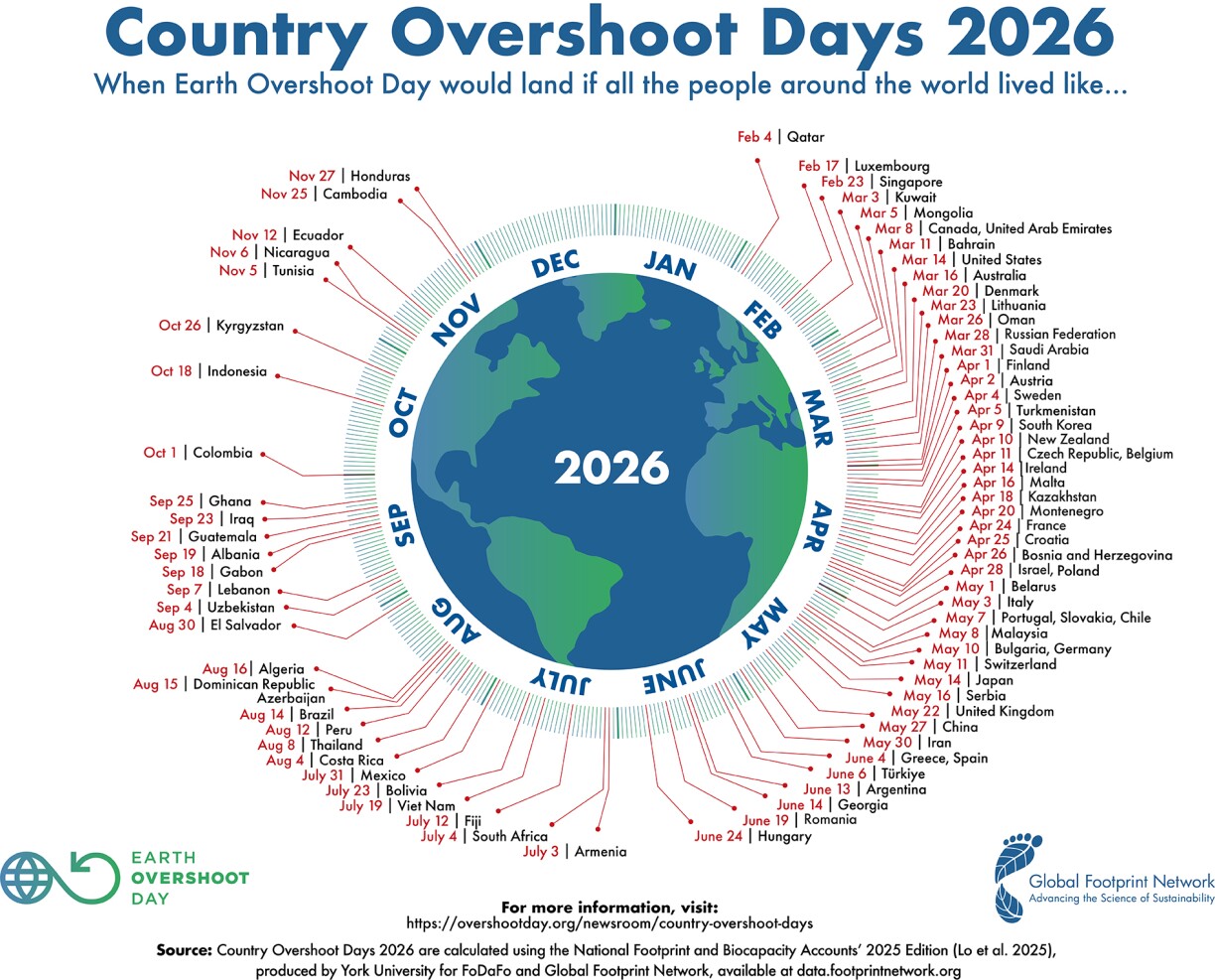
For Luxembourg, the findings are stark. If everyone lived as people do in Luxembourg, humanity would require not just one, but seven to eight planets to meet global demand. This illustrates the scale of the country's ecological footprint per capita.
Schneider argued that such a trajectory is clearly unsustainable. He warned that Luxembourg is not alone in the world and that other countries also have needs, which inevitably leads to resource bottlenecks if consumption continues at this level.
Although the consequences of climate change are not yet as extreme in Luxembourg as in some other parts of the world, changes are already noticeable in daily life, particularly regarding water. Schneider noted that while Luxembourg cannot be compared to countries such as Bangladesh, it is experiencing periods of heavy rainfall in short bursts, leading to flooding, followed by dry spells that put pressure on agriculture.
There are, however, more positive examples within Europe. Countries such as Denmark, Sweden, Finland, and Switzerland have managed to slightly reduce their resource consumption in recent years and push their Overshoot Day further back in the calendar. Greater use of renewable energy, local production, and consistent climate policies have played an important role.
In Luxembourg, by contrast, fuel tourism remains a major contributor to the country's poor CO2 balance.
Beyond mobility, diet also has a significant impact on the ecological footprint, particularly imported food products. Schneider pointed out that individuals can influence this area themselves through their purchasing and eating habits.
While some critics argue that Overshoot Day is overly symbolic and simplifies complex realities, environmental organisations see it as an important awareness tool, not as alarmism, but as a measurable indicator of where improvements can be made. Every day that Overshoot Day is pushed back represents a small gain for the environment, the economy, and future generations.





