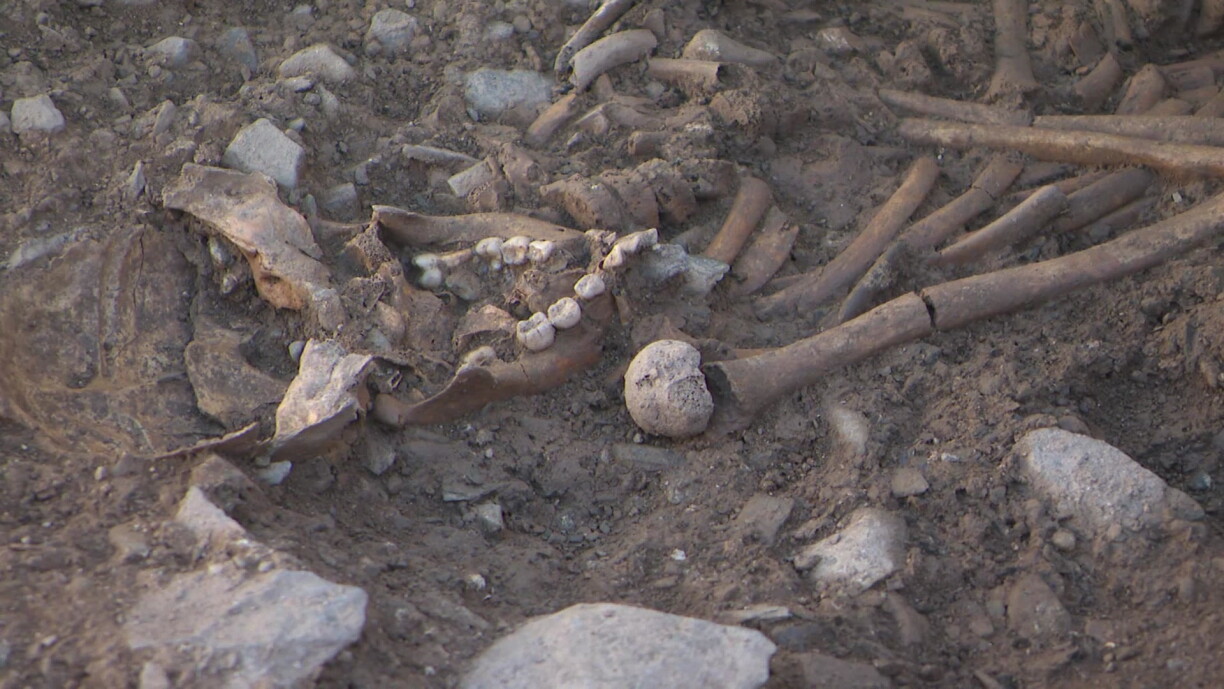
Archaeological excavations have uncovered more than 150 human skeletons beneath a car park in Vianden, where construction of a new youth hostel is underway.
The discovery was made during routine digs prompted by the building project, revealing a cemetery believed to be connected to the Trinitarian Church, which was built in the 13th century.
Minister for Culture Eric Thill visited the site on Wednesday to inspect the findings.
The site first attracted attention in 2021 when workers installing electricity discovered a Gothic window. This led to targeted excavations, with archaeologists shifting focus to the cemetery beneath the Place de la Résistance car park.
Until recently, it was assumed that most medieval remains would have been destroyed during the Second World War.
To mitigate potential losses, precautionary measures were introduced as building works progressed. It soon became apparent that significant archaeological material had survived.
The National Institute for Archaeological Research (INRA) was notified and ordered preventive excavations, which led to the extraordinary find.
Andrea Bischof of the INRA expressed the Institute's surprise at the sheer number of the skeletons found. "Contrary to what had long been believed, the war did not destroy everything on site", she continued.
As a result, work on the new youth hostel was temporarily halted to allow for systematic archaeological digs. Over 150 skeletons have been recovered so far.
Because the individuals were buried without clothing, little is currently known about the exact time periods these remains belong to.


Despite this, anthropologists have already been able to draw early conclusions about the health of the population. Injuries and infections are still visible on the bones.
One particularly moving example, Bischof noted, was the burial of a young child who suffered from a severe sinus infection that had spread to the bone, but it is currently difficult to determine whether that was the cause of death, she said.
At present, the skeletons are being cleaned and subjected to detailed analysis by an external specialist.
Bischof added that, as a matter of principle, samples are always retained for scientific analysis. A new agreement between the INRA and the Catholic Church now ensures that human remains are reburied in a dedicated grave within a cemetery, in line with ethical standards.
Luxembourg’s 2022 Heritage Law has introduced new resources and standards for archaeological excavations. Minister Thill explained that preventive archaeology means carrying out proactive digs before construction begins.
This approach, only recently put into practice, "now sees the state fully covering the costs of such preventive operations".
A team has been working on site in Vianden since January, aiming to complete the excavations before the end of this year.
So far, the cost of the archaeological work is estimated to be in the "several hundreds of thousands of euros", according to the INRA.





