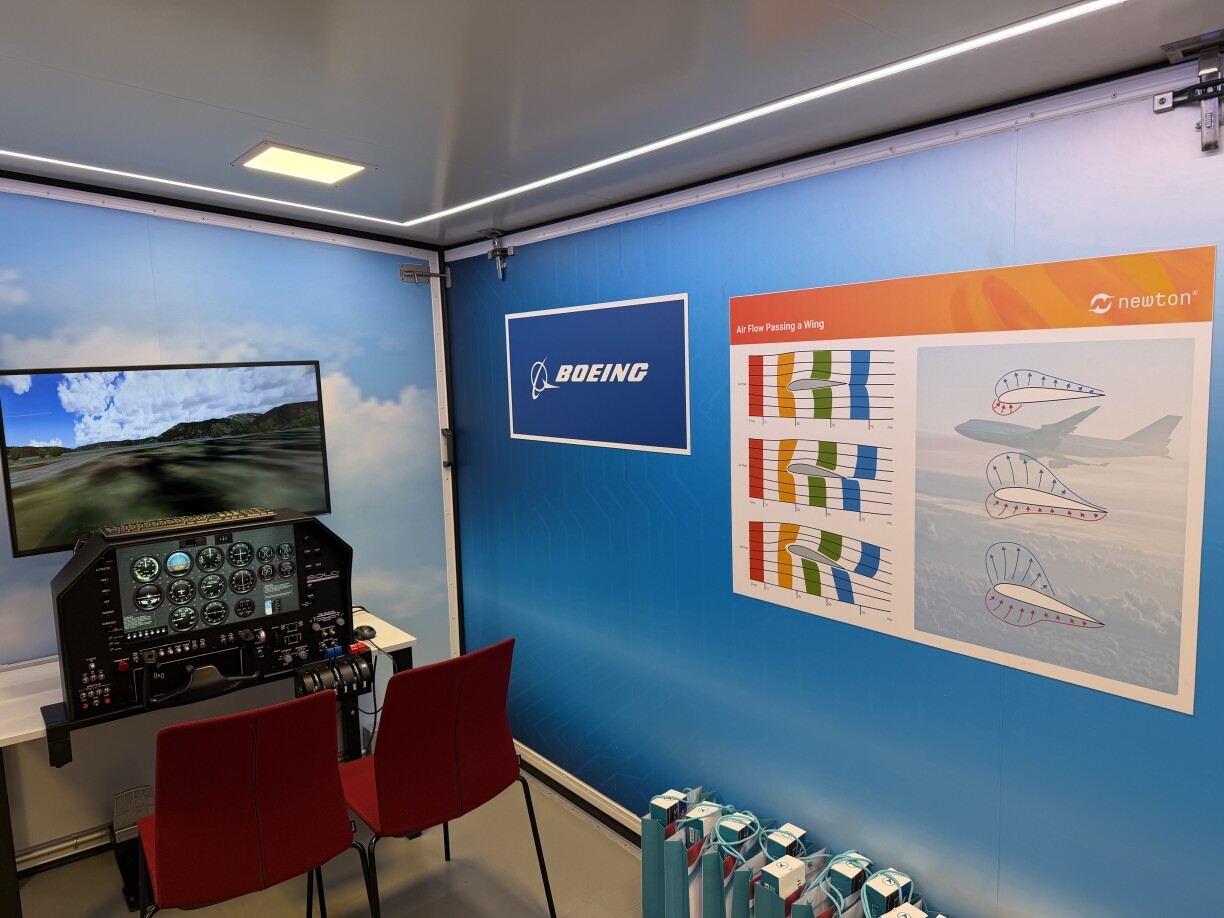
Tucked inside a pair of unassuming containers, a new mobile classroom is bringing science to life for students across Luxembourg. The 'Mobile Newton Room,' a travelling laboratory equipped with flight simulators and digital workstations, aims to spark passion for science, technology, and mathematics through hands-on experience.
Students aged 13 to 16 are using the facility this week to explore aviation, moving from theoretical calculations to practical application. They learn to plan flight routes, calculate distances and speeds, and then test their work in simulators.
For Bhuvi Kothari, a student at the International School of Luxembourg, the visit aligns with her career ambitions. "I'd like to pursue a career in aerospace engineering, and this gives me the opportunity to experience both flying and the theory behind how to calculate flight paths," she said, adding, "It's an experience that is really relevant to what I want to do in my future."
The mobile unit, which can be set up at schools or public venues, features a lab, an amphitheater, and is run by coaches like Philippe Margue from the Luxembourg Tech School. Margue emphasises the direct connection between theory and practice in his lessons. Students learn about nautical miles for distance, knots for speed, and time conversions – all of which they immediately apply in the cockpit simulators.
"Everything we do in the theoretical part has a direct link to the practical part," Margue explained, "Nothing we do is, so to speak, superfluous."
The Newton Room initiative originated in Scandinavia in 2005 and has since expanded to 16 countries. Its core mission is to make STEM subjects, including mathematics, computer science, and technology, more engaging and tangible for students, fostering long-term interest in technical and scientific careers.
According to founder Per-Arild Konradsen, the approach is built on "practical and exploratory education" designed to bridge classroom theory with real-world application. "They have to calculate a flight plan in order to then fly their own flight plan," Konradsen explained. He emphasised the model's adaptability, noting that "everything we do in the Newton concept is linked to the curriculum and can actually be adapted in any school worldwide."
Looking ahead, Konradsen aims to establish the project in every European country. The long-term vision is to create a cross-border network where students can collaborate on scientific projects, learn together, and collectively develop future-ready skills.
For its current stop, the Mobile Newton Room will remain at the Campus Geeseknäppchen near the International School of Luxembourg until 13 February. During this period, it will host approximately 300 students from six different secondary schools in Luxembourg. Following its stay, the mobile lab will continue its journey to Norway.





