While Europe focuses on the EU election results and upcoming parliamentary shake-ups in France, war continues to rage in Gaza. On Wednesday, the Hamas health ministry said the latest death toll was estimated to exceed 37,200, although it is likely to be even higher given the difficulties in confirming the number of victims.
Aurélie Godard, head of MSF's medical activities, gave an exclusive interview on her recent experiences in Gaza and why the exact death toll is so difficult to establish.
"The count is confirmed at the hospital," she says, which means that the number of people buried under the rubble of bombed-out buildings will not necessarily be counted, nor will the victims who died elsewhere. "There are also collateral victims," she explains. "Pregnant women who needed medical intervention or surgery, but were unable to access the hospital and therefore died in childbirth, for example. " The French doctor also highlights the number of sick patients in need of regular treatment, but who cannot access the medical help they so desperately need.
“Unfortunately, we have returned to the Middle Ages of medicine for certain things,” Dr Godard says. She recently returned from her second deployment to Gaza on behalf of MSF. "Hospitals are closing one after the other," she says. "It is a humanitarian disaster."
Residents in Gaza are forced to live in crowded, "abominable" conditions, she describes, and for the most part, do not have access to water or food.
Conditions are only worsening as a result of regular bombings, the displacement of the population, and blockades of humanitarian aid. "Some people had quality tents at the start of the conflict but this is no longer the case, after damage through the winter, and now summer is nearly upon them, temperatures are reaching 35°C already, and it is only going to get worse," says Dr Godard. She says the entire population are in despair and after "eight months of horror", they no longer believe in the possibility of a truce.


"There is a whole generation of children and teens living on the streets, amid the rubble. There are no more schools, no universities, no prospects for the future," Dr Godard laments. The situation will inevitably lead to a brain drain. "And they will not return, which we can completely understand."
The future for those trapped in the Gaza Strip is sombre indeed.
"There's no way out. The wounded aren't even being evacuated any more at this stage. I'm lucky to have a French passport which allowed me to leave. This isn't the case for Palestinians, and indeed, leaving is sometimes harder than entering because we have this impression of abandoning the ship," says a visibly emotional Dr Godard.
She confirms that the Médecins Sans Frontières organisation has suffered human losses in this conflict. This has also been the case for many other humanitarian organisations on the ground. The worst fate remains for ambulance workers who are "all the more exposed" to the bombardments. But in reality, the doctor admits that no one is safe anywhere. Working in a hospital is "not a guarantee of security," she clarifies.
Her comments are illustrated by the recent Israeli bombings targeting a UN school in Gaza. "Wanting to hit a Hamas target is not an excuse to kill all the nearby civilians," she says. On the topic of Israel's military strategy, Dr Godard responds bluntly: "It seems very organised to me in terms of destroying the health system, that is what I see the most. But it also applies to the destruction of factories, farms and schools... it's destruction of civilian targets."
"It's all happening before the world's eyes," says the doctor. "There are international laws, humanitarian corridors, all these mechanisms which are supposed to protect civilian populations, but none of these have worked to date." Although she says she understands Israel has the right to defend itself after the attack on 7 October, she considers this response to be "clearly disproportionate."
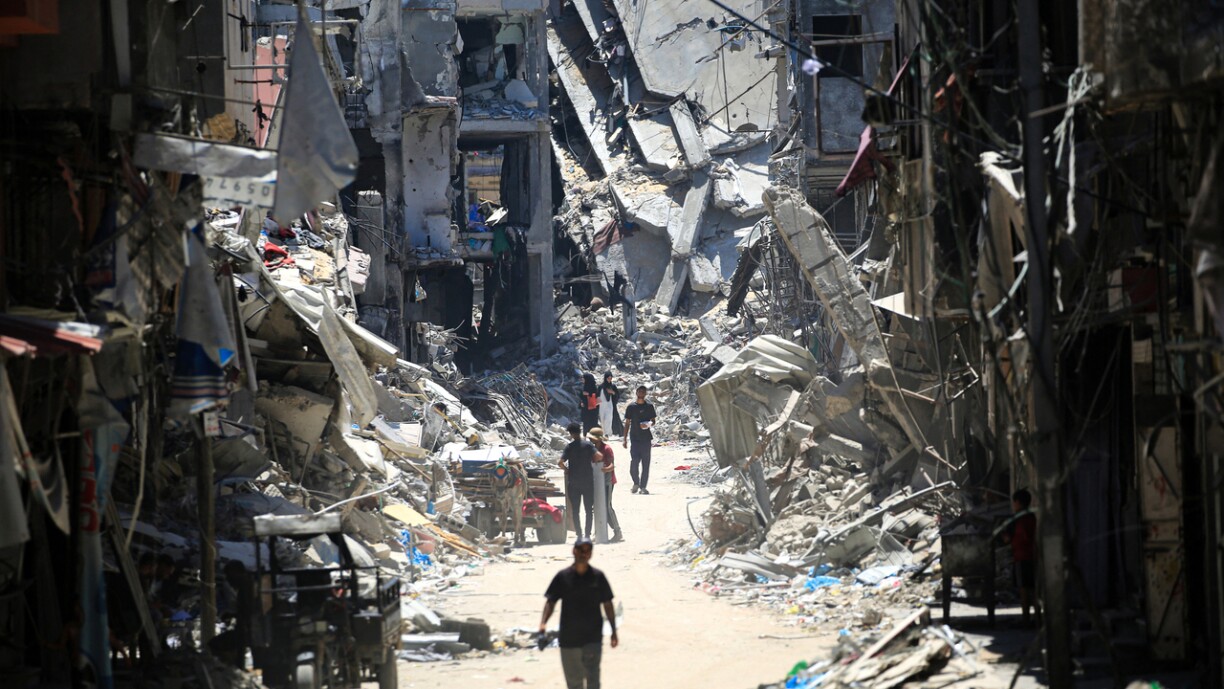
As far as Dr Godard is concerned, "it has to stop". While awaiting a truce, the solution to help civilians seems obvious, she says. "Checkpoints need to be opened and humanitarian aid trucks must be allowed in
On Tuesday, Hamas responded to the ceasefire plan presented by US president Joe Biden on 31 May. The US Secretary of State Anthony Blinken has since announced that some of Hamas' demands were " workable " but that it was necessary to " stop the bargaining " on the truce in Gaza.





