Since then, more and more people are turning to electric cars and the necessary infrastructure is expanding. Luxembourg wants to anticipate the holiday traffic of tomorrow, especially at motorway service stations.
Everyone probably has at least some experience with traffic jams on the road to a holiday destination. Nowadays, electric cars are becoming an increasingly common sight on the road.
Simeon Hagspiel, commissioner at the Ministry of Energy, explains that in recent months and years, they have seen that electromobility is becoming more and more important. The increasing number of electric cars on the roads, Hagspiel continues, is of course something that is also reflected at the service stations.
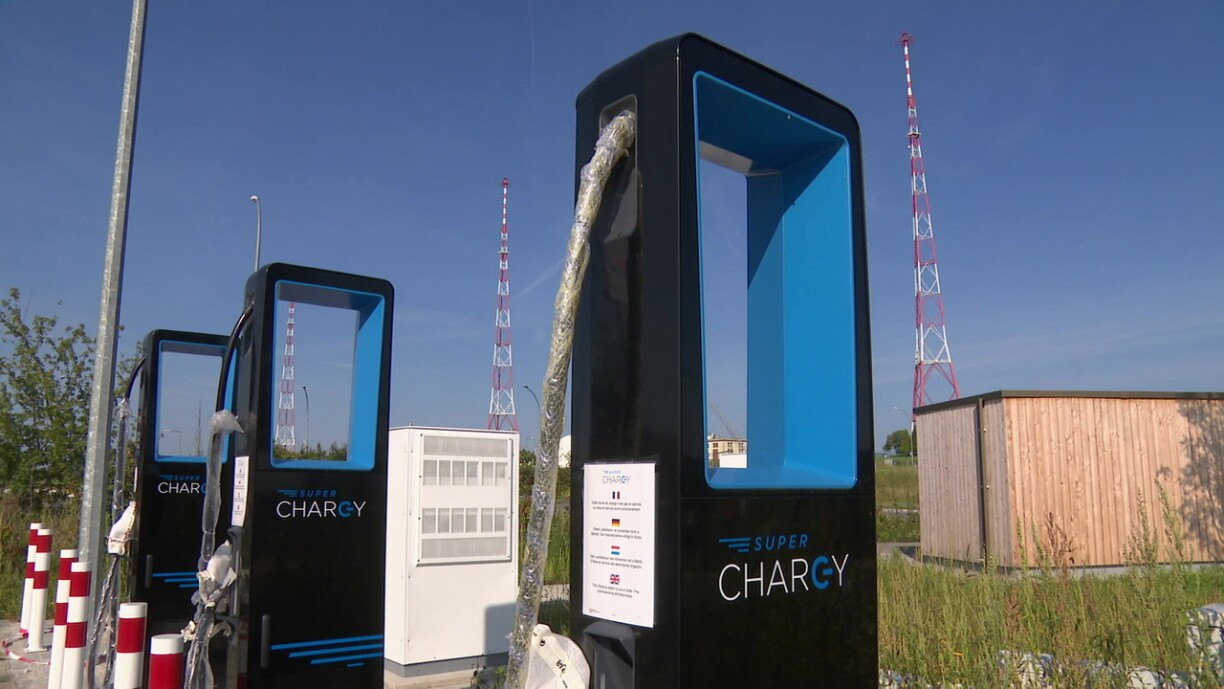
Motorway service stations on major roads are preparing for this development. Creos has been commissioned by the public authorities to install 36 Super Chargy stations (with a capacity of 320 kW). They will become operational between November 2021 and 2023. The first stations will be accessible in November at the Berchem and Capellen service stations, both in the direction of one of Luxembourg's neighbouring countries.
According to Hagspiel, the Chargy system is "very well developed". Consumption is increasing, so it is important that the system is "expanded as planned". In addition, he adds, there are projects by private developers to meet the growing demand.
Minister for Energy Claude Turmes is currently working on a bill that will give private companies and petrol stations subsidies to expand the installation of charging points in the country.
Without such a subsidy, this type of expansion would not be possible at all, according to petrol station operators.
Eric Bleyer, Director of Mobility & New Energies at Total, explains that if the electric car market develops "as is often said", it will be "very complicated". Bleyer points out that on peak days at the Wasserbillig site alone there are "several thousand customers a day". The service station would simply "not be able to cope" with six charging points.
Regarding costs, the charging points are currently not profitable.
According to Romain Hoffmann, Managing Director at Aral, there is "no money to be made" at the moment with the current fleet of electric cars. This also makes large investements "difficult". In Hoffmann's eyes, the "few charging points" that the state is currently installing will "certainly not be enough" if the policy of switching to electromobility is carried out successfully.
Six charging points per filling station theoretically correspond to 288 charges per day. Alternatives will also be installed throughout the country.
Marc Reiffers, CEO of Creos, states that overall, the company his installing 88 Super Chargy stations throughout the country. They will be available at petrol stations, but also in car parks, such as in Junglinster. They will also be installed on the main roads in the north and south. On average, one charging station costs €150,000.
And that is for a lifetime of ten to twelve years. Despite this, it is not planned to increase the prices for charging to pay for the installations.
Reiffers explains that they expect consumption to increase over the years, which would make the financial impact "not particularly significant".
Going on holiday with an electric car will therefore also be possible on Luxembourg's motorways.
With the current plans to extend the charging network, Luxembourg is among the forerunners on the European continent.
The full report in Luxembourgish:





