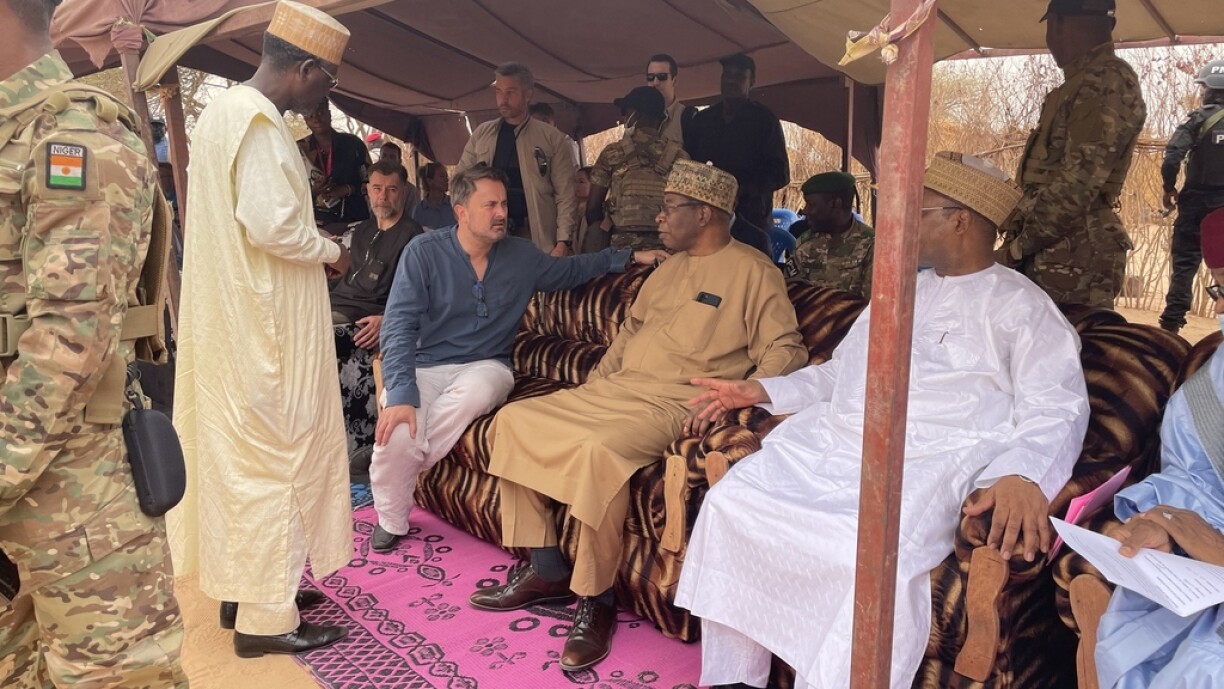
The trip includes stops in two very different countries: Niger, where climate change and Islamist extremism are the two most pressing issues, and Rwanda, which has set ambitious economic goals for itself.
The first stop was in Niger, where Luxembourg has been providing assistance to the country for the past 30 years. The ministers and their delegation were carried by helicopter to Simri, a town 50 kilometres from Niamey, the capital city.
In Simri, Bettel and Fayot visited one of the projects funded by Luxembourg's development aid. The LuxDevelopment Agency has built a hydraulic station next to a school. A water tower that provides clean drinking water to thousands of people. Eric Dietz spent six years as a project manager in Niger, and as a result, he is intimately familiar with this and other similar projects.
Dietz explains that LuxDevelopment has built similar installations across the country, enabling "over 600,000 people" to benefit from clean drinking water. Access to clean drinking water is important to develop other sectors, such as healthcare or education, according to Dietz.
As a result, the country's water supply will receive a substantial portion of the €145 million Luxembourg has set aside for development aid in Niger until 2026. During his visit in Simri, Prime Minister Xavier Bettel stressed that access to water "can solve many other problems".
"Without water there is no life," Bettel declared, pointing out that the absence of water regularly leads to conflicts.
But building infrastructure is just one part of the solution. To ensure that a project is sustainable, local authorities must be entrusted with the responsibility to do the follow-up checks themselves. The government of Niger intends to assume that responsibility, according to the Prime Minister of Niger, Ouhoumoudou Mahamadou.
"We are grateful for this help. It will also allow us to make progress in the area of vocational training," Mahamadou stated.
But Niger still has a long path ahead of it. Farmers often lose entire harvests as a result of climate change, while young people with no hopes for the future are radicalised by Jihadists and become terrorists. All of these different crises are actually interconnected, and they force thousands of people from the border triangle of Mali, Burkina Faso, and Niger to go on the run. Many end up in special camps, such as the on in Ouallam in Niger.
Prosper Zombre, the head of mission for Niger at the Red Cross, explains that Ouallam is "a site where people who are seeking protection from armed groups in their region can find refuge".
Several of these camps are within walking distance of one another. Different Red Cross Offices have worked together under the direction of the Red Cross International Committee to build the centre. The Luxembourg Red Cross has long supplied assistance in the form of infrastructure and know-how, according to Rémi Fabbri, Director of the Department for International Aid.
However, Prosper Zombre points out that the demand far outweighs the offer. "A visit from the Prime Minister emphasises our need for further donations to help more people," Zombre says.
The Luxembourgish delegation will go to Kigali, Rwanda's capital, on Tuesday to participate in an international technology conference, among other things.





