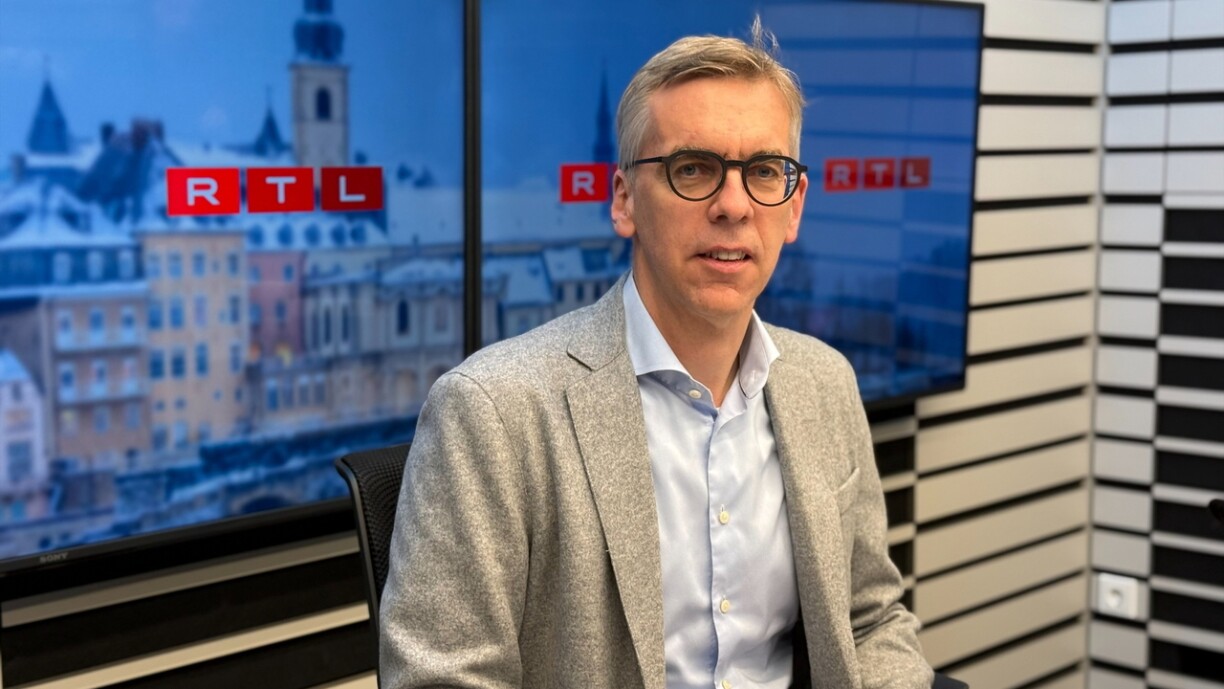
On Saturday, Minister for Home Affairs Léon Gloden of the Christian Social People's Party (CSV) spoke with our colleagues from RTL Radio, addressing a range of pressing issues, from international politics to domestic concerns.
Reflecting on the recent heated exchange between US President Donald Trump and Ukrainian President Volodymyr Zelensky in Washington DC, Gloden admitted, "I almost had tears in my eyes." He emphasised that Europe must now take greater responsibility and defend its strategic interests independently.
When questioned about the controversial begging ban introduced at the start of his tenure, Gloden stood by his decision, stating he would do the same again. However, he acknowledged that the communication around the policy could have been handled better.
The minister also expressed concern about the political shifts in Luxembourg's neighbouring countries, where right-wing populist and even far-right parties are gaining influence and, in some cases, joining governments. Gloden attributed the resilience of Luxembourg's political centre to the Grand Duchy's targeted social policies, which he said effectively support those in need. He defended the government's stricter asylum policy, rejecting opposition claims of authoritarianism. Instead, he described the approach as a balanced decision guided by "heart and reason."
Gloden voiced worries about the growing scepticism toward democracy among Luxembourg's population. He stressed that it is the responsibility of politicians to demonstrate that democratic systems can effectively address people's concerns. To foster greater trust, he advocated for increased public involvement in local community projects and decision-making processes.
On the topic of public security, Gloden called for a balanced approach that considers both factual data and public sentiment. He criticised the opposition's stance on the issue as "overly theoretical". Regarding the Gare neighbourhood in Luxembourg City, the minister acknowledged rising crime rates and announced plans for a new conference focused on drug-related issues. His ministry is currently developing "concrete solutions," with increased police patrols – many involving plain-clothes officers – already in place. Gloden emphasised that while the police are "part of the solution," they cannot address the challenges alone.
Minister Gloden proposed a social version of the Emergency Medical Assistant Teams (SAMU) as part of the solution to address the needs of homeless individuals and those in social emergency situations. This initiative would provide outpatient medical care to vulnerable groups.
Meanwhile, the government is drafting a bill to expand police powers, allowing officers to remove individuals causing disturbances from public spaces ("Platzverweis"). Gloden explained that the draft legislation would cover three specific scenarios: causing disturbances in public areas, begging near traffic lights, and harassing others on pavements. While the Council of State has raised six formal objections to the bill, Gloden expressed confidence that these issues can be resolved, despite disagreeing with the council's legal assessment.
Regarding the use of a private security company in Ettelbruck, Gloden clarified that the local police station will be expanded in the coming months. He noted that the mayors of Ettelbruck and Dudelange support his approach to enhancing public safety.
Two pilot projects involving local police forces are currently underway in Luxembourg City and Esch-sur-Alzette. Another initiative, focusing on rural areas, is set to launch in the Moselle Valley region by mid-2025. Gloden highlighted that 80% of current police work is reactive, with only 20% dedicated to preventative measures. He aims to reverse this ratio, envisioning a police force that is seen as "good neighbours" by the public. To support this shift, body cameras will be introduced, followed by the unveiling of a new, more colourful police uniform designed to foster a friendlier image.
Minister Gloden expressed strong criticism of the border controls between Germany and Luxembourg, stating that they are negatively affecting the quality of life for cross-border workers. To address this issue, Gloden revealed that he has proposed bilateral agreements with both Germany and France to regulate procedures for individuals ordered to leave a country. According to Gloden, Luxembourg's decision to file a complaint against the border controls has "made an impression" on both Germany and the European Commission.
Immigration was another key topic during the interview. Gloden emphasised the need for stronger protection of the EU's external borders and more efficient deportations of individuals who do not have the right to stay. He noted that Luxembourg is "on the right path," pointing out that the number of deportations has nearly doubled, rising from 278 to 450.
Regarding Syrian nationals, Gloden explained that their cases have been temporarily put on hold due to the "unclear" security situation in Syria. He stated that processing cases of those who fled the Assad regime under current conditions would, strictly speaking, result in rejections. Meanwhile, the minister highlighted a "massive" decline in the number of Afghan refugees, with only 49 recorded in 2024.
Gloden clarified that he does not support deportations for minor offences, such as "stealing two bottles from a supermarket." However, in cases of more serious crimes, such as stabbing attacks, deportation remains an option. He acknowledged the challenges of repatriating individuals to their countries of origin, noting that the European Commission is exploring partnerships with third countries to address this issue.





