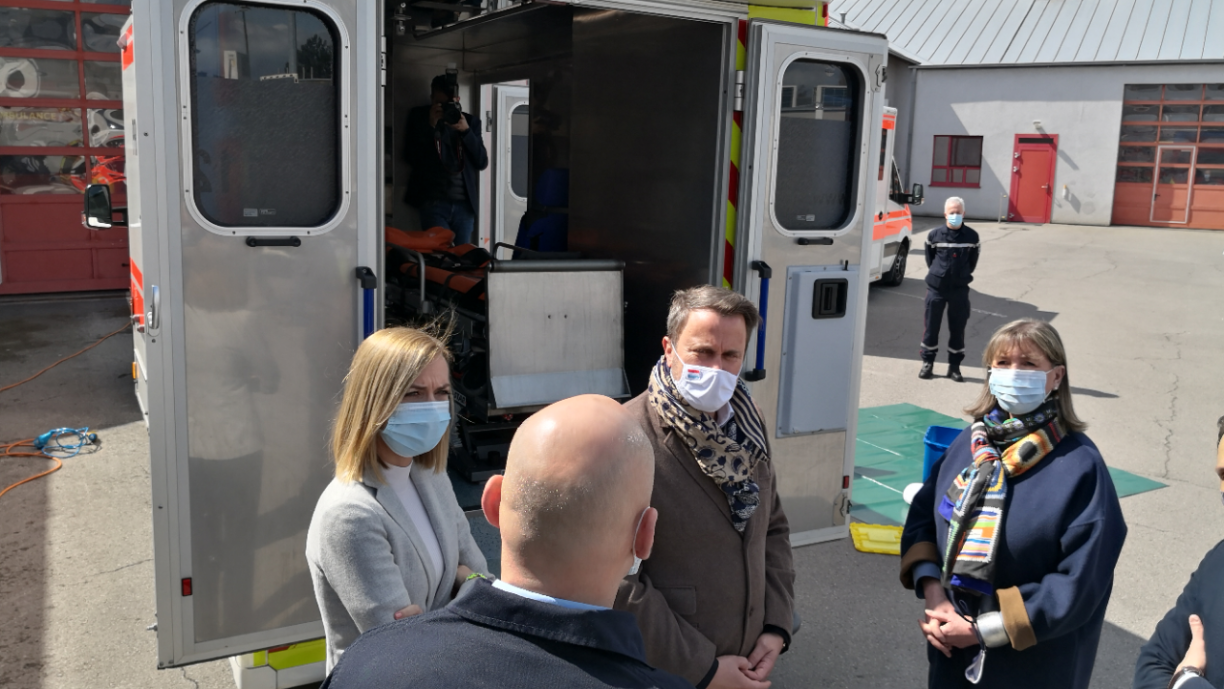
Minister for Home Affairs Taina Bofferding recently presented the 500-pages long "National Plan for the Organisation of the Emergency Services". Among other objectives, the plan stipulates that the Grand Ducal Fire and Rescue Corps (CGDIS) should be able to reach the site of an accident within 15 minutes, no matter where it occurs in the country.
On Wednesday morning and on the request of the Christian Social People's Party (CSV), MPs in the Chamber of Deputies held a briefing on the current situation. Funding was among the topics discussed.
When the plan was first presented a few weeks ago, Bofferding had stressed that civil security could not be guaranteed "for free". CSV MP Marc Lies questioned the contribution of the municipalities, stating that rough estimates set the cost between €100 and €150 per resident. Costs are supposed to be divided equally between the state and the municipalities, with each paying 50%. However, Ries pointed out, in practice, this is not the case. The MP explained that in the eyes of Syvicol, municipalities have to shoulder increasing financial burdens, even though the CGDIS is a public institution and falls thus under the responsibility of the state.
Bofferding stated that while she can understand the plight of the municipalities, some of whom face significant financial difficulties as a result of the pandemic, she also thinks that discussions surrounding "such an important topic" should not be solely focussed on funding.
The Minister made it very clear that she has no intention of changing the distribution key, i.e. the "big principal" that state and municipalities equally divide part of the budget. Bofferding also pointed out that not everything is being equally divided, with the state funding 100% of emergency doctors, airport emergency services, and international missions. If everything is taken into account, the municipalities' contributions make up around one fourth of the total budget, she explained.
Nevertheless, the Minister added, further negotiations with the municipalities, and in particular with Syvicol, are to be scheduled.
The decision to move the first responder unit Lëtzebuerg 2 from Hesperange to the new national operations centre at Cloche d'Or also drew criticism, mainly because there allegedly is a consensus that the unit "works perfectly" from the Hesperange location. However, the Minister wants to uphold this decision as well, leading CSV MP and Mayor of Hesperange Michel Wolter to express his bewilderment. Wolter argued that if the unit already meets "the goals of tomorrow today", then it should just be left as it is, with Wolter pointing to the principle "never change a winning team".
MPs across party lines stressed the important role of volunteers in the emergency services. Bofferding promised that they will be offered "the best possible conditions".
In 2020, around 500 new volunteers joined the CGDIS.
Regarding recruitment, a national strategy is to be put in place which will include the launch of a new campaign. Bofferding stated that an increased emphasis is to be placed on encouraging women and non-Luxembourg nationals to join the CGDIS.





