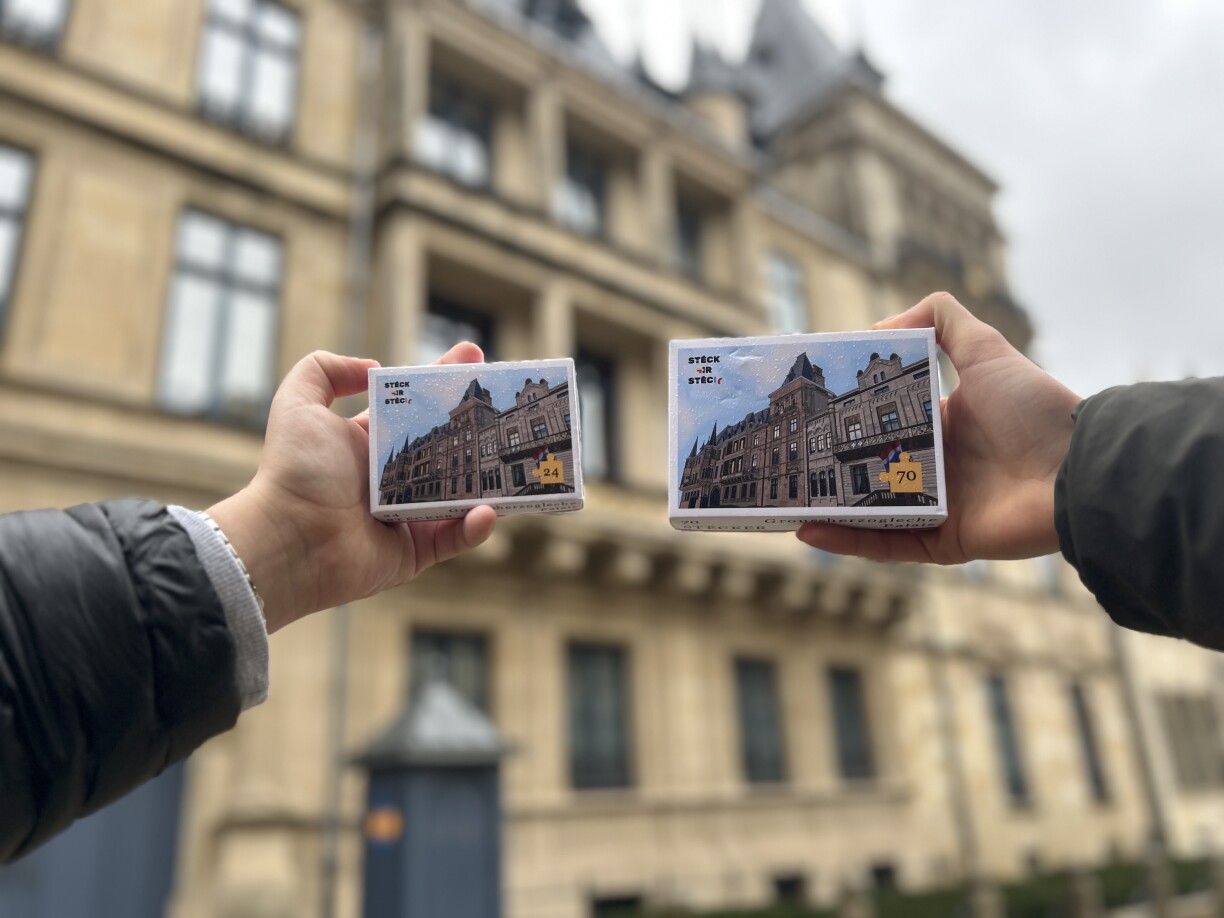
At the Lycée Michel Lucius, a group of students are running a "Mini-Enterprise" called Stéck fir Stéck ("Piece by Piece"). Part of the Young Enterprise Project, an initiative which aims to give young people their first real step into the business world.
Stéck fir Stéck produces puzzles that celebrate Luxembourg's most recognisable monuments. The choice of theme was a deliberate one. "We came up with the idea of making puzzles simply because we can show our monuments to very young children in a playful way," explains student Samuel Bost. Preserving culture while making it accessible was at the heart of the concept from the very beginning.
The puzzles currently feature three motifs: the Golden Lady, the Grand Ducal Palace and the Cathedral, with the Casemates set to become the next addition. The students receive weekly classes covering various aspects of running a business, from management to marketing, supported throughout by their teachers.
The students initially considered using AI to generate the puzzle images, but ultimately chose a different path. With the help of their teachers, they connected with Liz Kuffer, a student from the art section at the Lycée Michel Rodange. A social dimension has also been woven into the enterprise as with every puzzle sold, the students donate €1 to Unicef in support of children's aid.
The puzzles are produced at the studio of Kräizbierg Foundation in Dudelange, where Sebastian Morth oversees the printing process. The finished motifs are sent to the studio with precise measurements, and the workshop handles both small projects like the students' "Mini-Enterprise" and larger commercial orders.
Each puzzle is priced at €13, with 64% of the revenue going to the Kräizbierg studio. While a share goes to the artist, the remainder is divided among the students at the end of the year.
For Laura Schmidt, who works with people with disabilities at Kräizbierg, the partnership brings something genuinely different to the workshop floor. "It's a completely different approach, but it can also be really nice," she says.
Since 1977, Kräizbierg foundation has placed great emphasis on enabling people with disabilities to work as independently as possible. The goal is to assign each person tasks they can carry out on their own, offering training and placing special focus on developing personal skills.
The students are not planing on stopping here. David Loschetter, who handles marketing for the mini-enterprise, is open about where he hopes this leads. "Our big goal is for it to become a real company," he says. "We are still at the beginning, but we hope it grows into something much bigger."
Stéck fir Stéck - discovering Luxembourg piece by piece. And if these students have their way, this is only the start.





