There is no actual village called Kiischpelt. The name refers instead to the whole stretch of territory lying roughly between Wiltz in the west and Clervaux and Hosingen in the east. The word "Kiischpelt" comes from the German word "Kirchspiel", a reference to the former parish of Pintsch. Around 1,300 people live in the municipality today, spread across seven villages and 33.5 square kilometres.
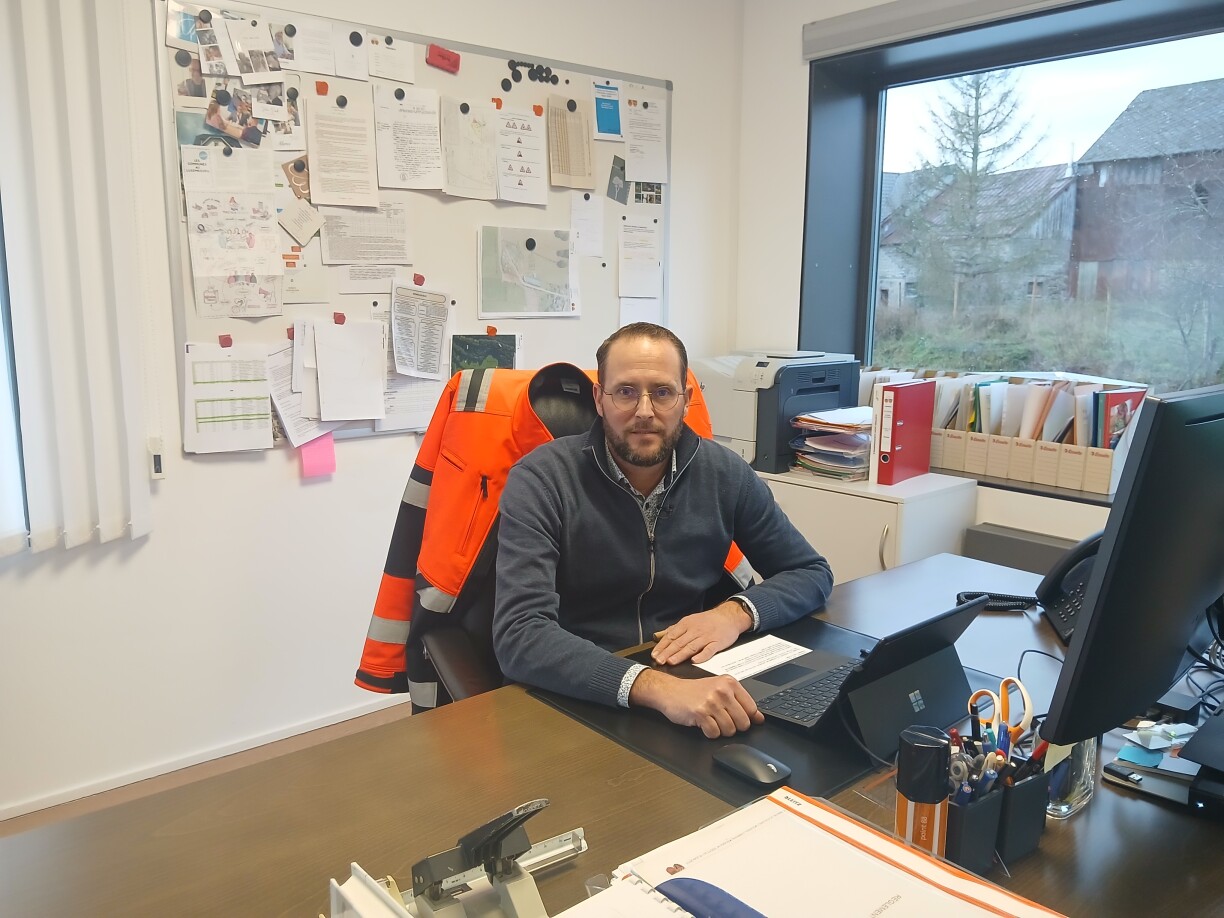
Kaiser, a native of Kautenbach, has served as mayor since 2017. He first stood for election in 2011, when he received the highest number of votes on his first attempt. At that time, elections were still held in two sections, as Kiischpelt had only recently been created through the 2006 merger of Kautenbach and Wilwerwiltz. Kaiser recalled that the then-mayoral council encouraged him and a colleague to run because they were already active in local associations. He admitted, however, that he had not expected such an immediate result.
The mayoralty nevertheless remained in the hands of Armand Meyer, who stepped down from municipal politics in 2017 after an unprecedented 42 uninterrupted years in office, a national record. Kaiser said he learned a great deal from Meyer about how municipalities operate.
Kaiser works for the State and is pleased that taking political leave has never been an issue. He also said he does not feel his political role causes him to miss out on important work-related matters. Kaiser is a member of the Democratic Party (DP) but stressed that with a majoritarian voting system, party politics plays virtually no role in Kiischpelt.
Although Kiischpelt is a merger municipality, it remains one of the smallest in Luxembourg in terms of population. The administration employs six people and the technical service seven. Even so, Kaiser sees no need for another merger in the foreseeable future. In his view, Kautenbach and Wilwerwiltz had come together naturally, not artificially, since children from Kautenbach had long been attending primary school in Wilwerwiltz, at the 'Schoulkauz'. A future merger would require pairing with a far larger partner, he said.
Kiischpelt borders Bourscheid, Clervaux, Goesdorf, Parc Hosingen, and Wiltz.
The broader discussion around municipal mergers is driven both by the increasing number and complexity of tasks municipalities must shoulder and by the financial challenges faced particularly by small rural municipalities, with Kiischpelt being no exception.
At present, Kiischpelt's per-capita debt remains manageable at around €1,900. Despite regularly setting money aside in past years, Kaiser said the municipality will not be able to avoid further borrowing. Over the next decade alone, around €19 million will need to be invested in wastewater management.
In that context, Kaiser is relieved that municipalities have, for several years now, been permitted to build shared wastewater treatment plants serving multiple localities. Such cooperation often extends across municipal boundaries.
In Lellingen, for instance, a plant is planned that will serve the four villages of the former municipality of Wilwerwiltz as well as two villages from Clervaux. Kaiser explained that a single larger facility, housing the same technology that would otherwise be spread across several smaller units, saves both construction and maintenance costs.
Wastewater, however, is not the only priority. The creation of affordable housing is also a key issue in Kiischpelt. Since 2018, Kiischpelt has developed land for 25 affordable units.
Kaiser said that another location where the municipality would like to create housing, but cannot, is the so-called 'Sproochenhaus' ('Language House') in Wilwerwiltz. The State acquired the building in 2016 under the condition that it must be used for educational purposes.
A project involving the Ministry of Education and the Lycée Edward Steichen in Clervaux was once envisaged, but nothing has happened since, and no one can say whether the project has been abandoned or simply delayed. Kaiser admitted that it is frustrating that the State neither uses the building nor allows the municipality to develop its own project there.
One place where housing will be built is the site of the former vehicle inspection station. For many years, Wilwerwiltz and its inspection site played the same role in the north that Sandweiler and its site plays in central Luxembourg.
In 2020, however, the new inspection station opened in Marnach and the Wilwerwiltz centre closed. From the outside, little seems to have changed, but looking through the windows one can see that the municipality now uses the site for storage. The land belongs to Kiischpelt and is classified as a new housing district in the general development plan (PAG). Construction, however, will not begin until other projects are completed, Kaiser said.
The relocation of the inspection station significantly reduced car traffic through Kiischpelt, especially from Hosingen. Rail transport still plays a central role, with stations in both Kautenbach and Wilwerwiltz used by commuters from the wider region, according to Kaiser. He added that train frequency is good, with services every 30 minutes in each direction. Regarding the often-requested upgrade of the northern railway line, Kaiser is rather cautious.
In August 2022, the Schieburg tunnel, located within Kiischpelt, partially collapsed, causing severe disruption to public transport in the north of Luxembourg. Repairs took almost a year, which triggered heavy criticism. Kaiser said he does not believe the works would have finished any sooner had the incident occurred in central or southern Luxembourg.
As for the level crossings in Enscherange, Kautenbach, and Wilwerwiltz, Kaiser does not expect them to disappear anytime soon. The national railway company CFL aims to eliminate as many above-ground crossings as possible, but, according to Kaiser, this is difficult in Kiischpelt because the crossings lie in the middle of villages and near watercourses, making flood safety a concern.
At Merkholz, trains stop on request. Kiischpelt considered installing a bus stop there, but that would require a proper platform, for which there is no space. Kaiser said he would welcome a clearer distinction between urban and rural contexts when such decisions are made.
Kiischpelt is highly rural, and job opportunities are limited. According to Kaiser, creating an industrial zone or a trading estate is difficult, as the valleys carry a risk of flooding, while the hilltops lack good transport connections. Only around 3% of the municipal territory lies within the construction perimeter. Most of the territory is classified as green zone, and three-quarters of that is under environmental protection. It is therefore unsurprising that the municipality bets on tourism as a key economic drive.
Hotels and restaurants, for example in Kautenbach, face tougher conditions today than in the past. Kaiser said this is partly because residents go out for drinks together less frequently, particularly during the week.
For many years, Kiischpelt was a hotspot for "Louschläissen", the tradition of removing the tanbark from young oak trees. Today, this practice is no longer common, and the traditional Louschläissen festival has not been held for around 15 years. Kaiser said he has heard talk of reviving the event, which he deems as fitting given that this practice was added to UNESCO's list of intangible cultural heritage this year.





