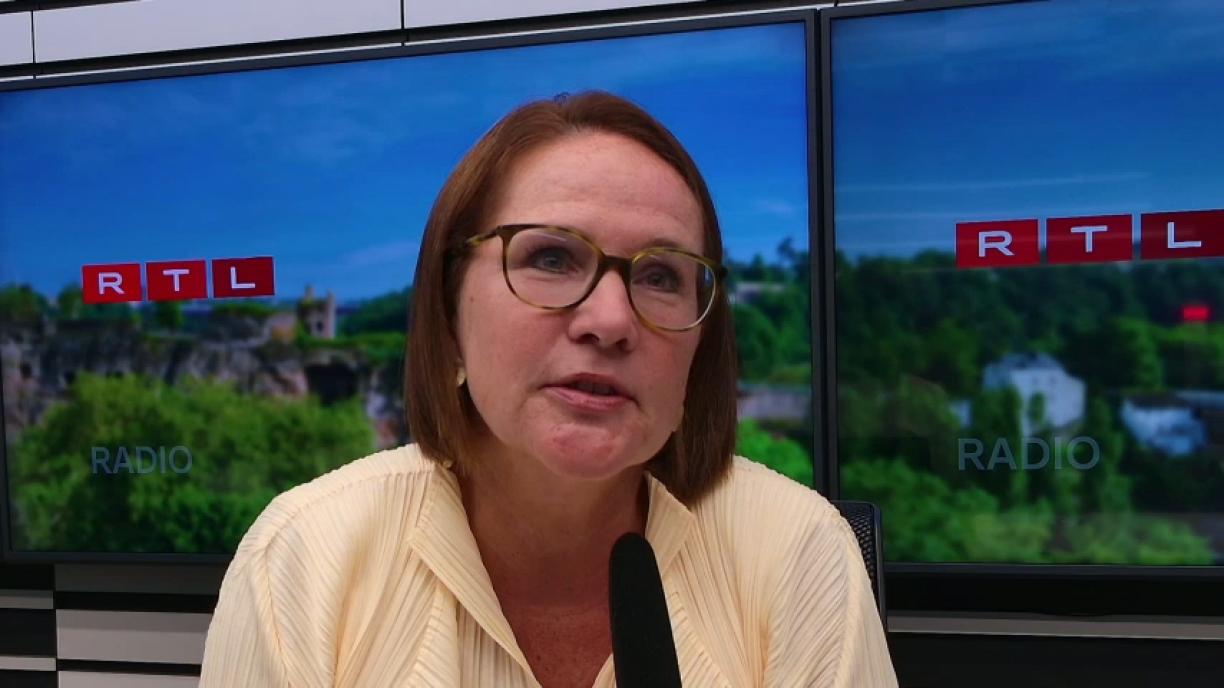
Minister for Mobility Yuriko Backes confirmed that improvements to the train connection between Luxembourg and Brussels, often labelled the “Bummelzuch” (slow train) due to its three-hour journey time, will not arrive as soon as hoped and instead will only be ready in 2031.
Following her meeting with Belgian federal transport minister Jean-Luc Cruchten, she recalled having signed a letter of intent a year ago with her Belgian counterpart, aiming to motivate Belgian stakeholders to finish the works – potentially by 2029. However, she conceded that yesterday's meeting clarified that that is really very unlikely, with 2031 now the best-case scenario for reducing travel time to about two hours and ten minutes between Brussels and Luxembourg.
Backes also addressed Belgium’s planned motorway vignette, a toll system that could impact cross-border commuters. She stressed that an official draft from the Walloon region or elsewhere has not yet been received. Despite repeated requests and having already raised the issue with Belgium’s federal government, she said that she would have hoped for a more "proactive dialogue" from the Walloon region. Backes noted that the only recent change is the negative opinion issued by the Social and Economic Council of Flanders (SERV) regarding the vignette, which she said she would examine more closely.
She also expressed concern over the potential impact on commuters, saying Luxembourg would prefer to see a "special zone" exempting cross-border workers from the vignette, to avoid discouraging people from crossing the border or pushing them to use side roads through small villages.
With the start of the school year approaching, Backes acknowledged expected road congestion and emphasised the complexity of improving mobility in Luxembourg. Backes explained that a paradigm shift, focused on multimodality, has already begun, referring to the National Mobility Plan 2035, which aims to give people more choices between private and public transport.
She pointed to the tram as a "real success story", noting the significant increase in users and ongoing investments such as the new tram depot and tram network extension. New rail projects, including the planned station at Hollerich and the Bettembourg-Luxembourg line, will also help, especially for cross-border workers. Nonetheless, such large, complex projects cannot be completed overnight, she acknowledged.
Asked about forecasts that predict 86,000 more cars by 2035, Backes put this in context, explaining that since the last survey for the national mobility plan nine years ago, Luxembourg has 90,000 more residents and about 50,000 more cross-border workers. She announced that the results of a new mobility survey, Luxmobil 2025, carried out last year, will be presented in September and will serve as the basis for the next national mobility plan.
Backes insisted that continuing to invest in expanding both roads and public transport, including carpooling infrastructure and cycle paths, remains essential. She stated the key is to give people as many options as possible, so they can easily switch between modes of transport, adding that people will use public transport if it is “modern, efficient, and comfortable”.
The discussion also touched on whether Luxembourg City should consider a full ring road or even a third lane on existing motorways. Backes said she had discussed the idea with municipal officials but acknowledged that new roads also naturally attract more traffic. Moreover, building new ring roads or bridges over historic city quarters is not a viable solution, also because it would mean significant encroachment on areas like Bambësch and Gréngewald. Instead, she suggested continuing efforts to get people into the city and on to their workplaces as comfortably as possible, stressing the role of further tram expansion and a high-performance bus network.
On the issue of lengthy construction works, such as those on the Dudelange motorway, Backes reassured the public that delays are not deliberate. For large and complex projects, like the A3 motorway expansion, work is done while traffic continues to flow, and safety must always be respected, which explains why certain construction work might take longer to finish.
Backes concluded by underlining the importance of long-term infrastructure investments and warned that what would really cost Luxembourg dearly would be the "investments we do not make, or those we make too late", which would have negative consequences for the country, its people, and its economy.





