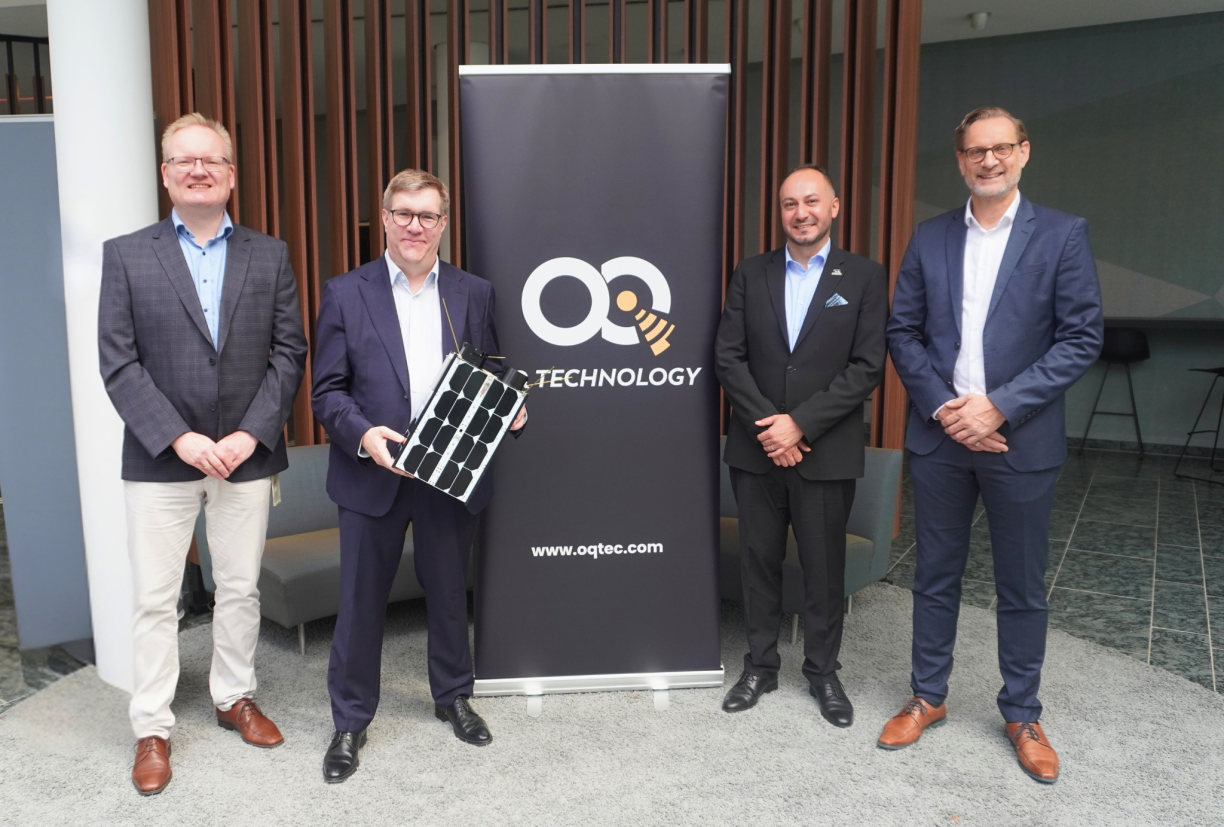
Mobile connections beamed in from space look set to be a key piece of the future of communications. While most minds turn straight to Starlink, the US company owned by Elon Musk, a Luxembourg firm is also carving out a place in this market with Luxembourg's OQ Technology and Telefónica Deutschland joining forces on mobile phone communications via satellite.
OQ Technology has signed a major contract with Telefónica Deutschland, the parent company of O2, with the first tests due to be carried out early next year. The purpose of the tests is to use the Luxembourg firm's technology to plug the gaps in O2's network. OQ relies on satellites but plans to operate over the standard mobile phone frequency wherever its technology is deployed.
Starlink, by contrast, uses the substantially more expensive Mobile Satellite Service (MSS). That system only works if customers carry MSS-compatible phones, which cost considerably more than ordinary smartphones. It will still be a few years, however, before either system, the Grand Ducal or the American one, is running in Germany's market. Both fall under so-called direct-to-device satellite communication.
Beyond bridging coverage gaps, the system is also designed to keep communications open during disasters such as major power cuts or extreme weather, at least in one direction via the satellite link. That would allow an operator such as O2 to push warnings or messages to a customer even when there is no signal.
OQ Technology, headquartered in Leiden, currently has five satellites in space, with three more to be added this year. Each satellite is roughly the size of a shoebox and can at present send out warnings, though they do not yet allow two-way data traffic, such as a chat between users. According to founder and CEO Omar Qaise, that should change with the next generation of satellites next year, by which point the company aims to have 48 in orbit. With that fleet, he said, an area on Earth could be covered by a satellite every 30 minutes.
Qaise told the DPA news agency that when Luxembourg's mobile network went down after a cyberattack last year, residents had been unable to communicate by mobile for an entire day. In hindsight, he said, it would have been a great help to have a connection available at least every half hour.
By 2029, the plan is to have 150 satellites in space, which would make permanent coverage possible, even with more data-intensive use. OQ Technology wants to allow not just text or voice messages but, in theory, full video to travel over its system. According to Qaise, this extra coverage is more about fulfilling users' basic communication needs, not necessarily the possibility to stream videos while out on a forest walk. Live video transmission is, for instance, valuable for applications such as drones, which is currently in strong demand, and the tests with O2 are intended to show that it works.
A small Luxembourg company with five satellites in orbit is setting out to compete with Starlink, which has around 10,000 in space. For Qaise, the advantage lies elsewhere, namely in OQ being a fully European company operating from Europe with its cloud services based in Europe. US cloud providers, he noted, are obliged to hand data over to American authorities, which is not the case in the EU.
For him, it is therefore clear that Europe must build a sovereign space-based mobile communications infrastructure. This is what the tests with O2 are meant to demonstrate, alongside the technical proof that a link between satellites and ordinary mobile phones, over the standard mobile frequency, is achievable.





