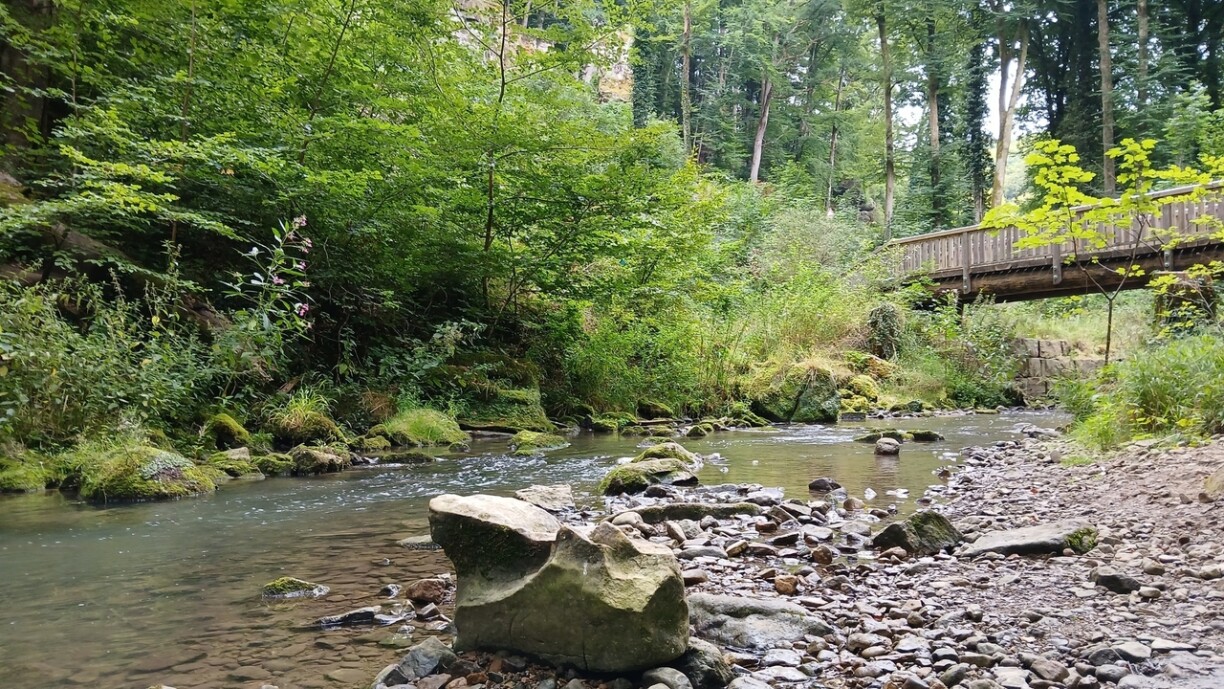
Luxembourg’s drinking water reserves are currently well filled, both in the Upper Sûre Lake and in groundwater, each of which supplies about half of the country’s drinking water. While some may believe this has to do with this year's wet July, it is in fact because of the last two winters, during which above-average rainfall was recorded.
However, looking to the medium- and long-term, shortages could arise from 2040 onwards if water consumption were to spike suddenly. To avoid this, the government is relying on three pillars, one of which involves tapping into new resources. Therefore, from 2040 onwards, water from the Moselle is set to be treated for drinking purposes.
Technically, this is possible, but as Tom Schaul – working on water management at the Ministry of the Environment – explained, there are also a number of constraints involved.
"A treatment facility of this nature requires a lot of space, because the water has to be treated, unlike spring water. The quality of the water must be examined very carefully in order to determine the technology needed to treat it. The method of transporting the water to the population must also be taken into account, because if we take water from the Moselle, it is not yet available at the tap, which means that pipes will also have to be built."
Due to the amount of space the facility will take up, it will be built on the southern part of the Moselle. However, before exploiting additional resources, existing reserves must first be protected. Luxembourg's current water quality is very high, according to Schaul:
"Luxembourg ranks third in terms of drinking water quality. This means that we are among the leaders in Europe. This is also due to the large number of analyses we carry out: In Luxembourg, drinking water is the most closely monitored foodstuff and 99% of the analyses carried out are up to standard."
Aiming for high water quality standards is not only important for human consumption but also for nature's well-being too. The third pillar of sustainable supply is responsible management of drinking water. Drinking water is not only used for food, but also for washing the car or watering the garden, for example. The aim here is to encourage people to use rainwater instead, but this will not be enough.
"The use of rainwater is already financially encouraged, and we want to expand this in the future. Then there are also opportunities to save tap water, for example by reducing the flow rate. Raising awareness is essential, especially among the younger generation. The Water Management Authority is very active in schools, with exhibitions and awareness campaigns."
As far as industry is concerned, there is speculation throughout Europe as to whether data centres could be cooled with much less water, or even without water, in the future. New technologies could also represent an opportunity for the economy.
The Ministry of the Environment also examined whether building a new reservoir similar to the Upper Sûre Lake could be an option. However, it concluded that this would not be feasible.






