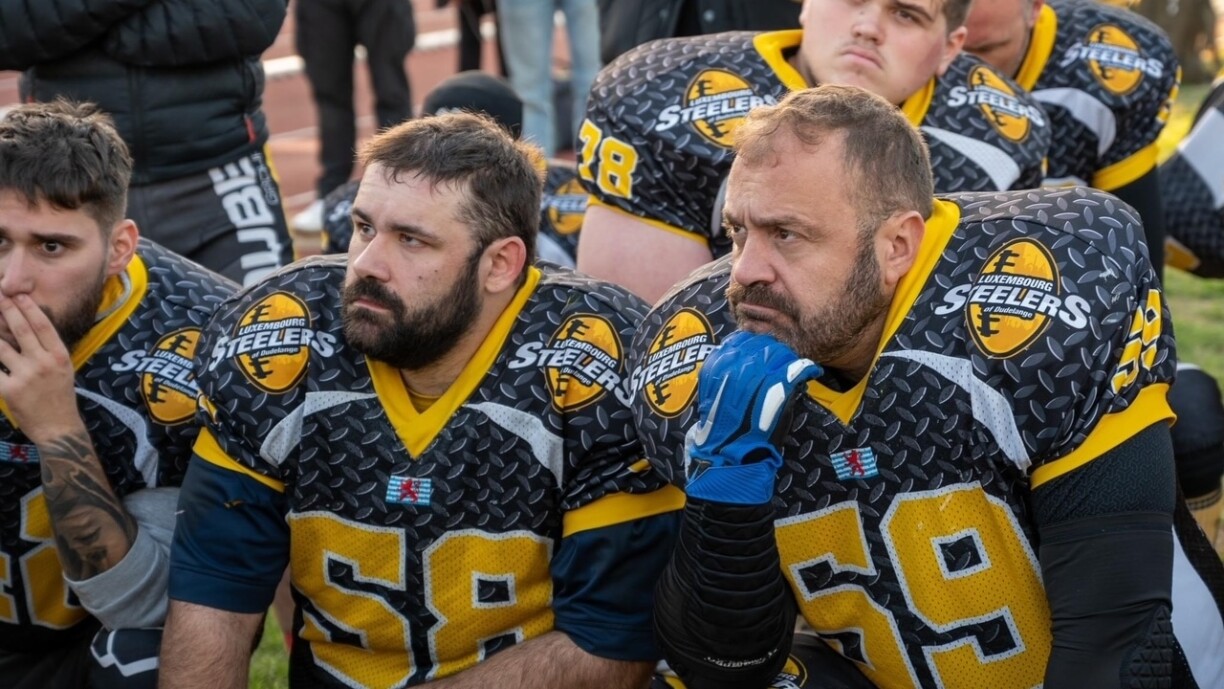
"Asking me to go to a psychiatrist because they think I'm too fat to do sport? Is this a joke?" On Tuesday evening, 47-year-old José Sanchez expressed his frustration at Luxembourg's Sports Medicine Service on social media.
Sanchez is a fan of American football and played the sport for three years with the Dudelange Steelers, the only American football club in Luxembourg. Recently, he wanted to renew his licence.
His licence, which had been extended because of the Covid-19 pandemic, expired at the end of 2022. What seemed like an innocuous bit of admin quickly took an unexpected turn.
In Luxembourg, to obtain a club licence in almost any discipline, athletes have to undergo a medical check-up, more commonly known as a contrôle médico-sportif.
"As usual, I was expecting to be sent to a cardiologist for a stress test," Sanchez, who already played football and went kayaking as a child, recalls.
"I feel in great shape," he swears. In order to take part in the final matches of the Dudelange Steelers this season in the German championship and to be ready for next season, Sanchez took a blood test, the results of which he says were "perfect."
However, after an initial examination by a medical examiner on 12 June 2023, the Sports Medicine Service advised him to consult his GP, who, in view of the recommended "obesity advice," referred him to a clinic.
The reason given was that his BMI (see info box) was too high, classifying him as "moderately obese." Sanchez notes that since his first check-up three years ago, his weight has not changed.
"I've been going to the gym almost every day for 20 years. I've built up quite a strong upper body. For my position on the pitch, it's exactly what I need," Sanchez, who has also made a name for himself in Luxembourg as a DJ, explains.
Sceptical, he went to the CHL obesity clinic on 18 July 2023, where he was told to see a sports doctor. But also, a dietician, a pneumologist, and even a psychiatrist, as part of a "medico-dietary pathway."
"The nurse explained to me that the reason I needed to see a psychiatrist was to identify any eating disorders," according to Sanchez.
For Sanchez, this was too much.
"I felt humiliated. The questionnaire I was given resembled the one they do before stomach reduction surgeries. The main impression I got was that the doctors wanted to divide up the money between themselves. Well, in any case, it's the social security system that pays," Sanchez quips.
To make matters worse, the waiting times for certain specialists can be "as long as the end of 2024," according to Sanchez, who is clearly not the only one to experience similar problems with the Sports Medicine Service, which, it should be noted, is under the authority of the Ministry of Sport.
"It's all nonsense, things really need to change in Luxembourg because what they're doing isn't right," he criticises.
Sanchez insists that he doesn't want to lose weight, just "do some sport."
"Mentally, I'm doing well, I'm fulfilled in my life. I have no problem with my weight. I accept my body as it is. I don't drink alcohol, I don't smoke, I rarely drink Coke. I have no cholesterol. I've got a big belly, but I've got muscle too. That's an asset in American football, as it is in rugby, where you need players of all sizes. There are young people who are prevented from taking part in sport because they're considered too fat. That's got to stop!"
In the meantime, Sanchez is waiting. The Sports Medicine Service has authorised him to play until 12 September 2023. After that, seeing as it seems near impossible to schedule appointments with the various specialists, his return to the pitch hangs in the balance.
Sanchez calls for a revision of the rules regarding BMI assessments, emphasising the importance of considering the specific needs of different sports rather than applying a one-size-fits-all approach.
"I'm also doing this for my club and its future. You can't imagine how complicated it already is to recruit new players. I don't want them to be stuck like I am today," he adds, citing a recent example.
"At the club, we had a youngster who was almost 2 metres tall. You could see he'd found his calling. He was a giant, he was wearing size 47 or 48 shoes… but the problem was that he weighed 150kg. He ended up being 'blocked' by the Sports Medicine Service, like me…"
Contacted this week by our colleagues from RTL Infos, the Sports Medicine Service did not respond to their request for an interview.





