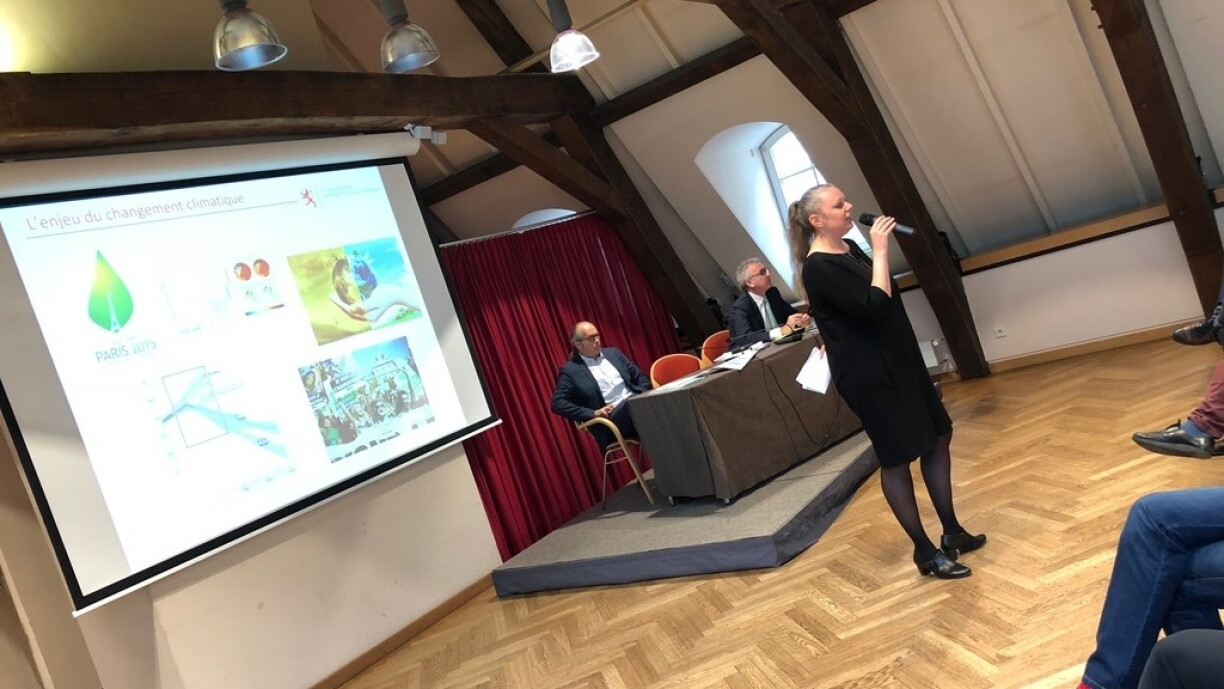
On Tuesday, ministers and concerned actors in the sector met at the Neumunster Abbey to begin drafting plans. Participants took part in workshops to focus on forging tangible measures, which are all the more important as the government has set itself more ambitious objectives than those set out by the European Commission. The Luxembourgish authorities are also hoping to focus specifically on the finance sector.
Minister of Finance Pierre Gramegna, usually seen wearing a blue tie to reflect his party colours, was sporting a green tie on Tuesday in a symbolic move. Speaking to his ministerial colleagues from the Green Party (Minister for Energy Claude Turmes and Minister for the Environment Carole Dieschbourg), Gramegna promised to make the finance sector more environmentally friendly. He highlighted that this would be an opportunity for banks and businesses in the sector, stressing Luxembourg's position as one of the top three finance sectors in the EU.
He explained that financial sector businesses must also act if they want to make an environmental difference, stating that the government investing billions is insufficient. Instead, funding must reach the trillions, which Gramegna stressed was only possible with the help of the private sector, namely the banking and funds industry.
The issue in this seismic shift is introducing credible products. The minister cited green savings accounts as a positive example. In this scenario, banks would only be able to invest savings into environmental projects. However, Gramegna outlined that not enough of these types of products exist.
In order to see change, the industry must combine efforts with the state. The government's main NECP objective is to slash carbon emissions by 50% by 2030. This paradigm shift could possibly have financial implications for the sector. One of the four workshops on Tuesday was dedicated to finding solutions. As the director of myenergy, Gilbert Théato, explained, the main idea brought up the workshop was a de-risking instrument involving the set up of a fund. The workshop mainly discussed hypothetical ideas, but the idea of a fund in which the state and investors could allocate funds for potential risks seemed to gain traction.


On several occasions, Turmes highlighted the country and the sector's obligation to be more environmentally conscious. His speeches were full of phrases such as "Luxembourg must do more," and "we have to be more efficient". Turmes referred to everything ranging from building new homes to purchasing new cars in changing habits and moving away from non-sustainable forms of energy.
Whilst Gramegna cited the need for trillions in funding, Dieschbourg stressed that there is no choice in deciding the matter, claiming "Luxembourg cannot afford to not have climate protection". She noted that the effects of climate change affect everyone in society and require change on behalf of a number of sectors, especially the investment sector.
The government will publish its findings from the workshops in a report in June.





