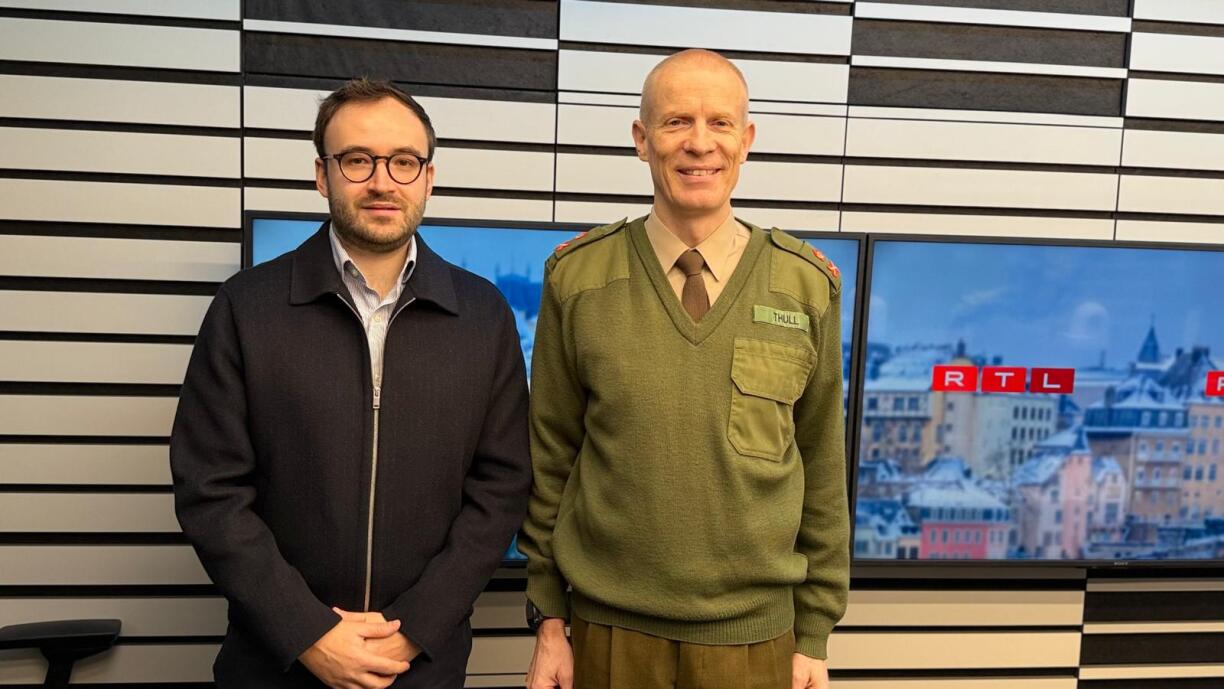
In a Saturday interview with our colleagues from RTL Radio, Luxembourg Army Chief of Staff General Steve Thull discussed a range of defence policy issues.
Thull underscored the enduring need for armed forces, stating, "One must always be prepared, so an army will always be necessary in the future."
He emphasised the critical importance of greater European autonomy in defence – a goal he said had been "unfortunately neglected until now." According to Thull, Europe had "blindly relied on the USA" and is now facing the consequences. Militarily, he noted, Europe is not yet where it needs to be, though he acknowledged that efforts are now "thankfully" underway.
"Preparing for war doesn't mean you want war," Thull stressed, "However, one must be ready for an emergency, to be able to defend oneself." He argued it is therefore essential to build resilience and achieve a more stable and secure position.
At the same time, Thull recognised Luxembourg's limitations, noting that even significant military investments by the country would not "make a tangible difference" on its own. "Luxembourg must understand that it can only survive in this world if it sticks together with other European nations," he concluded.
On the subject of Greenland, General Thull currently sees no immediate risk of direct military confrontation with the USA. He highlighted the island's strategic significance, citing both the increasing accessibility of the Northwest Passage due to climate change and its role as a potential flight path for Russian missiles targeting the United States, which makes radar and defence systems there essential.
To date, the Luxembourg Army has received no request to deploy personnel to Greenland. Thull declined to comment further on developments there, noting that current decisions are primarily political rather than military in nature.
"Without peace, nothing works – neither the welfare state nor climate policy," General Thull stressed. He acknowledged the criticism directed at rising defence spending but emphasised that peace is the fundamental prerequisite for all else. In his view, defence investments are not in competition with social welfare but are instead a necessary foundation for a stable society. Thull expressed regret that greater investment had not been made earlier, noting that Luxembourg and its allies are now compelled to catch up rapidly.
He pointed to the strong public subscription of the Luxembourg state's defence bonds – which sold out quickly – as a sign that many citizens are willing to financially support national security, motivated not only by return on investment but also by conviction.
Beyond material investments in new armoured vehicles (CLRV, Jaguar, Griffon), communications and satellite infrastructure (GovSat), air and missile defence, and the modernisation of the Härebierg military centre, a major strategic shift is the formation of a binational combat battalion with Belgium.
Approximately 350 soldiers are slated to be operationally ready by 2030. This commitment entails heavier equipment, more intensive training, and a fundamental shift in mindset: preparing the army once again for large-scale conventional conflict.
The most persistent challenge, according to Thull, remains recruitment. The army requires more personnel at all levels. Proposed measures to attract and retain staff include longer contracts, improved pay, and more attractive career models. While currently sceptical about reinstating compulsory military service, General Thull did not rule out the future development of more structured voluntary service frameworks.
General Thull stated unequivocally that Ukraine must not lose the war. He argued that a Ukrainian defeat would have severe repercussions not only for the nation itself but for the entire European security architecture.
He highlighted a critical imbalance, noting that Russia has effectively converted its economy to a war footing and now outproduces Europe in weapons manufacturing. This disparity, according to Thull, makes sustained support for Ukraine – particularly the provision of air defence systems to protect civilians – more urgent than ever.
After nearly 40 years of service, General Thull is set to retire in 2026. Reflecting on his career in Saturday's interview, he described his military service not merely as a job but as a calling.
He acknowledged making significant demands of his personnel but emphasised that effective leadership is grounded in humanity, trust, and credibility. Looking ahead to his departure, his wishes are concrete: improved soldier pay, tangible progress on the binational combat battalion with Belgium, and a definitive plan for Luxembourg's air and missile defence.
It is not yet known who will succeed General Steve Thull as Chief of Staff of the Luxembourg Army.





