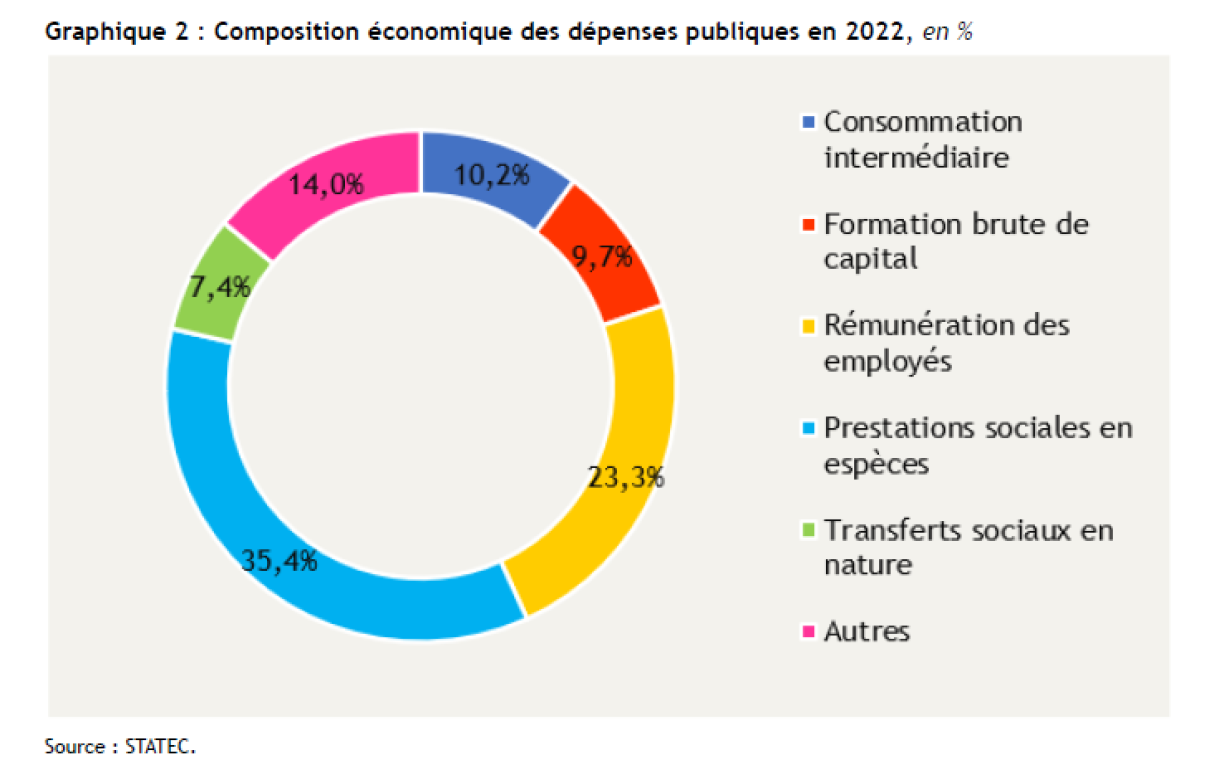
In Luxembourg, activities such as visiting the doctor, enrolling a child in a crèche, taking the tram, or receiving a pension are all considered forms of public expenditure.
Generally, the Grand Duchy is quite generous, but this generosity comes at a cost. In 2022, Luxembourg's public spending reached €34 billion, almost 44% of GDP. This figure is projected to rise to €40 billion by 2024, according to economist Muriel Bouchet, author of an extensive study by the Idea Foundation.


Muriel Bouchet undertook the challenging task of comparing the Grand Duchy's public spending with that of four countries "reasonably similar to Luxembourg"—its three direct neighbours (France, Germany, and Belgium) and one indirect neighbour (the Netherlands).
One issue complicating the comparison is Luxembourg's high proportion of cross-border workers and non-resident pensioners. In 2022, these groups accounted for just 13.7% of total public spending, while 47% of employees working in Luxembourg were cross-border workers, illustrating a certain imbalance.
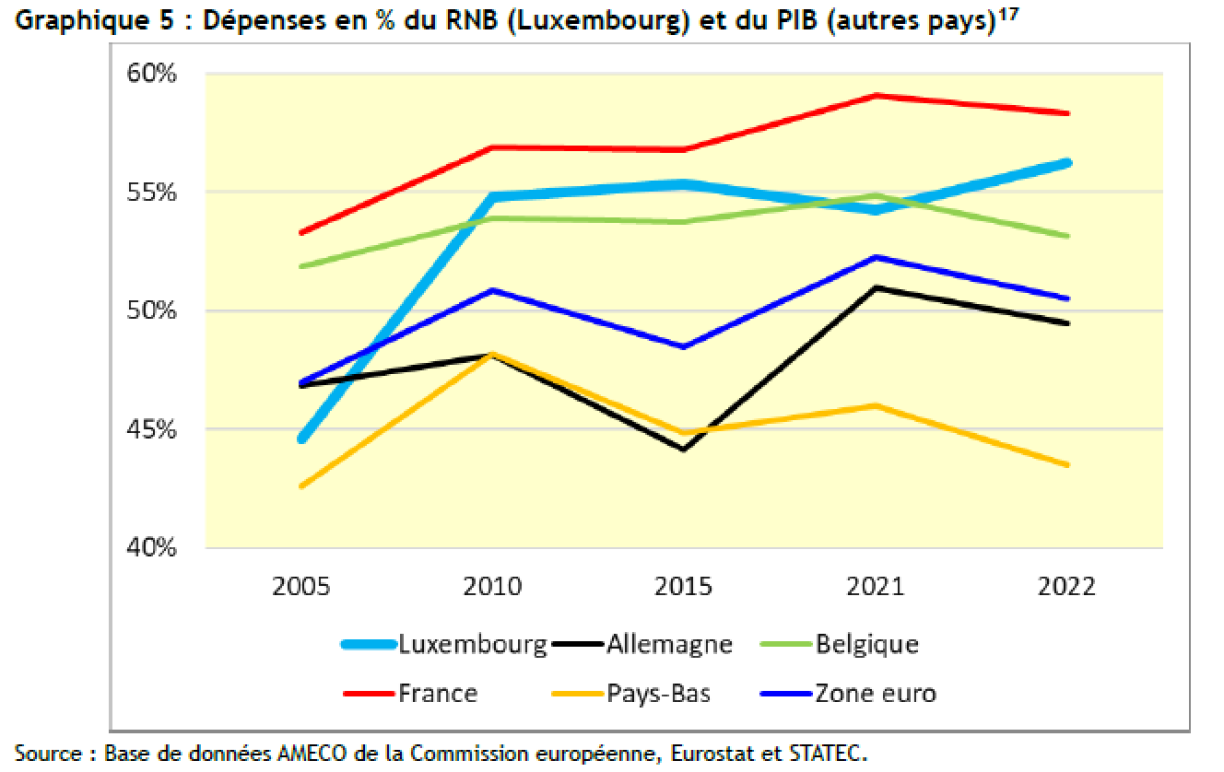
To ensure a fair comparison, the Idea Foundation chose to base its analysis on gross national income (GNI), which is derived by subtracting the income paid to non-residents from gross domestic product (GDP). On this basis, in 2022, public spending in Luxembourg amounted to 56% of GNI, compared with 51% for the "four neighbours." In monetary terms, this equates to €35,000 per inhabitant in Luxembourg, compared with an average of €21,000 in the "four neighbours," or 66% more.
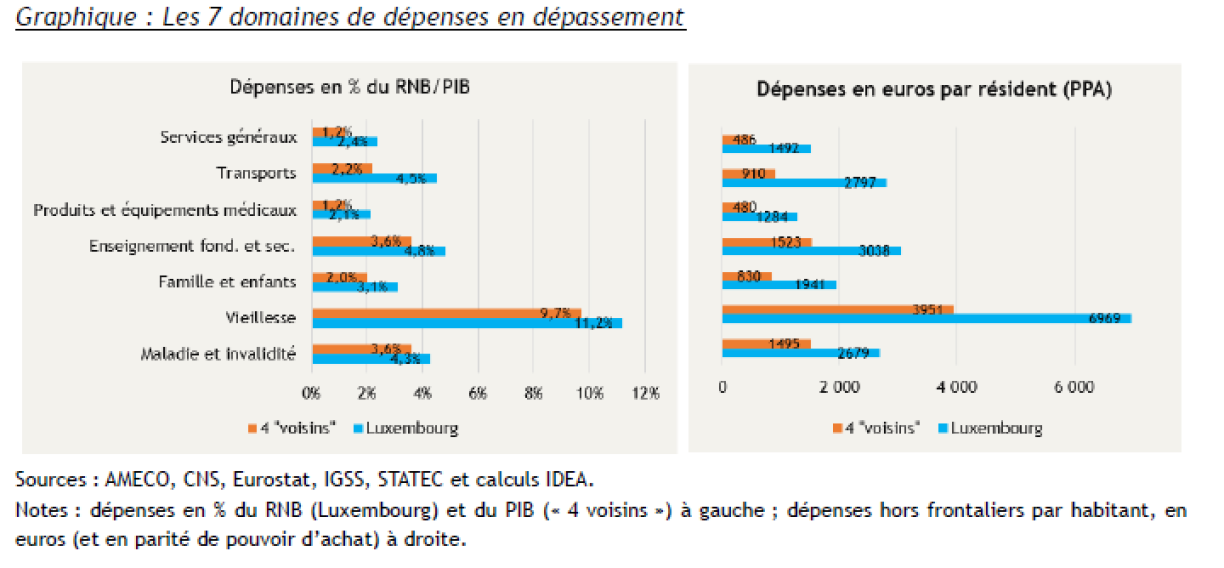
Luxembourg spends more in particular on areas such as sickness and invalidity, old age (including pensions), family and children (notably family allowances), primary education, medical products and equipment, and transport. Conversely, it spends less than its neighbours on outpatient and hospital services, survivors' pensions, energy, defence, and public debt.
Overall, Luxembourg is spending more, which is neither surprising nor inherently problematic. The key question is whether this money is spent effectively and results in improved performance. The answer is complex and varies by sector. Let's take a closer look at two critical sectors for Luxembourg: education and pensions.
The PISA study, a global benchmark that has been tracking the performance of education systems since 2000, has long been a source of concern for Luxembourg. For years, Luxembourg has scored below the OECD average, leading to the announcement in 2019 that it would space out its participation in future PISA studies.


Despite this, Luxembourg spends an average of €4,210 per resident on education, nearly double the expenditure of its four neighbouring countries. Almost 80% of this spending goes towards staff salaries. The Idea Foundation analysed the efficiency of spending on primary and secondary education in Europe, using the 2018 PISA results (as Luxembourg did not participate in the 2022 study).
The findings reveal that Luxembourg lags significantly behind, with results much lower than those of Denmark, Portugal, or Slovenia, despite similar spending levels. Luxembourg's results are comparable to those of Spain or Italy, which spend significantly less. Additionally, the four neighbouring countries spend considerably less and achieve much better scores.
The foreign origin of a large number of pupils in Luxembourg, often cited as a reason for learning delays, also does not fully explain these results. When focusing solely on pupils of Luxembourgish origin, the Idea Foundation found that the rankings remain virtually unchanged.
In 2022, Luxembourg spent around €6,969 per resident on the "old age" category, 76% more than the €3,951 spent by its "four neighbours." This difference is largely due to the weight of pensions. The Idea Foundation notes that the maximum pension in Luxembourg is around €10,276 per month, with some special pension schemes for public employees offering even higher amounts. Additionally, Luxembourg has the longest retirement period in the European Union, averaging 23.8 years compared to 21 years for the "four neighbours," according to Eurostat.
Despite having a lower proportion of residents aged 60 and over (20.4%) compared to its neighbours (27.3%), Luxembourg is expected to face significant population aging in the coming decades. Consequently, associated public spending is likely to increase. The Idea Foundation warns that spending on old-age pensions alone is projected to rise from 7.2% of GDP currently to 10.5% by 2050, while the corresponding proportion will increase from 8.8% to 9.9% in the four neighbouring countries.
Public spending by Luxembourg's administrations increased by a factor of 2.5 between 2005 and 2022, compared to a 1.8-fold increase for the average of Luxembourg's "four neighbours."
Despite this significant increase, it would be premature to label this trend as a "drift" in spending, considering the unique characteristics of the Grand Duchy. The Idea Foundation highlights that Luxembourg's wealth naturally leads to higher demand for public services, and consequently, higher costs. However, this situation can also "reflect problems of governance or deeply rooted wasteful behaviour by citizens or those who govern them."
Simply cutting back on expenditure without making structural changes would be ineffective. Such an approach would likely deteriorate service quality and social conditions without enhancing efficiency in the relevant areas. Instead, it is crucial to "improve efficiency sustainably through comprehensive measures that address the root of the problems. This approach aims to reconcile budgetary discipline—an essential need in the current context—with the quality of public services," concludes the Idea Foundation.
For more information, visit the Idea Foundation website (in French).





