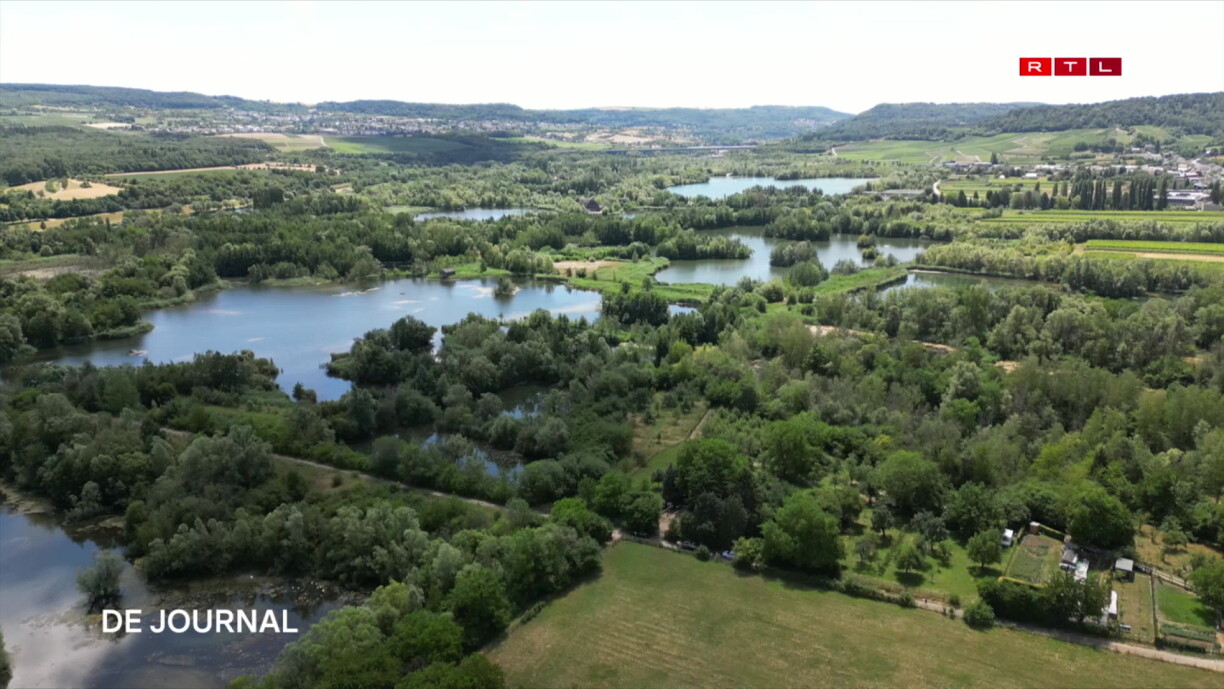
Nature reserve Haff Réimech has become a breeding ground for wild boar, and traps will not solve the problem of overpopulation, according to local hunter Robert Frank, who argues that only driven hunts will make a meaningful difference.
Frank's family has hunted in this part of the Moselle region for decades, he explained. Since the state took over responsibility for hunting district 620 in 2021, he said the absence of driven hunts has allowed the wild boar population to soar.
Frank does not believe the trap installed in the reserve offers a solution. He does, however, welcome the Nature and Forest Agency's (ANF) proposal to work together on a broader response.
It is not the first time Frank has criticised the lack of driven hunts around the former gravel pits. There have always been large numbers of wild boar in the Moselle region, he said, but never as many as there are now.
He described Haff Réimech as a "maternity ward for wild boar", arguing that the animals can remain there largely undisturbed.
His family has hunted in the area for around 50 years. Frank said he knows how the animals move through the landscape and points to what he calls their "motorways" across farmers' fields and vineyards.
In his view, trapping is the wrong approach. Frank said that, like many other hunters, he is also dealing with damage caused by wild animals on local farms, which he believes the state is not doing enough to prevent.
According to Frank, studies were carried out between 2021 and 2024, but no culling took place. He also argues that traps are normally strictly prohibited inside nature reserves, expressing frustration that this one has instead been authorised under nature conservation law.
Marianne Jacobs of the ANF explained that the trap is used to complement high-seat hunting.
Since November 2024, the ANF has recorded 114 wild boar removed from its hunting district. Some were shot from high seats, while others were caught in the trap and subsequently killed. Frank says 80 animals were removed from his own hunting area last year.
During the first driven hunt opposite Haff Réimech, only three wild boar were shot, despite the "motorways" running through the vineyards and fields, Frank said. He believes around 80 more animals were still hiding in the reeds at the time.
The water and vegetation inside the nature reserve effectively provide the animals with natural "air conditioning", he added.
Both sides agree that there are, and have been, too many wild boar in the area. The question is what measures should now be taken to achieve better results.
Frank welcomed the idea of finding solutions together, but regretted that there has been no further contact since the ANF proposed a meeting in April.
Meanwhile, a new revision of Luxembourg's hunting law is expected to be submitted to the Chamber of Deputies before the summer recess. So far, however, officials have declined to provide details of the proposed changes.





