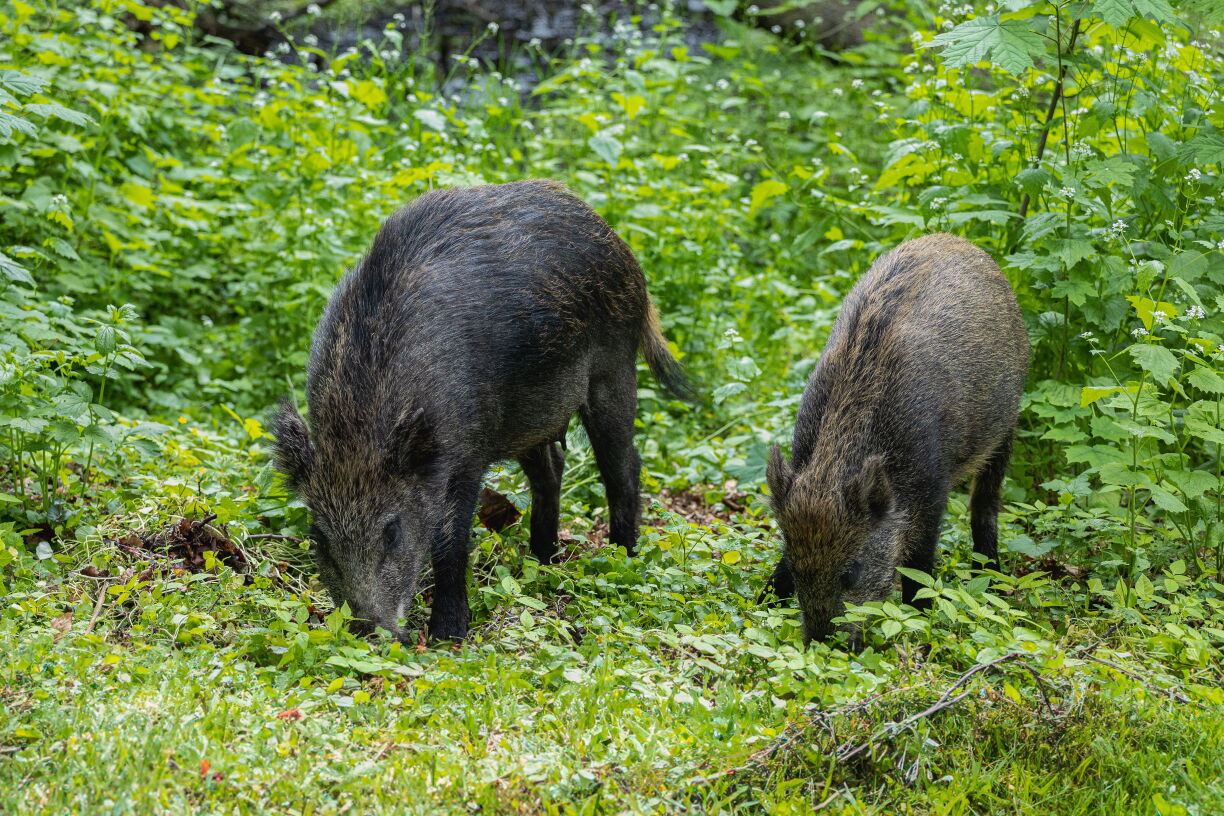
Wild boar numbers at the Haff Réimech nature reserve have become high enough to require targeted intervention by the Nature and Forest Agency (ANF).
Since November 2024, 114 wild boar have been removed from the area: 54 were caught in a trap inside the reserve and subsequently shot, while a further 60 were shot through high-seat hunting outside the specially protected zone. The 300-hectare reserve is governed primarily by nature conservation law rather than hunting law, with strict rules in place to protect its many species.
Wild boar do not fall into that category, and because their numbers here are far too high, the ANF is relying on a combination of high-seat hunting and trapping.
The trap is located close to the Remerschen lakes, in the heart of the nature reserve, in an area that is generally off limits to the public. That is by design, so as not to disturb the protected species or scare off the wild boars. As RTL was not permitted to enter the area, Marianne Jacobs, the ANF official responsible for hunting, filmed the trap on its behalf.
Jacobs draws a clear distinction between conventional hunting and trapping. Trapping, too, is a craft that has to be learned. RTL was told that this type of trap falls under the nature conservation law and is therefore allowed at this ecological hotspot.
Two ANF staff look after this complementary measure. Food is used to lure the wild boar inside at night. Once the animals have entered, the trap is monitored remotely and the door can be closed from home.
Staff wait until the entire group is inside before activating the trap, ensuring, for example, that a piglet is not left outside while the rest of its group is captured.
The ANF emphasises that trapping does not replace hunting from high seats but complements it. A number of high seats are positioned around the reserve, outside the specially protected zone.
This is a management concept tailored specifically to Haff Réimech and is not necessarily intended for use throughout the Grand Duchy. Here, however, the approach appears to be working.
Since November 2024, 54 wild boar have been removed from the reserve through trapping, while another 60 have been shot during high-seat hunting.
Once the animals have been captured, ANF staff dispatch them, preferably with a shot to the head. Until then, the animals appear relatively calm. According to the ANF, the process causes them less stress than a driven hunt would.
Wild boar numbers are considered excessive in several parts of Luxembourg, although the animals appear to have a particular preference for the Moselle region.
The ANF rejects claims that Haff Réimech is responsible for the problem or has effectively become a "maternity ward" for wild boar.
The problem cannot be solved locally, Jacobs argues, and did not originate at Haff Réimech alone. She sees the entire region as having been affected for decades, and says the solution needs to be worked out collectively.
The ANF is now proposing three further measures to take the pressure off the reserve: The first would be to allow hunting from high seats outside the reserve at night. Changes to Luxembourg's hunting legislation could eventually make this option available to hunters more generally.
A second trap could also be installed inside the nature reserve. The third element would involve talks with neighbouring stakeholders.





