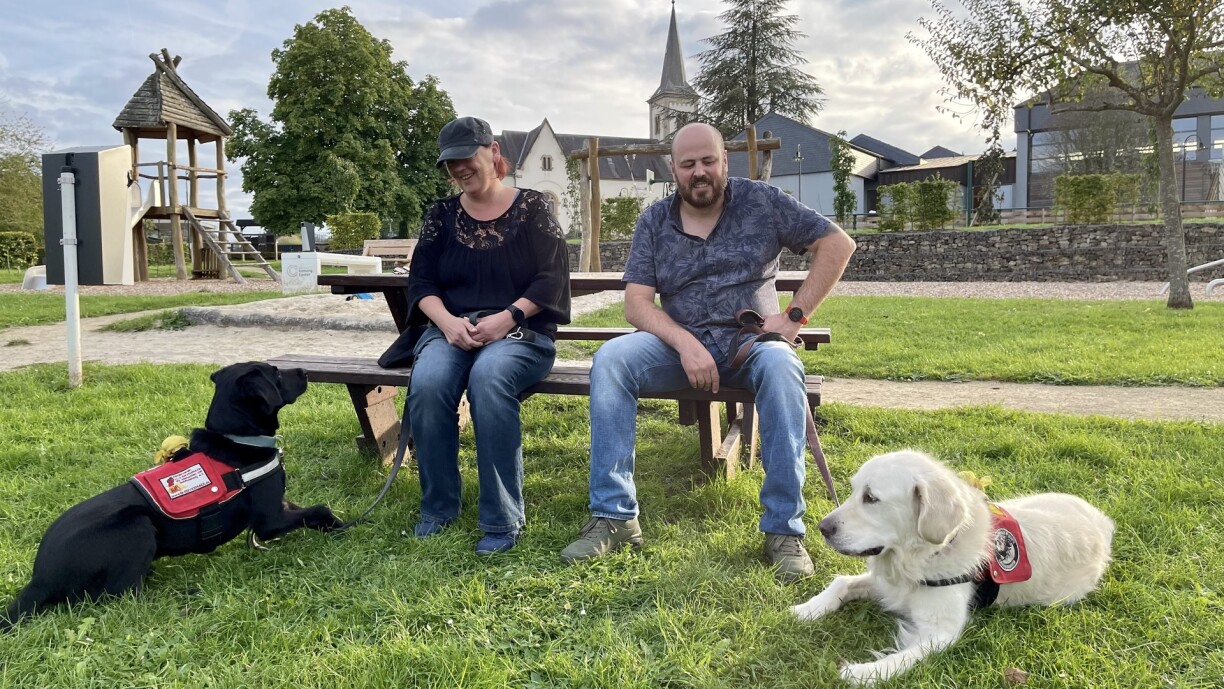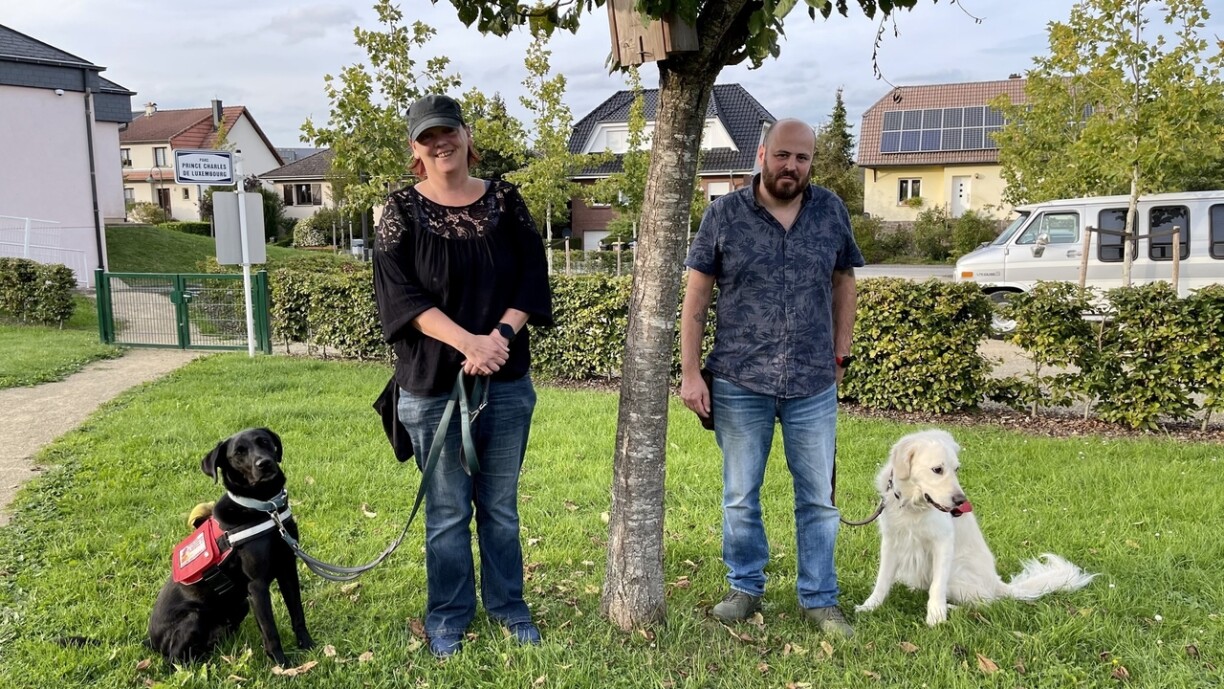
Marielle Rollmann and her husband Roberto Tralci recently discussed their experience of suffering from an "invisible" illness and how they have come to rely on their assistance dogs, Sunny and Lex.
When thinking of assistance dogs, it is easy for the mind to pivot towards guide dogs, or dogs trained to support wheelchair users. But, our four-legged friends are capable of much more, as Marielle and Roberto have discovered from their own experiences with chronic illness.
Marielle and her assistance dog Lex have been a team for over six years. The Labrador was specially trained as a puppy to respond to his mistress' needs. With diagnoses of diabetes, fibromyalgia and Asperger's syndrome (now known as Autism Spectrum Disorder), Marielle's needs are complex, and the young dog had much to learn. However, Lex showed his abilities from an early age, attending the couple's wedding while still in training, at which point he was able to signal to the trainer that Marielle's blood sugar levels were too high. When Lex notices something is wrong, he reacts with agitation and licking his mistress' hand.
A lifetime of work is necessary for an assistance dog to be able to recognise such situations. When training an assistance dog, breeds such as golden retrievers, labradors, or labradoodles are considered to be especially suitable. Training begins only once a number of personality and behaviour tests have been performed, and can be done with external trainers or the patient in question from the age of eight weeks. However, training does not simply conclude once the dog has refined its abilities - with assistance dogs, it can go on for a lifetime and of course, dogs need 24/7 care too.
In order to help teach the dog to pick things up, open doors, or even use equipment, the couple uses the "imitation" method. This has already saved Marielle's life once in the past. In autumn 2022, her blood sugar dropped to a dangerous point one morning, causing her to fall into a coma. When she woke up that afternoon, she saw Lex had bitten through her insulin pump. "What we do is imitation, so the dogs watch what we do and then replicate it. And Lex had often seen Roberto pulling the hose from me to help me feel better. And in this case, Lex was able to link the two and help," she explains.


Sunny joined the couple a few years ago as a "normal family dog". After Roberto underwent heart surgery, Sunny learned to notice when his master was not doing well and began to support him with everyday life. Eventually, the couple opted to have the golden retriever trained as a mobility assistance dog to help with practical life skills. For Sunny, who was used to training courses as a puppy, the additional skills include picking things up and seeking outside assistance if Roberto feels unwell. He can communicate with Roberto's co-workers when something is not right.
Initially, Roberto says he encountered misunderstandings at work, as not everyone welcomed the dog's presence. At one point he was accused of using his illness as an excuse to bring his pet to work. "Of course, they didn't ask why I needed an assistance dog in the first place," he says. The couple often encounter confusion and misunderstandings when out and about with their assistance dogs, because they have no outwardly visible signs of illness. As a result, they find themselves having to explain the dogs' presence over and over, whether at the supermarket, GP's, or at work. "People don't know a lot about assistance dogs and how they can be trained." Society needs to be sufficiently informed, the couple say.
After two years of taking Sunny to work, Roberto's colleagues have got used to the dog's presence, and in fact, it has become a more positive experience. However, it must be made clear that they cannot distract the dog too much, as would usually be the case with a pet. Assistance dogs should not be disturbed too much from their work, as distraction can cause them to potentially miss vital signs of risk. Many assistance dogs wear yellow vests or scarves, as Lex and Sunny do, as an international sign to indicate that the dog should be left alone. Although this is discussed in the media every now and then, it is still not widely known in society.


Training Lex was a lot of fun for Marielle. So much so that she decided to start a professional training to become a coach.
Now that she is a trainer for assistance dogs, she also created the organisation Helping Paws. After one of her coworkers had an epileptic attack, Marielle wondered what would happen to her own dog if something bad were to happen to her. She thus asked the police and hospital officials this very question. Should no other place be found for her dog, it would be placed in an animal shelter, she was told.
To save the dogs from that fate, the couple created their organisation to give them a space where they would be taken care of.
They also collect donations for people with assistance dogs. While the National Health Fund (CNS) helps out with guide dogs for blind people, they do not help with people who need dogs that are specialised in other illnesses. The basic training for these dogs costs between €35,000 and €40,000 and goes on for around two and a half years. Even though owning an assistance dog can be life changing, not everybody can afford them, so a lot of people rely on donations.
Knowing that their dogs can alert them should they go through a crisis is very calming for the couple. Therefore, they want to raise awareness for assistance dogs with their organisation. As they can be life-saving for disabled and traumatised people, but also for people who suffer from a mental illness.