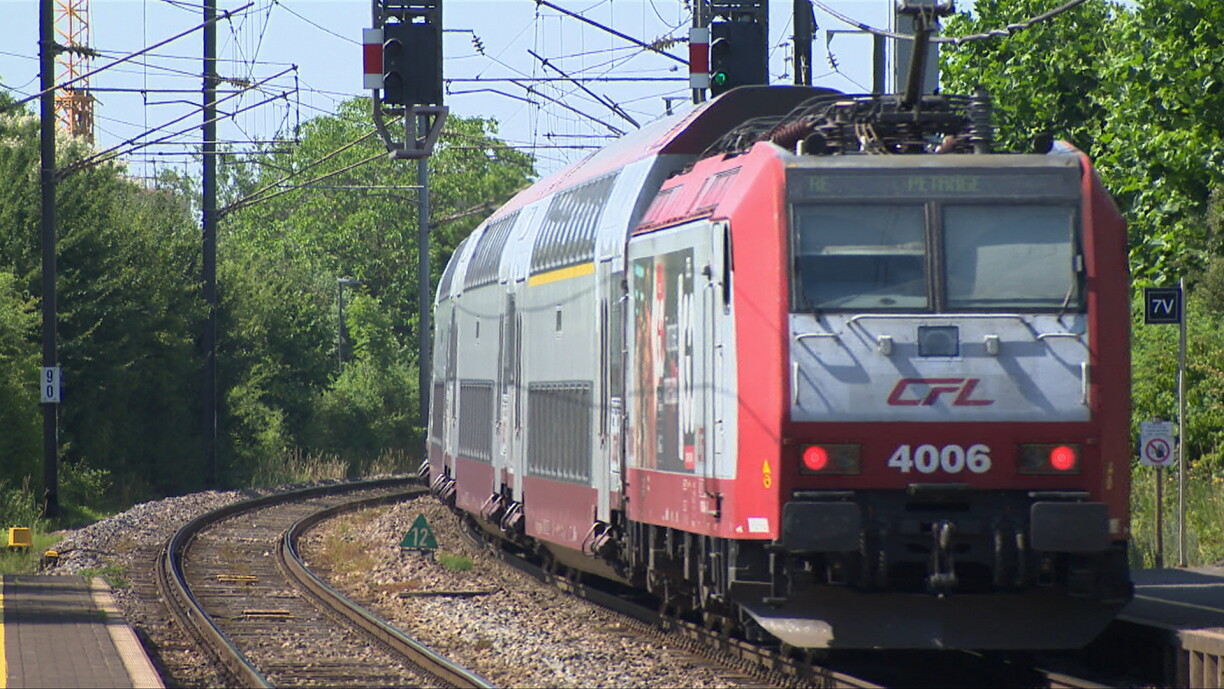
Rail services between Bettembourg and Luxembourg City were severely affected on Monday after extreme heat caused a rail track to shift between Berchem and Howald stations. For safety reasons, train traffic on the Luxembourg–Esch–Rodange line, as well as towards Thionville and Metz, was heavily restricted until Thursday.
According to Kim Rohmann, head of the specialised track unit at CFL, it took only a few millimetres of movement to force a drastic reduction in rail services for several days. The issue, known as "track buckling", was detected after a train driver reported an irregularity near Berchem. This phenomenon was caused by the extreme heat and required swift intervention to ensure safety.
Rohmann explains that safety regulations limit the temperatures at which work can be carried out on the tracks. The rail must be below 32°C before any maintenance can take place. At the time of the incident, temperatures on the rails reached 54°C. Therefore, the team had to wait until after midnight, when the rail temperature had dropped to around 20–22°C, to use a track-aligning machine to restore the track to its proper position.
The physical properties of steel mean that rails expand in the heat. In this case, the section was fixed at both ends, so instead of lengthening, the rail was forced sideways. With climate change leading to more frequent heatwaves, questions arise about whether such disruptions will become more common.
However, CFL spokesperson Sandy Nonnweiler reassured that Luxembourg's rail network is well prepared. Unlike in the UK, where train services are sometimes reduced during heatwaves, there are currently no plans for such measures in Luxembourg.
CFL conducts regular "heat patrols", inspecting tracks during hot weather. There are also three monitoring stations across the country – in Esch, Mersch, and Luxembourg City – that provide continuous data, allowing for preventive action when needed. Nonnweiler also pointed out that the use of natural stone ballast helps make the tracks more robust, reducing the likelihood of heat-related incidents.
While track work during extreme heat is not considered dangerous, CFL has adjusted working hours to protect staff from the hottest part of the day. Therefore, during the day, their teams work from 6am to 2pm to avoid afternoon heat, and from 10pm to 6am in the cooler hours, while some work has to be rescheduled as it is not technically feasible in high temperatures.
Rohmann also notes that when rail temperatures reach certain thresholds, additional heat patrols monitor the tracks. CFL is also taking preventive measures inside the trains, with air conditioning systems checked ahead of every summer to maintain reliable service, even during extreme heat.





