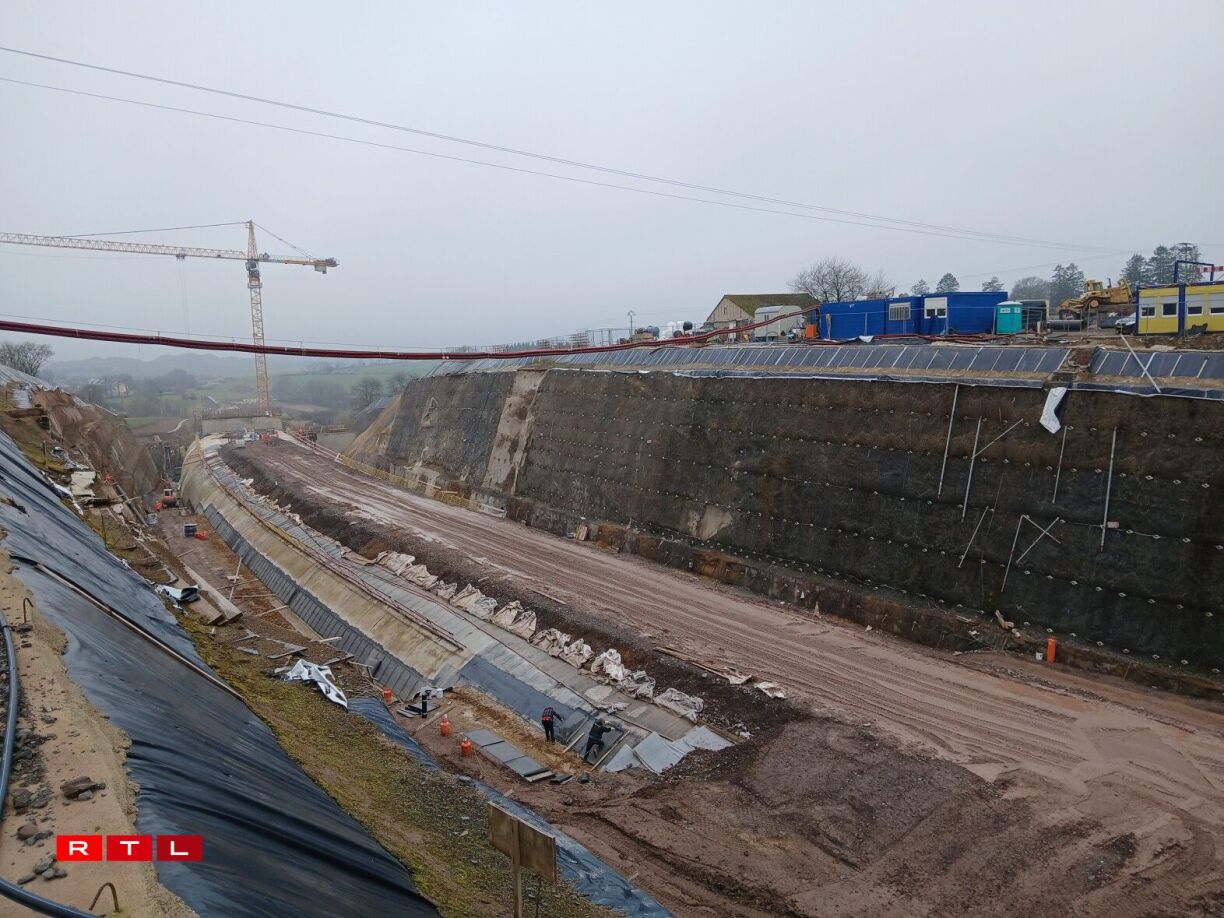
Plans for a bypass around Hosingen were already being discussed in the municipal council back in 1972. More than 50 years later, construction finally began in 2023. The most visible progress so far has been made on the tunnel at the northern entrance to the village, but this year is set to mark a major step forward along the entire length of the bypass. While the opening of the first section is now within sight, full completion will still require some patience.
Around 17,000 vehicles currently pass through Hosingen on the N7 every day. As the road was never designed to handle that volume of traffic, calls for a bypass have been growing for years. That project is now taking shape, starting with the tunnel at the northern approach to the village. About 450,000 cubic metres of soil were excavated during construction. Now that the tunnel structure is complete, around 250,000 cubic metres are being backfilled on top. Technically, this type of structure is known as a cut-and-cover tunnel.
According to Roland Fox, director of the National Roads Administration, the tunnel was built gradually over the past two and a half years using a phased construction process. He explained that the contractor worked in sections of around 12 metres, installing formwork, reinforcement, and concrete on a weekly cycle before moving the structure forward once the concrete had set. The final concrete pour was completed in October last year, Fox said.
At present, waterproofing works are being completed at the southern end of the tunnel before it is fully covered with soil. Tenders for the technical installations are due to be launched by the end of the year. As the tunnel is "only" 325 metres long, no mechanical ventilation system is required, but safety considerations remain central given the expected traffic volumes.
According to Fox, traffic forecasts suggest between 20,000 and 25,000 vehicles will use the bypass each day. He explained that the tunnel has therefore been designed with two lanes in each direction, although the speed limit inside will be set at 70 km/h rather than the 90 km/h allowed on open stretches of road.
The bypass will run for around 2.5 kilometres, from the roundabout near the petrol station to the junction leading towards Rodershausen. From this year onwards, construction will intensify not only on the tunnel but also on the remaining sections of the route.
All construction lots have either already been tendered or are currently under way, according to Fox. He stated that from spring or summer onwards, work is expected to be taking place simultaneously on up to eight sites along the 2.5-kilometre stretch, adding that the the aim is to open the section running directly past Hosingen in summer 2028, after which work within the village itself can begin.
Construction is already under way on a bridge crossing a wetland area near the housing estate at the An der Méilchen district. Another bridge is being built between Boukelzerstrooss and Happerfeld. In the future, Boukelzerstrooss will pass underneath this bridge and rejoin the network opposite the traffic police offices, further reducing through-traffic in the village centre.
Once finished in its entirety, the bypass will extend by almost another two kilometres, reaching as far as Dorscheiderhaischen. According to Fox, some of the tendering process for this section is already under way, with completion towards Dorscheiderhaischen currently expected in 2030 or 2031. After that, he said, further safety works will continue on the N7 heading north towards Marnach.
Between Hosingen and Dorscheiderhaischen, a wildlife bridge will be built, and the junction leading towards Dorscheid and Neidhausen will be replaced by an interchange. Initial plans had envisaged the entire road opening in 2029, a date later pushed to 2030 and more recently to 2031. For most residents of Hosingen, however, the opening of the first section remains the priority, as it will divert through-traffic away from the village and make it possible to redesign the main road and renew underground utilities.
In terms of cost, the original financing law earmarked just under €155 million for the Hosingen bypass. That figure has since been revised upwards to around €200 million.
The Hosingen bypass forms part of a wider project to improve safety along the N7. Over much of the route between Fridhaff and Weiswampach, a central safety barrier is planned to reduce the risk of head-on collisions. Although these works were initially due to start last year, progress only became visible around a week ago near Fridhaff.
According to Fox, what is currently taking place is preliminary clearance along the roadside, following the completion of environmental compensation measures. He explained that these include the creation of habitats such as nut orchards and measures to protect species like the hazel dormouse, ensuring that the project complies with the environmental authorisations granted.





