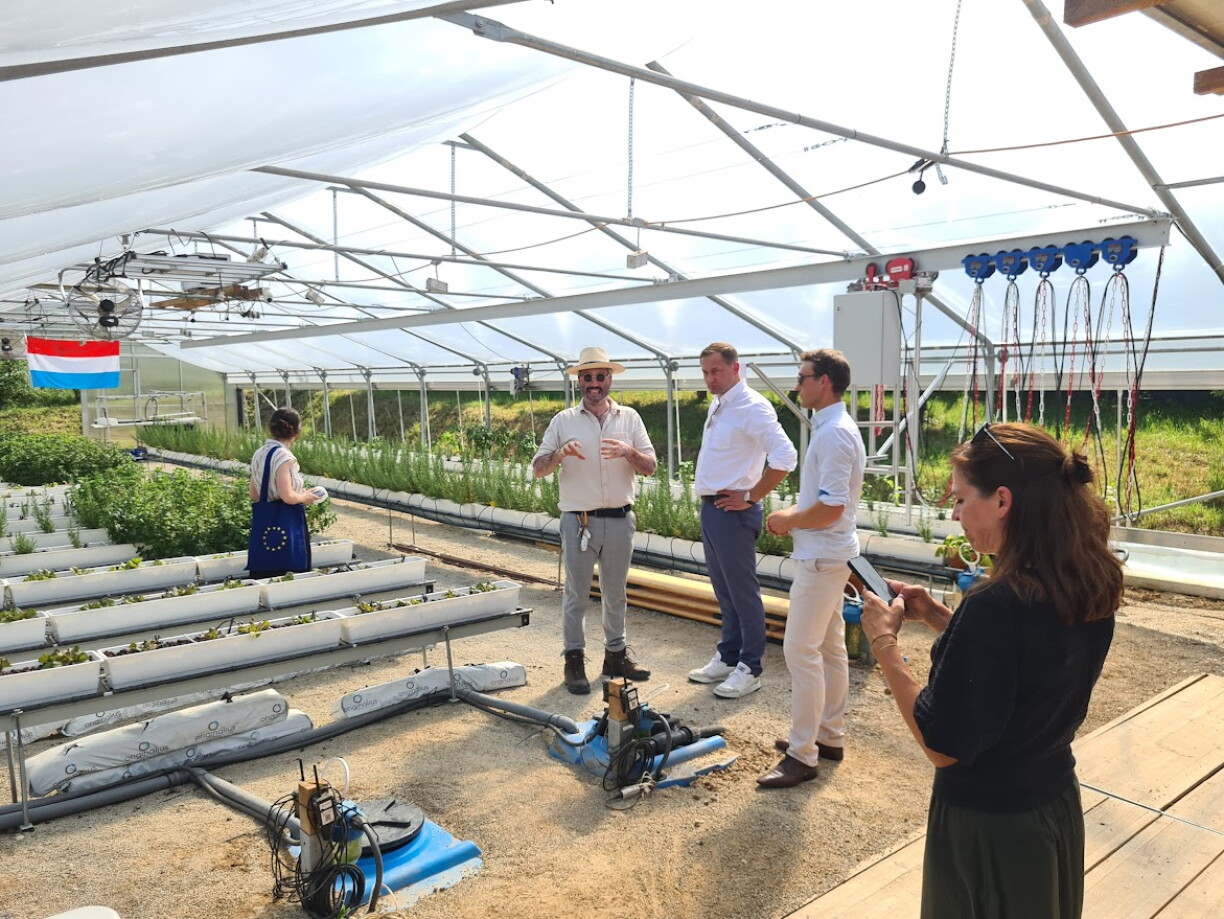
Luxembourg start-up Horizon Farms has acquired Greiveldange-based company Fësch Haff, with plans to bring innovative agricultural production in the country to a commercial scale.
As part of the development, EU Commissioner for Agriculture and Food Christophe Hansen and Anne Calteux, head of the European Commission Representation in Luxembourg, visited Fësch Haff's pilot facility in Greiveldange on 22 June.
Horizon Farms said it had also raised seven-figure seed funding, primarily from Luxembourg investors, to support further innovation in agriculture.
Founded in 2021, Fësch Haff specialises in aquaponics and hydroponics. Its system combines fish farming with soil-free plant cultivation in a closed water cycle, which the company says reduces water consumption and enables pesticide-free production.


Horizon Farms plans to use the investment to expand Fësch Haff's capacity and finance what it describes as Luxembourg's first commercial-scale agritech greenhouse.
The company sees the project as a way of strengthening Luxembourg's food supply. According to its press release, the country currently imports around 95% of its fruit and vegetables.
During his visit to the pilot facility, Hansen praised the company's innovative approach. He said aquaponics demonstrated that more sustainable food production using less water and no pesticides was not merely a "vision for the future", but was already being put into practice in Luxembourg.
Innovations of this kind could help make food systems more sustainable while creating new opportunities for agriculture, Hansen concluded.





