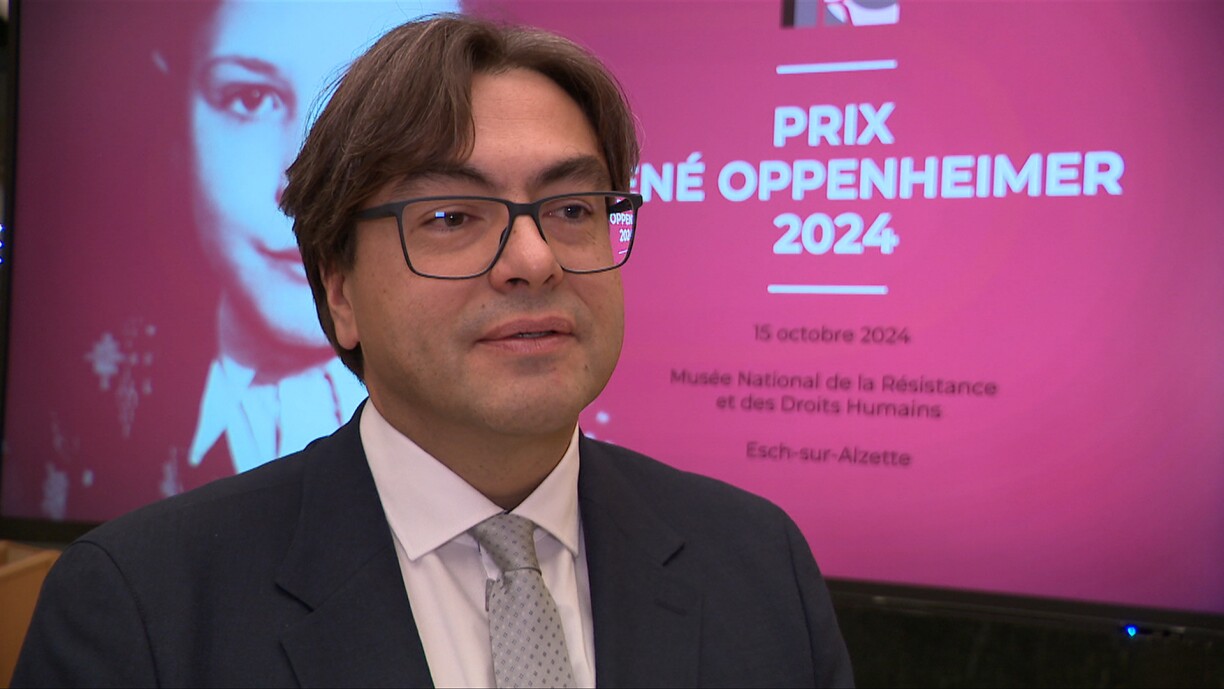
On Tuesday, the award went to Daniel Thilman at the ceremony in Esch-sur-Alzette's National Museum of Resistance. RTL's Claudia Kollwelter spoke to the historian about his work and the prize.
Thilman was at a loss for words when he was told he would be receiving this year's René Oppenheimer prize. He said he had not expected it at all.
The prize was partially awarded for his commitment as an historian and researcher, but also for his work for the Friends of the Old Synagogue ASBL in Mondorf, which seeks to enhance cultural life, and also for his dedication to his job as history teacher at the Dudelange secondary school.
"I think that it is above all a recognition for the work that has been done so far. In my case, honestly, I think it is representative, as I've previously worked for other associations active in the commemoration of the Shoah. So I see this as a bit of encouragement that we are on the right path and should continue with this work."
One project that Thilman has been working on since 2022, alongside the University of Luxembourg C2DH, is the "Digital Memory of the Shoah". The project seeks to represent people who lived in Luxembourg before or during World War II, who were persecuted during the Shoah, using biographies to paint a full picture of their lives instead of reducing them to names on a list.
"It's about showing these people at a time when they migrated to Luxembourg, how they integrated, what jobs they had, their education, culture, sports, politics, every aspect of their lives."
The researchers have amassed information through different archives or by contacting the descendants of the people involved. There are currently 143 biographies online, 18 of which were written by Thilman.
"It can take three or four days of research work to put these together, using national archives, foreign police files, or archives like e-Luxemburgensia to find old newspaper articles. But sometimes the search is interrupted for months, and you have to dig deeper and search other sources to find anything."
The project is currently expected to run until 2026, although the website will of course remain online after it has concluded.
"We think of it as a kind of encyclopedia. It's not just for Luxembourg, it's available in three languages, so people can use it to look up information all over the world. Above all we wanted it to be for families, descendants from three or four generations, or old neighbours, to give them a place where the information has been collated for them."
The René Oppenheimer prize is worth €2,500, which will be split across multiple associations, Thilman says.





